
Dive to the Mariana Trench at -11034 meters, what creatures did scientists find?
What creatures have scientists found on the bottom of the sea?

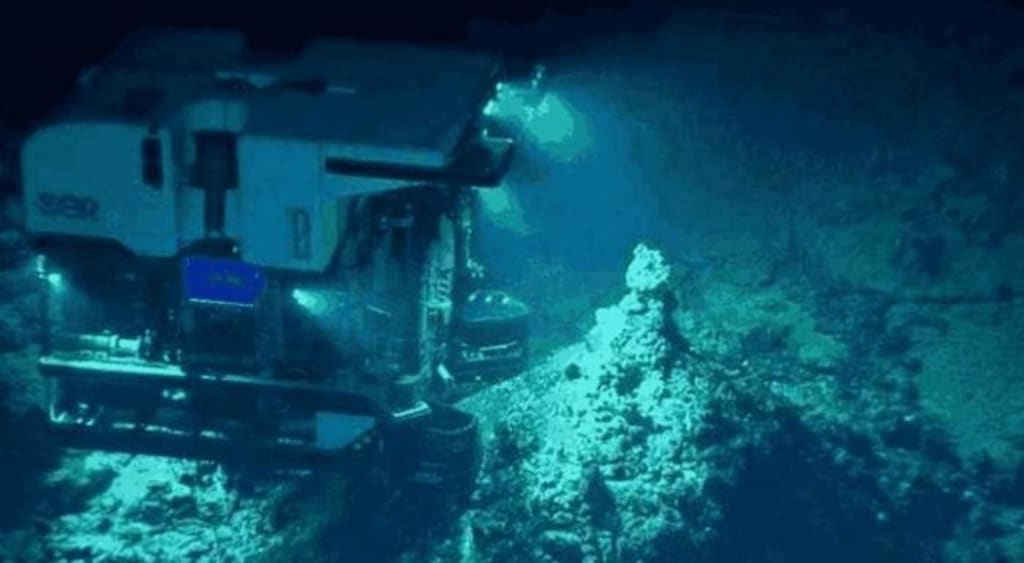
If there is any scariest place on earth, it must be the Mariana Trench. The Mariana Trench, located in the northwest of the North Pacific Ocean, is the deepest area on earth, with a length of about 2,550 kilometers and an average width of 69.2 kilometers. Most of the entire trench is more than 8,000 meters deep. Among them, the lowest point of the trench is called the Fichards Deep, and the deepest point is more than 11,034 meters. If it is used as a standard, even if the Himalayas, the highest mountain range on earth, are put in it, they will not be able to emerge from the sea.
In the depths of the Mariana Trench, it can be said that there is never sunshine, it is a terrible place of cold, high pressure and darkness. It is almost a forbidden area for life, so the Mariana Trench is also known as the most harsh environment on earth.
Little was known about the Mariana Trench in the past. It was not until nearly a hundred years ago that the development of human science and technology began to set foot in this area. In the 1960s, the Diriaste submersible that scientists took for the first time successfully dived to 10,916 meters in the deepest part of the trench. This place has a pressure of 1,110 atmospheres. If People standing in it can be crushed instantly, because the pressure per cubic centimeter is as high as 1.1 tons.
On May 13, 2009, the "Poseidon" underwater robot developed by the Woods Hole Oceanographic Institute in the United States dived 6.8 miles (about 11,000m) and successfully reached the "Challenger Abyss", the deepest part of the Mariana Trench. It has two basic modes, "remote control mode" and "automatic working mode", which belong to the cabled robot ARV.
Japan is also an international leader in deep-dive underwater robot technology. The cable-controlled underwater robot "Trench" developed by the Japan Marine Science and Technology Center has successfully dived to the Mariana Trench. At 7:54 a.m. on March 24, 1995, it was hoisted into the water from a crane at the stern end of the mother ship, and the 12,000-meter-long primary cable it carried was slowly released at the speed of human walking until it reached the ocean. At the bottom, the submersible took 3 and a half hours to reach the bottom of the Challenger Deep. At this time, the depth presented was 10,903.3 meters, and the corrected water depth was 10,911 meters.
Since my country entered the 21st century, it has made rapid progress in the field of ocean exploration, and has also made great progress in ROV technology. The "Haidou" autonomous intelligent remote-controlled underwater robot developed by the Shenyang Institute of Automation Technology of the Chinese Academy of Sciences successfully dived to the Mariana Trench 10,767 meters in 2016, making my country the third largest after the United States and Japan. A country with unmanned submersibles. The underwater robot carries a micro-optical cable and has two working modes, "remote control mode" and "autonomous working mode", which belong to ARV. Due to the limited energy carried by itself, the umbilical does not provide energy, so it adopts an unpowered diving method.
After that, the famous Hollywood director Cameron also took the single-person submersible Deep Sea Challenger to dive into the abyss of the Mariana Trench. In 2020, my country also successfully carried people to 10,909 meters on the Striver.
Although the Mariana Trench has always been known as a forbidden area for life, scientists have discovered during deep-sea diving that life still exists in the deep-sea world with huge water pressure and no sunlight. At a depth of 2,000 to 3,000 meters, we saw large-mouthed anglerfish in groups, and at a depth of 5,000 meters, we found Dumbo, octopus and deep-sea dragon fish. Even in the ultra-deep sea of 8,145 meters, lionfish were found, breaking the record for the highest depth ever recorded by fish.
The creatures living in these areas are very strange and terrifying. Like extraterrestrial organisms, some organisms have even evolved light emitters due to the influence of their living environment. Not only that, Japan's Trench also saw some white-colored, insect-like creatures slowly wriggling on the seabed soil at 10,911 meters. This is also a strange creature that human beings have never come into contact with. There is still life in the abyss. Scientists speculate that in the depths of the Mariana Trench, there must be many unknown creatures that can adapt to this terrible environment, but we humans don't know it!
About the Creator
witty lukas
The doubts held by human beings are the germs of science
Keep reading
More stories from witty lukas and writers in FYI and other communities.
The 2021 PDC asteroid impact probability increases, NASA recommends launching an asteroid impact defense exercise?
Living on earth seems very safe, but the universe is actually full of dangers. Astronomers have so far discovered more than 25,000 impact-threatening asteroids and comets.
By witty lukas3 years ago in FYI
On National Cheese Lover’s Day, Don’t Feel Bleu—Celebrate the Curds That Bind Us
January 20th rolls around every year with a simple but powerful message: don’t feel bleu, throw a feta, and absolutely act capriciously if cheese is involved. National Cheese Lover’s Day is the perfect excuse to lean into one of humanity’s oldest and most beloved foods. Whether you’re reaching for cheddar, asiago, fontina, or something that smells questionable but tastes incredible, this is a gouda day to celebrate it all.
By Lawrence Leasea day ago in FYI


Comments
There are no comments for this story
Be the first to respond and start the conversation.