
Did Apollo 11 actually land on the moon? How did it get back to Earth without a launch vehicle?
Apollo 11 moon landing

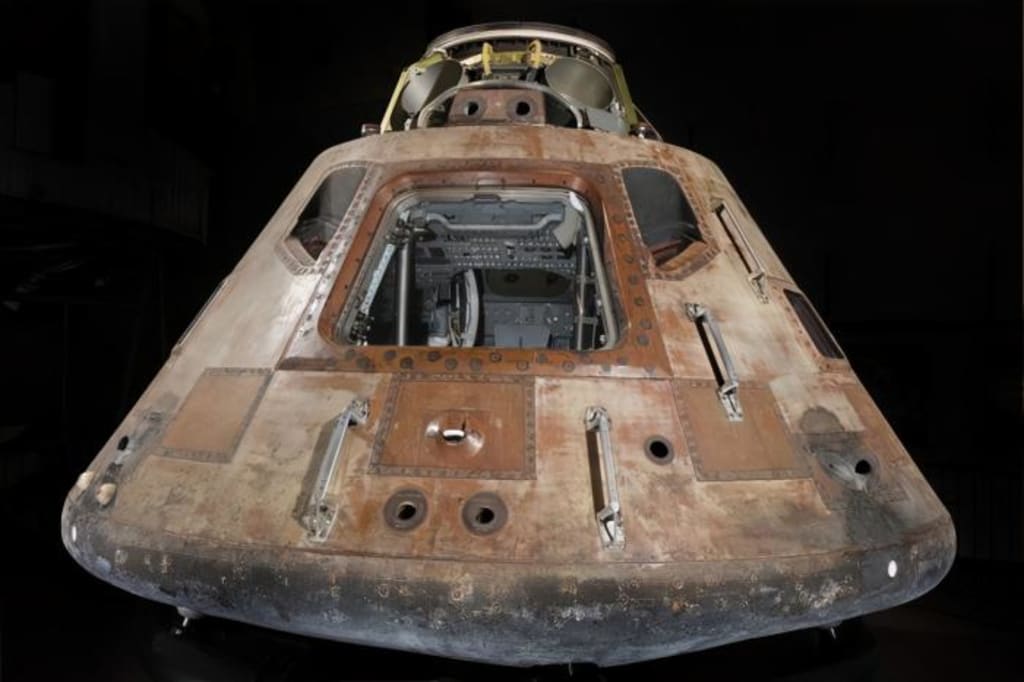
When it comes to the space race, the Soviet Union has always felt particularly "big", having lost the space race after a series of embarrassing failed missions.
On July 20, 1969, the U.S. Apollo 11 successfully landed on the moon, which officially declared that the United States had won the space race.
The launch vehicle for Apollo 11 was the Saturn 5, and it was one of the most powerful rockets ever built by man.
However, we know that the launch vehicle of any space mission is gradually abandoned in the process of ascent, after running out of fuel, the same is true of Saturn 5, which was left on Earth, and only Apollo 11 entered the orbit of the moon.
Then the question arises. After going to the moon, how did Apollo 11 return to the earth from the moon without the boost of a rocket?
When Armstrong finished his famous saying "That's one small step for man, one giant leap for mankind", it was time to plant flags, take pictures, drill holes and take rocks. The next is to go home.
What do they need to go through to answer that? Simply put, it's launching a spacecraft from the lunar surface, docking with another spacecraft in lunar orbit, then propelling the crew hundreds of thousands of kilometers, and finally surviving the scorching heat when it returns to Earth!
In fact, in the subsequent Apollo missions to the moon, they all returned to Earth in this way.
It sounds like it's easy, but it's hard to do, because any failure will prevent them from coming back.
So the President of the United States at the time prepared two speeches, one for the successful moon landing and one for the failure.
But what we're talking about today is just how would a spacecraft launch on the moon without a launch vehicle, and how would it return to Earth in lunar orbit?
Then, we don't need to know what kind of risks are there, just simply knowing the composition of Apollo 11 can clearly understand the process.
This is the scene of the Saturn 5 launch more than 50 years ago (above), the Apollo 11 spacecraft is at the top of the rocket, and the bottom is basically a storage room for rocket fuel.
This is what Apollo 11 looked like (above), the Saturn 5 was completely jettisoned after it ran out of fuel, and Apollo 11 entered lunar orbit in a little over three days.
You may have seen some science fiction movies. When the spacecraft reaches an unknown planet, some people are often left on the orbit of the planet to do technical support and information analysis, and then another part of the people drive the spacecraft to explore the planet.
In fact, the Apollo 11 mission was also like this. It was divided into two parts, the service module (or Columbia) and the lunar module (or Eagle).
Armstrong and Aldrin were the astronauts who drove the lunar module into the lunar expedition, while Collins was the one who stayed in the service module to check and adjust the machines and prepare for the return flight.
A bit different from the spaceships in sci-fi movies, though, the Apollo 11 lunar module was ugly, with rough edges, wrinkled foil, spider-like legs, and nothing of a spaceship aesthetic.
The same is true, the lunar module is carried in the protective cover of the Saturn 5, it can only operate in the vacuum of space, fortunately the moon's air is very thin (almost vacuum), so it is not designed with aerodynamics in mind It is very lightweight and practical.
Even so, the lunar module is divided into two parts, the descending stage and the ascending stage. It is not difficult to understand the name. One is used to descend to the moon, and the other is used to ascend to the lunar orbit.
In fact, the two parts of the lunar module and the service module are very similar to the launch vehicle. At least both have booster engines, and both have sufficient fuel stored, and they are discarded after use. .
The moon's gravity is about one-sixth that of the earth, and they are lightweight and have no air resistance, so their fuel doesn't need to be as "big" as Saturn 5.
Legend: The service module, with the small command module at the top
How do astronauts return to Earth from the moon?
When everything is ready, the lunar module and the service module are separated, and when the two are at a safe distance, the down-stage engines start to slow down the lunar module and lower its orbit.
After landing on the moon, the fuel of the descending stage was basically exhausted. After Armstrong and Aldrin walked on the moon for more than 2 hours, the expedition mission was over, and the next step was to return to lunar orbit.
After the astronauts return to the capsule, the engines of the upper stage are started, and the down stage module is jettisoned (like a rocket lifts off), and it is believed that the upper stage produces about 3500 pounds (1 pound ≈ 0.45 kg) of thrust in 435 seconds, Accelerates a 32,500-pound upgrade to 2,000m/s.
About 4 hours later, the upper upgrade module was docked with the service module in lunar orbit. At this time, the upper upgrade fuel was exhausted, so after the astronauts entered the service module, the upper upgrade module was also abandoned.
At this time, the engine of the service module starts and accelerates back to the earth, which is a bit similar to the time when the earth came over.
About 3 days later, the service module reached the sky above the earth, the fuel was exhausted, and it was abandoned, leaving only the "command module" (above) with a narrow top and three astronauts for three days. .
Interestingly, the location where they were scheduled to land was warned of thunderstorms, but there was not enough fuel to wait for the storm to pass, so they chose to land, which is the most powerful part of the old beauty, and this accident was also considered by them. .
They used the bell-shaped bottom of the command module as a wing, and as they re-entered the atmosphere, they extended the landing zone hundreds of kilometers away at an angle, perfectly avoiding the storm.
After that, the three astronauts were taken on the "Hornet", where they were quarantined for 21 days out of concerns about the "moon germ" and received condolences from the president.
at last
As Armstrong said, this is definitely a big step for mankind, but also as many people have questioned, can such a small lunar module really carry enough fuel, human "this step" has really been Did you step out?
The answer is yes, I have to admire the aerospace technology of Laomei. All this is due to the low gravity and close vacuum of the moon. If it is replaced by Mars, maybe it really needs a rocket launch pad, otherwise the astronauts will buy a one-way ticket. .
About the Creator
nally norris
Science needs fantasy, invention is expensive
Keep reading
More stories from nally norris and writers in FYI and other communities.
Top 10 Luxury Travel Experiences Around the World for 2026
Luxury travel in 2026 is no longer just about opulence; it’s about immersive, transformative experiences that combine comfort, adventure, and cultural depth. For seasoned travellers seeking something beyond ordinary vacations, the world offers a rich tapestry of unique journeys—from private islands to cultural explorations with personal guides. Below, we explore ten luxury travel experiences that promise exclusivity, personalization, and unforgettable memories.
By All 4 Season6 days ago in FYI



Comments
There are no comments for this story
Be the first to respond and start the conversation.