
Damp Survey vs. Home Inspection: Key Differences You Must Know
Different surveys, different insights


Buying or maintaining a home can feel like stepping into a maze of checklists, inspections, and technical jargon. I still remember the day I walked into my first house viewing-it was charming, freshly painted, and smelled faintly of new carpet. Everything looked perfect. But when a friend suggested I get a damp survey, I thought, “Isn’t that what the home inspection is for?”
If you’ve had that same question, you’re not alone. Many homeowners, especially first-time buyers, assume that a home inspection covers everything. But here’s the truth: while both processes are essential, they’re not the same. And missing the difference could cost you thousands down the line.
What Exactly Is a Home Inspection?
Think of a home inspection as a general health check-up for your property. A certified inspector goes through the house, from the roof to the basement, and looks for visible issues. They’ll check:
- Structural integrity (walls, floors, roof)
- Electrical systems
- Plumbing fixtures
- Heating and cooling units
- Windows, doors, and insulation
It’s broad, useful, and necessary if you’re buying or selling. But here’s the catch: most inspectors are generalists. They’re trained to spot surface-level issues, not to dig into highly specialized problems like hidden damp or timber decay.
So, What Makes a Damp Survey Different?
A damp survey is laser-focused. Instead of a wide-angle view, it zooms into one of the most common and destructive issues in homes: moisture.
Damp specialists use advanced tools like:
- Moisture meters
- Thermal imaging cameras
- Hygrometers (measuring humidity)
They’re not just looking at walls and ceilings; they’re measuring, probing, and often uncovering problems invisible to the naked eye. Rising damp, penetrating damp, and condensation-all of these can escape a standard inspection, but they’re the bread and butter of a proper damp survey.
Real-Life Scenario: The Cost of Skipping a Damp Survey
A friend of mine bought a lovely Victorian-style home a few years back. The home inspection report came back with only minor issues-loose tiles, a cracked windowpane, and an outdated boiler. Nothing alarming.
Fast-forward six months, and the living room paint started bubbling. The air smelled musty. By the time a damp survey was finally carried out, it revealed rising damp that had been silently climbing through the walls for years. The repair bill? Over $12,000.
That’s when I realized home inspections and damp surveys aren’t competitors; they complement each other.
Key Differences at a Glance
To make it crystal clear, here’s a side-by-side breakdown:
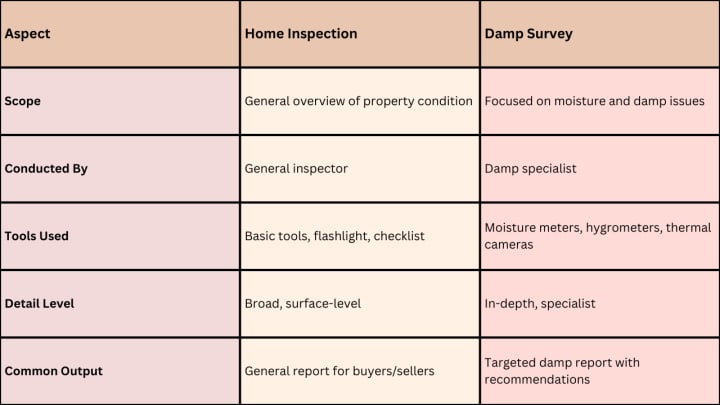
Why This Difference Matters
Moisture problems aren’t just cosmetic. Left untreated, damp can:
- Weaken structural integrity by damaging brick and timber.
- Trigger mold growth, leading to respiratory health issues.
- Lower property value (buyers often run when they see “damp” in a report).
A home inspection might flag a suspicious stain or peeling paint but often won’t confirm why it’s happening. That’s where a damp survey fills the gap.
Do You Really Need Both?
It’s tempting to save money by picking one, especially if you’re already stretched thin during a house purchase. But here’s a simple analogy:
- Home inspection = annual physical check-up with your doctor.
- Damp survey = seeing a specialist when something specific needs attention.
If you’re buying an older property, a home with a history of leaks, or you’ve noticed musty smells or mold patches, a damp survey isn’t optional-it’s essential.
My Personal Take
When I moved into my second property, I didn’t hesitate. I booked both. The damp survey uncovered early-stage condensation issues in the attic that hadn’t yet shown visible signs. Fixing it early costs a few hundred dollars. Ignoring it? That could’ve escalated into thousands.
I can’t overstate the peace of mind it gave me. Knowing that my walls weren’t secretly rotting behind the plaster meant I could focus on turning that house into a home, not a never-ending renovation project.
Final Thoughts
Home inspections and damp surveys serve different purposes, but together, they give you a complete picture. One ensures the house is broadly sound, while the other makes sure you’re not inheriting a silent, moisture-driven nightmare.
So, if you’re at that stage of buying or maintaining a home and weighing the cost of “one more survey,” think of the long-term savings and the security it brings. Sometimes, a little upfront investment saves you from a financial storm down the road.
And remember, if you’re unsure or suspect moisture issues, many providers now offer a free damp survey-a small step that could save you from a very big headache later.
About the Creator
Ananya Singh
With years of hands-on experience in the field, I am Ananya Singh, a dedicated Damp Proofing Expert based in the UK. I specialise in identifying, treating, and preventing damp-related issues in residential and commercial properties.
Keep reading
More stories from Ananya Singh and writers in FYI and other communities.
Why Damp Happens in Homes and How to Prevent It
It often starts with something small. Maybe a musty smell in the hallway. Or that darker patch on the wall you keep meaning to paint over. I remember visiting my grandmother’s old house and noticing the wallpaper in the dining room was curling at the edges. “It’s just the age of the house,” she’d say. But a year later, half that wall had to be replastered because the damp had quietly crept in.
By Ananya Singh6 months ago in FYI
A Failed Artist, A Disillusioned Poet, An Underpaid Game Show Host
I took my son and niece to Gori, a small town in Georgia where Joseph Stalin was born. They talked me into visiting the Stalin's Museum, the largest in the post-Soviet space. I had resisted going there because I just can't stand the monster and know enough about him, or so I thought.
By Lana V Lynx23 days ago in FYI
Inside the Nipah Virus Outbreak in India
In the shadowy intersections between humans and the wild, sometimes something ancient stirs. That’s the story of the Nipah virus, a microscopic agent that lurks within fruit bats but can unleash devastating effects in humans. It doesn’t announce itself with fanfare. Its presence is a whisper until suddenly it becomes a thunderclap. And right now, that thunder is echoing through parts of India.
By Aarsh Malik2 days ago in FYI


Comments
There are no comments for this story
Be the first to respond and start the conversation.