
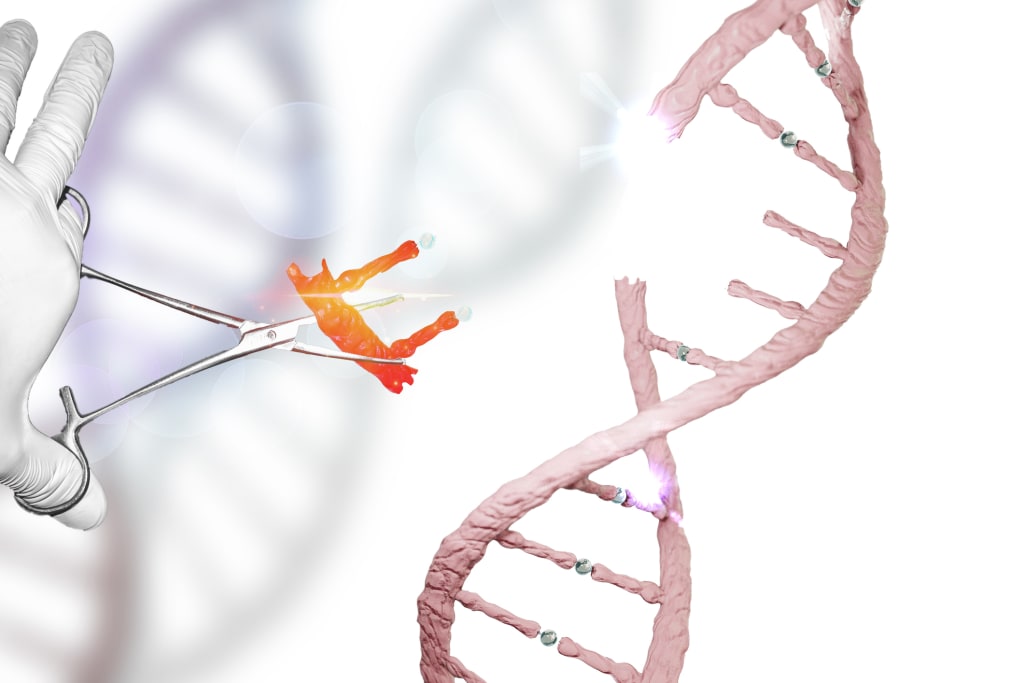
We've explored a handful of biotechnology concepts in previous tutorials, but now it's time to introduce what is undoubtedly the most promising biotechnology technique of the last decade. The CRISPR-Cas9 system is a genome editing technology that has revolutionised molecular biology because of its precise and site-specific gene editing capabilities, which essentially allow an unprecedented level of control over the manipulation of a living organism's genetic information. How does it work mechanistically and what are its applications? Let's take a closer look, starting with some historical context. In 1987, Atsuo Nakata and his research team at Osaka University in Japan first reported the presence of Clustered Regularly Interspaced Short Palindromic Repeats, or CRISPR, in the Escherichia coli genome. These are short, repeated sequences of DNA nucleotides found in the genomes of prokaryotes. These sequences are the same when read from 5' to 3' on one strand of DNA and from 5' to 3' on the complementary strand, and are therefore referred to as palindromic repeats, in the same way that we refer to words like racecar or kayak as palindromes because they are the same when read forward or backward. This was further reported in both gram-positive and gram-negative bacteria, as well as archaea, raising the obvious question of the relevance of CRISPR to these organisms, which drove research for some time. Later, in the mid-2000s, the functionality and importance of CRISPR was first realised in prokaryotes. It turns out that the CRISPR system is a key component of their adaptive immunity, which protects these prokaryotes from attack by viral DNA, bacteriophages and plasmids.
That's right, it may seem incredible, but even single-celled bacteria have a very simple immune system. Remember from our studies in the Immunology series that adaptive immunity refers to the immunity that an organism acquires after exposure to an antigen, either from a pathogen or from vaccination. Vaccination, for example, induces a form of adaptive immunity in humans because the body is exposed to antigens and produces antibodies in response, which help to develop immunity. The way this works in bacteria is as follows. The unique sequences sandwiched between the palindromic repeats, called spacers, are pieces of DNA that are foreign and do not belong to the bacterium, but come from mobile genetic elements, or MGEs, such as bacteriophages, transposons or plasmids that have previously infected the prokaryote. This was revealed by sequencing the spacers found in the CRISPR system, leading to the hypothesis that this could be a defence mechanism used by bacteria to recognise foreign DNA elements.
During a viral infection, bacteria acquire a small piece of foreign viral DNA and integrate it into the CRISPR locus to generate CRISPR arrays. These consist of duplicated sequences, the palindromic repeats of the bacterial genome, flanked by variable sequences, or spacers, derived from the foreign genetic elements. In this way, bacteria retain a memory of a previous infection. Although it was first discovered in the genomes of bacteria and archaea, CRISPR has inspired a method of genome editing that can be applied to various eukaryotic species. But before we get there, we need to understand the function of CRISPR in prokaryotes, because understanding the mechanism of its natural function will be necessary to understand how it can be exploited to achieve genome editing capabilities in humans and other organisms.
Let's look at a particular Streptococcus bacterium that is attacked by a bacteriophage. Once the viral DNA is injected into the cell, a piece of it can be incorporated into the bacterial genome and, as we mentioned earlier, it is inserted between the repeated palindromic sequences. This is called a spacer. So here we can see three different spacers, potentially from three different viruses, inserted between the repeated palindromic sequences. Now we have what is called a CRISPR array. This CRISPR array can be transcribed to form CRISPR RNA, or crRNA for short, although this longer strand is called pre-crRNA. The protein Cas9 then gets involved. Cas stands for CRISPR-associated nuclease protein, and as you know, nucleases are enzymes that can cut DNA at specific nucleotide sites, like a pair of scissors. In particular, Cas9 is one of the nucleases found in Streptococcus pyogenes, which is one of the most extensively studied and characterised CRISPR-associated nuclease proteins, so this is the one that we are going to be looking at in this bacterium. Now, in addition to Cas9, there are also molecules of tracrRNA. These have sections that are complementary to the palindromic repeats and can therefore anneal to them. So for each spacer and palindromic repeat, we end up with a complex consisting of that segment of pre-crRNA, a tracrRNA and a Cas9 protein. Then another enzyme called ribonuclease three, or RNase III, will cleave the strand between these complexes, leaving us with individual crRNA complexes, which we can call effector complexes. With these effector complexes formed, the cell is now ready to defend itself against the invader whose genome has produced this crRNA. When this complex encounters a stretch of viral DNA with a sequence complementary to the crRNA, the nuclease enzyme coordinates and, if it recognises a short sequence unique to the viral genome, called a protospacer adjacent motif, or PAM, it cuts both strands of DNA just a few base pairs upstream of the PAM. This neutralises the virus because its genome cannot be properly transcribed to make more viral particles, making infection impossible.
So we have a reasonable understanding of how CRISPR is used as a natural defence by prokaryotic organisms. Now it's time to understand how this phenomenon became the basis for biotechnological application. This begins in 2012, when Jennifer Doudna, a molecular biologist at the University of California, Berkeley, together with French microbiologist Emmanuelle Charpentier, first proposed that the bacterial CRISPR-Cas9 system could be used as a programmable toolkit for genome editing in humans and other animal species, and eventually won the Nobel Prize in Chemistry in 2020 for their work.
So how can genome editing be achieved with this method? The first thing to understand is that in bacteria, crRNA and tracrRNA are separate molecular entities. The first major breakthrough came when it was realised that the roles of these molecules could be combined into a single molecule by fusing them together with a linker to create something called a single guide RNA, or sgRNA, which can be synthesised in the lab.
When the sgRNA complexes with a Cas9 protein, this two-component system is able to cleave DNA in the same way as the three-component system in bacteria. This means that any sequence of about 20 base pairs can be identified as a target for editing, and all that needs to be done is to synthesise the appropriate sgRNA with the complementary sequence and insert it into a cell together with the Cas9 protein derived from Streptococcus pyogenes. The complex forms, reads the DNA until it finds the right sequence along with a PAM sequence, binds, and cleaves the DNA at the precise site. Cas9 has two domains, each of which cuts one of the DNA strands.
After cleavage, the natural DNA repair mechanism is activated for the target DNA. The cleaved dsDNA can be repaired in two ways. Either by homology-directed repair (HDR) or by non-homologous end joining (NHEJ). The NHEJ pathway repairs double-strand breaks in DNA by direct ligation without the need for a homologous template, i.e. a DNA strand with a similar sequence that can act as a template. The NHEJ mechanism can also insert or delete specific sequences at the joining ends, creating what are known as indels. Indels are DNA strands with either an insertion or deletion of nucleotide sequences. Thus, NHEJ produces DNA strands of uneven size. The other repair pathway, the HDR pathway, is common in bacterial and archaeal cells, whereas the NHEJ pathway is more common in the eukaryotic domain. Although more complex than NHEJ, the HDR process uses a homologous DNA template. The homologous DNA template has homology to the adjacent sequences surrounding the cleavage site to incorporate new DNA fragments. The template guides the repair process and reduces the possibility of errors. Since there is no insertion or deletion of nucleotide sequences, the HDR pathway maintains uniformity in the size of the resulting dsDNA, unlike NHEJ. So much for the mechanism of CRISPR genome editing. Now we move on to the potential applications, which have only expanded since Doudna and Charpentier suggested the possibility of using CRISPR for genome editing in humans and other animals. The potential applications of CRISPR are vast and include its use as a genetic screen to identify genes in different cells.One of the most prominent applications is cancer immunotherapy. This involves genetically modifying immune T cells, a type of white blood cell that fights disease, using CRISPR technology. Specifically, these T cells are taken from the patient's body and modified to make them more specialised in recognising and killing cancer cells when they are reintroduced into the patient's body. Similarly, CRISPR has also found its application in the therapeutic management of acquired immunodeficiency syndrome, or AIDS, caused by the human immunodeficiency virus, also known as HIV, as we covered in the Microbiology series.
Conventional antiretroviral therapies are able to suppress viral replication. But once the virus has switched to its proviral form, conventional therapies are ineffective against it. The provirus resides within the immune cells and continues to make copies of itself using the immune cell machinery, and the immune cells fail to target the latent proviral reservoir, leading to the risk of viral rebound or disease relapse. In addition to cancer and AIDS, CRISPR has found immense application in the development of assays to detect SARS-CoV-2 infection, the cause of the current global pandemic. Although the genome editing of human embryos and their implantation in the human womb, as well as the genetic editing of somatic cells, raises major ethical concerns and potential risks, CRISPR holds the promise of curing various diseases and preventing the inheritance of gene-linked diseases.In addition, genome editing in plants using CRISPR technology opens up the possibility of making plants resistant to certain diseases, improving their phenotype or observable characteristics, incorporating certain specific traits, improving crop yield, and so on. With so many exciting possibilities for this exciting new technology, it will be fascinating to see which of these major diseases and problems are solved first, heralding a new era in molecular biology.
About the Creator
Keep reading
More stories from V. D. Chouwa and writers in FYI and other communities.
Is meat really unhealthy ?
When our vegetarian ancestors started eating meat around two million years ago, it wasn't just because animals taste good, it was out of necessity. Climate change made many of the plants our ancestors relied on less available, and meat filled the gap. At least since the discovery of fire, meat has been a staple of the human diet. But in recent years, eating meat has been increasingly associated with health risks such as heart disease, certain cancers and early death. So how unhealthy is meat really?
By V. D. Chouwa3 years ago in FYI
A Failed Artist, A Disillusioned Poet, An Underpaid Game Show Host
I took my son and niece to Gori, a small town in Georgia where Joseph Stalin was born. They talked me into visiting the Stalin's Museum, the largest in the post-Soviet space. I had resisted going there because I just can't stand the monster and know enough about him, or so I thought.
By Lana V Lynx21 days ago in FYI
Mystical Manifestation Mantra in Search of Soul Mates and Twin Flames
Love is one of the most profound human desires. Many seek a soul mate, a companion who resonates deeply with their heart and soul, while others are drawn to a twin flame, a unique spiritual counterpart whose energy mirrors their own. These connections are not merely random—they require conscious alignment of the mind, heart, and universe. Mystical manifestation mantras have emerged as powerful tools for attracting these deep, transformative connections into one’s life.
By Zahid Hussain4 days ago in FYI
Affection and Healing for Yourself
During the night of the last quarter moon, I gathered my ritual supplies. I carefully handled the chunk of black tourmaline that would protect me from your overall negative and narcissistic energy. I carefully walked the house with my stick of selenite in hand, asking the universe to cleanse our working space.
By Alisha Wilkins ✒️🦋🖋️7 days ago in Fiction



Comments
There are no comments for this story
Be the first to respond and start the conversation.