
Countries with the Highest VPN Usage: 2025 Report
What Is a VPN and How Does It Work?

Virtual Private Networks (VPNs) have become a global phenomenon in recent years, with internet users around the world turning to VPNs for privacy, security, and access to restricted content. As of 2025, roughly one in three internet users worldwide relies on a VPN . This represents a significant increase from just a few years ago, and usage rates vary widely by country. In some nations, over half of all internet users connect through a VPN regularly, while in others the practice is far less common. This report provides a comprehensive overview of VPN usage patterns across the globe, focusing on the countries with the highest VPN adoption in 2025. We’ll also explain what a VPN is and how it works, explore global trends in VPN use, and examine why people use VPNs (from privacy and security to bypassing censorship). Finally, we’ll investigate whether VPNs are truly safe or just clever marketing, and offer guidance on choosing a reliable VPN service.
What Is a VPN and How Does It Work?
A Virtual Private Network (VPN) is a technology that creates an encrypted “tunnel” for your internet traffic, routing it through a remote server and masking your real IP address . In simpler terms, when you connect to a VPN, all the data leaving your device is scrambled (encrypted) and sent to a VPN server in a location of your choice. From there, it’s forwarded to the website or service you’re trying to access. Because your traffic appears to originate from the VPN server’s IP address, your real IP and location are hidden from websites and your Internet Service Provider (ISP). The encryption ensures that even if someone intercepts your data (for example, on a public Wi-Fi network), they can’t read it without the decryption key . This process effectively turns a public internet connection into a secure, private network, hence the name virtual private network.
VPNs achieve this security through encryption protocols and tunneling techniques. Common VPN protocols include OpenVPN, IKEv2/IPsec, and WireGuard – each with different strengths in speed and security. When you launch a VPN app and hit “connect,” your device and the VPN server perform an exchange to establish a secure connection using one of these protocols. All subsequent data packets from your device are encapsulated and encrypted within this tunnel. By the time your ISP or any snooping party sees the traffic, it’s just an indecipherable stream of data heading to the VPN server. Only the VPN server can decrypt it and send the request on to the destination (like a website). The response comes back through the same encrypted tunnel to your device. This end-to-end encryption and IP masking are what allow VPNs to protect your online privacy and circumvent geographic restrictions. In summary, a VPN routes and encrypts your internet traffic via an intermediary server, thereby hiding your identity and location online and securing your data from eavesdropping .
Global VPN Usage Trends (2018–2025)
VPN adoption has surged worldwide over the past decade. In 2016, only about 7% of global internet users reported using a VPN; by 2018 that figure had quadrupled to around 28% . This dramatic rise was fueled by growing awareness of online privacy and security, as well as increasing internet censorship in many countries. The trend has continued to accelerate. As of 2023, an estimated 31% of all internet users globally use a VPN . Industry forecasts project that over 2 billion people will be using VPNs by 2025 – roughly one-third of all internet users . This widespread adoption shows that VPNs have moved far beyond their niche origins and are now mainstream tools for a significant portion of the online population.
One major catalyst for increased VPN use was the COVID-19 pandemic in 2020. With millions of people forced to work and study from home, demand for secure remote access skyrocketed. VPN usage spiked dramatically in the spring of 2020 as companies and individuals scrambled to set up secure connections for telecommuting . In the United States alone, VPN usage jumped by 124% during the early weeks of the pandemic . Even after the initial surge, the habit of using VPNs persisted for many, especially for those who continued remote work or simply grew more conscious of their online privacy. The chart below illustrates the surge in global VPN downloads during this period.

Another factor driving VPN growth is the expansion of internet censorship and surveillance in various countries. As governments implement stricter controls on online content and monitor user activity, individuals have sought ways to circumvent these restrictions. VPNs have become a go-to tool for accessing websites or services that are blocked in one’s country, or for simply browsing without the fear of being tracked by authorities. Notably, the countries where internet freedom is most limited tend to have the highest VPN usage rates . This correlation suggests that people under heavy surveillance or censorship are turning to VPNs to reclaim their online freedom and privacy.
It’s also worth noting that the VPN market has expanded with dozens of providers competing for users, offering both free and paid services. This increased competition and visibility (through advertising, reviews, and word-of-mouth) has made VPNs more accessible and well-known. As a result, VPN use is no longer confined to tech-savvy enthusiasts – it’s now common among ordinary internet users who want to protect themselves or access global content. In the next section, we’ll take a closer look at which specific countries lead the world in VPN adoption and what might be driving those high usage rates.
Top Countries by VPN Usage (2025)
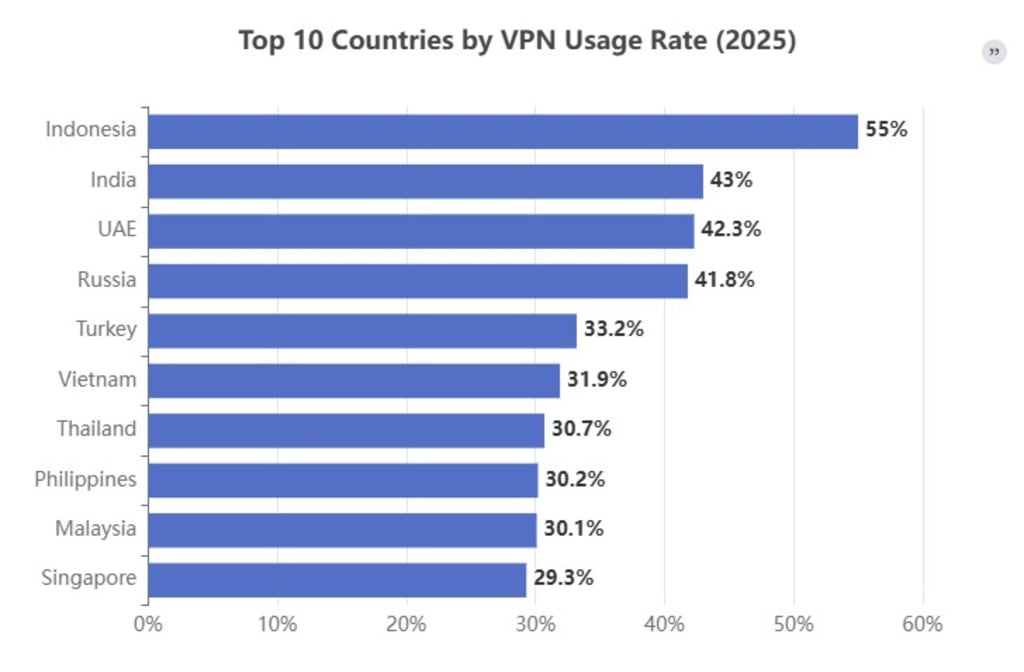
VPN usage varies significantly from one country to another. In 2025, the nations with the highest VPN adoption rates are spread across Asia, the Middle East, and beyond. The chart below visualizes the top 10 countries by VPN usage, highlighting the widespread adoption in these regions.

Below is a detailed look at the top countries where VPN use is most prevalent, along with their estimated usage rates and key insights:
Indonesia – ~55% VPN usage: Indonesia consistently ranks as the country with the highest VPN adoption in the world. As of 2025, an estimated 55% of Indonesian internet users use a VPN . This high rate is largely due to the Indonesian government’s strict filtering of online content. The country blocks access to websites deemed to contain “negative content,” including pornography, hate speech, and political dissent . To bypass these filters and access social media or streaming services freely, a large portion of the population relies on VPNs. Additionally, Indonesians use VPNs to stream international entertainment content that isn’t available locally. The combination of government censorship and a desire for uncensored entertainment has made Indonesia a global leader in VPN usage.
India – ~43% VPN usage: India is another country with extremely high VPN adoption, with roughly 43% of internet users using a VPN . There are several factors behind India’s love for VPNs. One major reason is the widespread use of mobile data and the popularity of streaming services – many Indians use VPNs to access international content libraries (for example, to watch American Netflix or BBC iPlayer) that are geo-restricted. Additionally, while India’s internet is relatively free compared to some countries, there have been instances of government-ordered website blocks and surveillance concerns. Privacy-conscious users and those in regions with local internet shutdowns (which have occurred in certain areas for security reasons) turn to VPNs to stay connected and anonymous. The availability of many free VPN apps in the Google Play Store has also contributed to high usage in India, as users can easily download a VPN to unblock apps or save money on data by using encrypted tunnels. All these factors combine to make India one of the top VPN-using nations.
United Arab Emirates (UAE) – ~42% VPN usage: The UAE has one of the highest VPN usage rates in the Middle East, with about 42% of residents using a VPN . Internet access in the UAE is heavily regulated – the government filters websites related to politics, religion, dating, and LGBTQ content, among other things, and requires ISPs to block “immoral” material. To circumvent these restrictions and access the full internet, many UAE residents use VPNs. Furthermore, the UAE enforces strict laws on online behavior, and using a VPN can help individuals avoid monitoring and potential legal issues for accessing forbidden content. Another motivator is streaming: residents use VPNs to watch content from other countries (for example, to access American Netflix or BBC iPlayer) that might not be available or has different licensing in the Middle East. The high cost of data plans in the UAE is also cited as a reason some use VPNs (some VPNs claim to compress data to save bandwidth, though this is not always reliable). In summary, heavy internet censorship and the desire for uncensored content drive a significant portion of the UAE population to use VPNs regularly.
Russia – ~41% VPN usage: Russia has seen a massive surge in VPN usage in recent years, reaching approximately 41% of internet users in 2025 . This marks a sharp increase, especially following geopolitical events. Notably, after Russia’s invasion of Ukraine in 2022 and the subsequent crackdown on independent media, VPN demand in Russia spiked by nearly 2,000% in a single week . Russians turned to VPNs to access news and social media platforms that were being blocked by the government. (For example, Facebook, Twitter, and Instagram were restricted or banned in Russia in 2022, leading users to find ways around the blocks.) The Russian government has also enacted laws requiring VPN providers to register with the state and block certain websites, which has pushed many users toward more secure, foreign-based VPN services. Despite the legal gray area, a large segment of the Russian population uses VPNs to circumvent censorship and maintain privacy under an increasingly restrictive online environment. In 2022 alone, Russians accounted for about 10% of all global VPN app downloads (33.5 million downloads) , underscoring how crucial VPNs have become for internet users in Russia.
Turkey – ~33% VPN usage: Turkey has one of the highest VPN adoption rates in Europe and the Middle East, with roughly 33% of Turkish internet users employing a VPN . This is a remarkable figure given that Turkey has at times tried to restrict VPN usage. The country’s government frequently blocks websites (including social media platforms like Twitter in the past, YouTube, and various news sites) for political or security reasons. In response, Turkish citizens have widely adopted VPNs to bypass these blocks and access the global internet. A notable spike occurred in 2023 when the government briefly imposed tighter restrictions on VPN access; Google Trends data showed that “VPN” searches in Turkey surged by 99% during that period , reflecting a rush to find working VPN solutions. Despite legal measures that require VPN providers to obtain a license (effectively forcing many popular VPNs to block Turkish users unless they use obfuscated servers), the demand remains high. Turks use VPNs not only to evade censorship but also to access streaming services and content that are region-locked. The result is that Turkey consistently ranks among the top countries for VPN usage in Europe/Middle East .
Vietnam – ~32% VPN usage: Vietnam is another nation with a high VPN uptake, estimated around 32% of internet users . The Vietnamese government imposes strict censorship on political and social content, blocking websites that discuss democracy, human rights, or criticize the ruling party. To freely access information and communicate, many Vietnamese citizens use VPNs to hide their online activity from authorities. Additionally, Vietnam’s young, tech-savvy population often uses VPNs to enjoy international entertainment (for instance, streaming US Netflix or other region-specific content). While the Vietnamese government has warned against using unlicensed VPNs, enforcement is challenging, and VPN use remains widespread. The combination of political censorship and the desire for global internet access drives a significant portion of Vietnam’s internet users to rely on VPNs.
Thailand – ~31% VPN usage: Approximately 31% of Thai internet users use a VPN . Thailand has a history of internet censorship, especially regarding content that violates its strict lese-majesté laws (insulting the monarchy) or criticizes the government. Websites and social media posts deemed offensive to the royal family are routinely blocked. Thai users often turn to VPNs to bypass these blocks and to access uncensored news. Moreover, like in many countries, Thai users use VPNs to watch foreign streaming services (such as HBO or Hulu) that aren’t available in Thailand. The relatively open availability of VPN apps means that many Thais can easily download and use a VPN to unblock content or protect their privacy. Even though Thailand has considered regulations on VPN usage, the practice remains common, making Thailand one of the top countries in the Asia-Pacific region for VPN adoption.
Philippines – ~30% VPN usage: The Philippines has an estimated 30% of internet users on VPNs . While the Philippines does not have the same level of government censorship as some countries in the region, there are still motivations for VPN use. Many Filipinos use VPNs to access region-locked content – for example, to stream American Netflix or US-based YouTube content that might have different availability. Additionally, concerns about online privacy and security are growing, and VPNs are seen as a way to protect data, especially when using public Wi-Fi in a country with a large mobile internet user base. The Philippines also experiences periodic internet disruptions or shutdowns (such as during elections or emergencies), and some users employ VPNs to maintain connectivity if certain networks are restricted. Overall, a significant minority of Filipino internet users leverage VPNs primarily for entertainment and privacy reasons.
Malaysia – ~30% VPN usage: In Malaysia, roughly 30% of internet users utilize a VPN . The Malaysian government filters some online content, particularly material deemed to threaten national security, promote violence, or violate religious and cultural sensitivities. Political websites critical of the government have been blocked at times. To access such blocked information or to simply browse without being tracked by ISPs, many Malaysians use VPNs. Additionally, as in neighboring countries, Malaysians use VPNs to stream content from other countries (for instance, to watch BBC iPlayer or Hulu when traveling or living in Malaysia). The availability of affordable VPN services and the awareness of online privacy have contributed to the steady adoption in Malaysia. It’s worth noting that Malaysia has laws against using VPNs for illegal activities, but using a VPN itself is not illegal; thus, a sizable portion of the population feels comfortable using VPNs to enhance their internet freedom.
Singapore – ~29% VPN usage: Singapore, a small but highly connected country, has about 29% of its internet users on VPNs . Singapore’s internet is generally open, but the government does filter certain content (such as pornography and sites related to gambling or extremism) and has enacted laws against online speech that can be seen as seditious or offensive. While censorship is not as pervasive as in some other countries, privacy-conscious individuals in Singapore often use VPNs to encrypt their traffic and avoid being monitored by their ISP or other third parties. Moreover, Singaporean users frequently travel and use VPNs to access local content when abroad, or conversely, to access foreign content while in Singapore (for example, watching US Netflix or ESPN). Given the high internet penetration and tech awareness in Singapore, it’s not surprising that nearly a third of users have tried a VPN. The city-state’s status as a regional business hub also means many professionals use VPNs for work (to securely access corporate networks), which contributes to the overall usage figures.
Other Notable Mentions: While the above countries lead in percentage of users, it’s important to mention China in any discussion of VPN usage. China has the world’s largest internet population, and despite a total ban on unlicensed VPNs, it’s estimated that tens of millions of Chinese citizens use VPNs to bypass the Great Firewall and access websites like Google, Facebook, and YouTube that are blocked by the government . Because the Chinese government tightly controls VPN access (only government-approved VPNs for business use are technically legal), usage statistics are hard to obtain. However, experts agree that China has the most VPN users of any country in absolute numbers, even if the percentage of the population is lower than in Indonesia or India . This underground usage is driven by the extensive censorship in China – the so-called Great Firewall – which blocks a vast array of foreign websites and imposes strict surveillance. Chinese citizens who want to access the global internet often rely on VPNs (or similar tools like Shadowsocks or V2Ray) at personal risk, as using an unauthorized VPN can result in fines or other penalties. Nonetheless, the demand remains high, making China a unique case of high VPN usage under officially repressive conditions.
Outside of Asia and the Middle East, Europe and North America have more moderate VPN adoption on average. For instance, in the United States, about 32% of adults used a VPN in 2023 (up from around 25% in 2020 ), and in the United Kingdom roughly 25% of internet users use a VPN . These rates are lower than in the top Asian countries, but still significant given the size of these populations. In Europe, countries like Switzerland and the Netherlands have relatively higher usage (often above 20%), while others like Germany and France are in the mid-teens in terms of percentage of users . Generally, Western countries with strong internet freedom laws don’t need VPNs to circumvent government censorship, so usage is more driven by privacy concerns, security on public networks, and accessing geo-blocked entertainment. For example, a common use case in the US and UK is using a VPN to watch streaming content from other countries (like accessing the US Netflix library from Europe or vice versa). Meanwhile, in parts of Africa and South America, VPN usage is growing but from a smaller base – countries like Nigeria and Brazil have seen increased interest in VPNs for privacy and to access global services, though their usage percentages are not as high as the leading Asian nations.
In summary, the countries with the highest VPN usage in 2025 are predominantly those where internet censorship or surveillance is high, or where there is a strong desire to access global online content. From Indonesia and India in Southeast Asia, to Russia and Turkey spanning Europe and Asia, to Middle Eastern nations like the UAE, people are turning to VPNs in large numbers. The motivations vary by region – from escaping government filters to simply getting a better selection of movies and shows – but the end result is the same: VPNs have become an integral tool for a significant portion of internet users in these countries.
Why Do People Use VPNs? Motivations Around the World
People use VPNs for a variety of reasons, and these motivations can differ based on a user’s location and needs. Broadly, the main reasons fall into a few categories: privacy, security, circumventing censorship, and accessing geo-restricted content. Let’s explore each of these motivations and how they play out around the world.
Privacy and Anonymity: One of the original purposes of VPNs is to protect users’ privacy by hiding their online activity from prying eyes. When you connect through a VPN, your ISP only sees encrypted traffic going to the VPN server – it cannot easily determine which websites you’re visiting or what data is being transferred. This is appealing to people who are concerned about ISPs tracking their browsing habits or selling their data. In countries where government surveillance is a concern, a VPN can provide a layer of anonymity, making it harder for authorities to monitor individual internet use. Even in more open societies, many users value the ability to browse privately. A 2024 survey found that 39% of British VPN users cited enhanced privacy as their main reason for using a VPN . Globally, privacy concerns – such as not wanting advertisers or third parties to collect your data – drive a significant portion of VPN usage. By masking your IP address and encrypting your traffic, a VPN helps you maintain a degree of anonymity online that would be difficult to achieve otherwise.
Security on Public Networks: VPNs are widely used to secure internet connections, especially when using public Wi-Fi in places like coffee shops, airports, or hotels. Public networks are often unencrypted, which means someone could potentially snoop on your traffic and steal sensitive information (like passwords or credit card numbers) if you’re not protected. A VPN encrypts all data sent and received, creating a secure tunnel even over an insecure network. This is crucial for people who travel or work remotely and frequently connect to unfamiliar networks. In fact, about 34% of VPN users globally say they use a VPN to stay safe on public Wi-Fi . For example, a business traveler in a foreign country can use a VPN to securely access their email or online banking without worrying that a nearby hacker is intercepting their data. Even outside of public Wi-Fi, many users keep a VPN on at home to add an extra layer of security against potential ISP-level snooping or malware that might try to intercept traffic. In regions where cybercrime is prevalent or where internet infrastructure security is not guaranteed, the security benefits of VPNs are a major draw.
Bypassing Censorship and Geo-Blocks: Perhaps the most visible use of VPNs today is to circumvent censorship and geographic restrictions. In countries with heavy internet censorship (like China, Iran, Russia, Turkey, and others), VPNs are used to access websites and services that the government has blocked. This could mean reading an uncensored news article, using social media platforms that are banned, or communicating via messaging apps that might be restricted. The ability of VPNs to route traffic through servers in other countries essentially allows users to “spoof” their location and appear as if they are browsing from a region with fewer restrictions. For instance, an Iranian user could connect to a VPN server in Germany to access Google or Facebook, which are otherwise blocked in Iran. Similarly, a user in Russia can use a VPN to read international news sites that the Kremlin has banned. Surveys confirm that around 20% of VPN users globally use them to beat censorship and access information that would otherwise be unavailable .
Beyond political or ideological censorship, geo-blocking for entertainment is another huge driver of VPN use. Streaming services like Netflix, Hulu, Amazon Prime Video, and BBC iPlayer often have different content libraries in different countries due to licensing agreements. This means a show available on Netflix in the US might not be available in another country. To get around these geo-restrictions, millions of people use VPNs to trick the streaming service into thinking they’re in a country where the content is available. In fact, accessing better entertainment content is one of the top motivations for VPN usage worldwide . According to one global survey, a majority of VPN users (over 50% in many countries) said they use a VPN primarily to watch TV shows or movies from other countries . For example, someone in Canada might use a VPN with a US server to watch American Netflix, or a Brit abroad might use a VPN to continue accessing BBC iPlayer. This trend is particularly strong in countries where local streaming options are limited or where popular international content is delayed or not offered. In emerging markets, VPNs are also used to access YouTube Premium or other services that might have region-specific pricing or availability. In short, VPNs have become the go-to tool for “unblocking” the internet – whether it’s to read the news, use a social network, or binge-watch a TV series that’s otherwise out of reach.
Work and Business Needs: A significant number of people use VPNs not out of personal choice but because their job or business requires it. Many companies set up VPNs for their employees to securely connect to the corporate network when working remotely or traveling. This was especially true during the COVID-19 pandemic when remote work surged. Even in 2025, with some return to offices, a lot of employees still use VPNs to access internal systems or cloud resources securely from outside the office. Surveys indicate that a substantial minority of VPN users (roughly one-quarter in some polls) use a VPN because their employer mandates it . In some countries, companies and individuals also use VPNs to bypass government restrictions on certain business tools or to securely communicate across borders. For instance, a journalist in a restrictive country might use a VPN to file reports safely, or an international business might use a VPN to ensure data sent between offices in different countries is encrypted. While this motivation overlaps with security and privacy, it’s worth noting separately because it represents a large segment of VPN usage that is driven by professional requirements rather than personal preference.
Other Reasons: There are a few other niche reasons people use VPNs. One is to circumvent ISP throttling – some ISPs slow down traffic to certain services (like streaming or P2P downloads). By encrypting traffic with a VPN, users can sometimes prevent their ISP from identifying and throttling that traffic. Another reason is online gaming and P2P sharing: gamers might use VPNs to reduce lag or connect to servers in other regions, and torrent users use VPNs to hide their IP while downloading files (to avoid legal issues or ISP penalties). Additionally, some users in countries with high data costs use VPNs that claim to compress data to save bandwidth (though the effectiveness of such claims varies). Lastly, there is a growing trend of using VPNs for digital nomadism and travel – for example, an expat might use a VPN to access websites or banking services from their home country while living abroad. Each of these contributes to the overall tapestry of why VPNs have become so popular.
In summary, the primary motivations for VPN use worldwide are privacy, security, and freedom. People want to protect their personal data from being tracked or stolen, they want to stay safe especially on untrusted networks, and they want the freedom to access information and services without arbitrary restrictions. The relative importance of each reason can vary by country – users in repressive regimes are more likely to emphasize bypassing censorship, whereas users in open societies might emphasize privacy or entertainment. But across the board, VPNs have proven to be a versatile tool that addresses these needs. The next section will delve into a critical question for anyone considering a VPN: Is using a VPN truly safe and effective, or is it just marketing hype? Understanding the potential risks and limitations of VPNs is important for making an informed decision about their use.
Are VPNs Really Safe or Just Marketing Hype?
VPN providers often advertise their services with bold claims of security, privacy, and freedom. But are VPNs truly safe, or is this just clever marketing? The answer is a bit nuanced. When used correctly, a reputable VPN can significantly enhance your online security and privacy. However, not all VPNs are created equal, and there are important caveats to keep in mind. In this section, we’ll separate fact from fiction and examine the safety of VPNs, addressing concerns like data logging, encryption strength, and whether you’re simply trading one monitor for another.
First, the good news: A properly configured VPN encrypts all your internet traffic, which makes it extremely difficult for anyone (be it your ISP, a hacker on the same Wi-Fi, or even a government agency) to intercept and read your data . This encryption is a fundamental layer of security that protects sensitive information such as passwords, banking details, and personal messages from being stolen. In that sense, using a VPN is safer than not using one in many scenarios – especially on public networks or when accessing websites that are not HTTPS encrypted. VPNs also hide your real IP address, which adds a layer of anonymity. They prevent your ISP from seeing exactly which websites you visit (it only sees encrypted traffic to the VPN server) and can thus protect you from ISP-level tracking or throttling. In short, a reliable VPN can genuinely make your online activities more secure and private, which is not just marketing – it’s backed by solid encryption technology and decades of use in enterprise security.
However, the effectiveness of a VPN depends largely on which VPN service you choose. This is where the line between reality and marketing hype can blur. Many VPN companies claim to offer “military-grade encryption” and “no logs” policies, but not all follow through on those promises. Here are some key considerations regarding the safety and trustworthiness of VPNs:
Encryption Strength: Virtually all reputable VPNs use strong encryption protocols (such as AES-256, which is the same level of encryption used by governments). This part is not hype – connecting through such a VPN is indeed very secure against eavesdropping. The encryption ensures that if someone intercepts your data packets, they’ll just see gibberish. So from a technical standpoint, VPNs do protect your data as advertised. The caveat is that you must ensure your VPN is up-to-date and using a secure protocol (avoid outdated protocols like PPTP, which is easily cracked). Most major VPNs have moved to secure protocols like OpenVPN or WireGuard, so this is usually not an issue if you stick to well-known providers.
No-Logging Policies: One of the biggest selling points for VPNs is the promise that they do not keep logs of your online activity. A “no-logs” policy means the VPN provider claims it doesn’t record which websites you visited, how much data you transferred, or any other information that could be used to identify your activity. If a VPN truly sticks to a no-log policy, then even if it were forced by law or hacked, there would be no sensitive user data to hand over or leak. This is crucial for privacy, because when you use a VPN, you are effectively trusting the VPN provider instead of your ISP. If the VPN logs everything, you’ve just swapped one tracker for another. The question is, how much can we trust these no-log claims? Many VPN companies market themselves as privacy champions with strict no-log policies, but the reality can vary. Some providers have been caught logging more data than they admitted. For example, in the past, certain VPN services claimed to be completely anonymous but were later found to keep connection logs or even sell user data to third parties . This doesn’t mean all VPNs are untrustworthy, but it highlights that not all no-log claims are equal. To separate fact from fiction, look for VPNs that have undergone third-party audits of their logging practices or have a strong reputation in the privacy community. Also, consider the jurisdiction of the VPN provider – companies based in countries with strong privacy laws or no mandatory data retention laws are less likely to be forced into logging user activity. In summary, a genuine no-log VPN can indeed protect your privacy, but this is only as good as the company’s integrity and transparency. It’s wise to do some research rather than taking marketing claims at face value.
Trading One Monitor for Another: A common critique is that when you use a VPN, you’re trading trust from your ISP to the VPN provider. Instead of your ISP knowing your browsing habits, now the VPN provider does (unless it truly doesn’t log). This is a valid point. In theory, a VPN provider could log your activity or even throttle your connection. However, there are a few counterpoints. First, a reputable VPN provider has a business model based on selling privacy – it has an incentive to not betray that trust, as news of logging would ruin its reputation. Second, many VPN providers are based in countries with privacy-friendly laws and have stated policies of not complying with mass surveillance (though they must still comply with valid legal requests, which is another reason no-logs are important). Third, if you choose a VPN that offers “zero-knowledge” or “no-log” services, even the provider cannot tie your identity to your online actions. For instance, some VPNs allow you to pay with cryptocurrency and don’t require real personal info, so even if logs existed, they couldn’t easily be linked to you. That said, it’s important to be aware that you are placing a degree of trust in the VPN service. This is why doing your homework on a provider’s reputation, reading independent reviews, and checking if they’ve had any security incidents is crucial. In essence, using a VPN is not an absolute guarantee of anonymity – it’s a trade-off. You are generally trading a larger, less controllable risk (your ISP or a hostile network) for a smaller, more manageable risk (the VPN provider). If you pick a trustworthy VPN, this is a very good trade; if you pick poorly, you might not be gaining much. So, the safety of a VPN is largely contingent on choosing the right provider (more on that in the next section).
Security Vulnerabilities and Updates: Another aspect of VPN safety is whether the VPN service itself is secure against attacks. VPN software can have bugs or vulnerabilities like any other software. Over the years, there have been instances of VPN services suffering data breaches or having flaws that could potentially expose user information. However, it’s worth noting that major VPN providers take security seriously and regularly update their software to patch vulnerabilities. In fact, many have bug bounty programs to encourage researchers to find and report issues. The risk here is relatively low for well-established VPNs, but it’s something to consider. Always ensure you’re using the latest version of the VPN app or client, as developers frequently release updates to improve security. Also, be cautious of extremely cheap or sketchy VPN apps, especially on mobile app stores – some of these could be malicious or poorly coded, potentially exposing your data instead of protecting it.
False Sense of Security: One subtle danger of VPNs is that some users might develop a false sense of security and let their guard down in other areas. For example, someone might think that because they’re on a VPN, they can click on any link or connect to any Wi-Fi without worry. This isn’t the case. A VPN protects your traffic from being intercepted and hides your IP, but it does not magically make unsafe websites safe. If you visit a malicious site or download a malware-infected file while on a VPN, the VPN won’t stop that malware from infecting your device. In other words, a VPN is a tool for privacy and network security, but it’s not a replacement for a good antivirus or safe browsing practices. Some marketing materials might imply that a VPN will protect you from all online threats, which is an overstatement. VPNs are not a silver bullet – they primarily protect you from network-level threats and snooping. You still need to be careful about phishing, malware, and other cyber threats. That said, using a VPN is generally a positive step for security, as long as you understand its limits.
Free VPNs – Too Good to Be True? The proliferation of free VPN services brings up the question of their safety. Many free VPNs are advertised as a great way to get privacy or unblock content at no cost. But in reality, free VPNs often come with significant trade-offs that can undermine your safety. A common business model for free VPNs is to monetize user data – this can mean logging your activity and selling it to advertisers, or injecting ads into your browsing. Some free VPN apps have been found to contain malware or adware that can harm your device. In fact, cybersecurity experts have warned that using an untrusted or free VPN can sometimes be worse than not using a VPN at all, because you might be handing your data to a shady company . Free VPNs also often have limited servers, slow speeds, and may not use the strongest encryption. While there are a few reputable companies offering limited free tiers (for example, ProtonVPN and Windscribe offer free versions with certain restrictions), these are the exception. As a rule of thumb, if a VPN is completely free and not clearly supported by a reputable company, treat it with skepticism. Paid VPNs, while not infallible, tend to have more incentive to protect their users and have the resources to do so. They also typically offer better performance and customer support. In summary, the “safety” of a VPN can be greatly diminished if you opt for a low-quality or free service – what you save in money you might lose in privacy or security.
So, are VPNs really safe? The answer is yes, but with conditions. A VPN from a trustworthy provider, used correctly, will encrypt your traffic, hide your IP, and generally make you more secure and anonymous online. This is not hype – it’s based on solid encryption and networking principles. However, the VPN industry is also full of marketing claims, and not every service lives up to them. There have been cases of VPN providers exaggerating their privacy protections or even engaging in deceptive practices . To ensure you’re not falling for hype, it’s important to critically evaluate VPN services. Look for evidence of their security (like encryption protocols, kill switches, DNS leak protection) and their privacy track record (independent audits, transparency reports). Also, understand that a VPN is one part of a broader security and privacy strategy – it’s not an invisibility cloak that makes you untouchable online, but it is a very useful tool in most cases.
In conclusion, VPNs are safe and effective when you choose wisely. They offer real protection against real threats (like eavesdropping and IP tracking). The hype comes in when companies overpromise or when users assume a VPN will solve all their problems. By being an informed user, you can enjoy the genuine benefits of VPNs while avoiding the pitfalls. The next section will guide you on how to select a reliable VPN service that aligns with your needs and values, ensuring that you get the most out of your VPN experience without compromising your security.
Choosing a Reliable VPN: Key Considerations
With hundreds of VPN providers on the market, selecting the right one can be a daunting task. To ensure you get a VPN that is secure, reliable, and effective, it’s important to consider several key factors. Here’s a guide to choosing a VPN service that aligns with your needs:
Security Features and Encryption: The foremost consideration is the strength of the VPN’s security. A reliable VPN should use strong encryption standards – 256-bit AES encryption is considered the gold standard and is used by most top providers . Additionally, check the VPN protocols supported. Modern, secure protocols like OpenVPN (with AES-256) and WireGuard are preferable, as they offer a good balance of security and speed . Avoid any VPN that still relies on outdated or easily cracked protocols (such as PPTP or the older L2TP/IPSec without strong encryption). Other security features to look for include a kill switch – a feature that automatically disconnects your device from the internet if the VPN connection drops, preventing any unencrypted traffic from leaking out. A kill switch is crucial for maintaining security, especially if you’re doing something sensitive and the VPN unexpectedly disconnects. Also ensure the VPN has measures against DNS and IPv6 leaks, which can expose your real IP or DNS queries even when connected. Leading VPNs typically have built-in protections for these leaks. In summary, prioritize VPNs with proven encryption, modern protocols, and robust security features like a kill switch and leak protection.
No-Logs Policy and Privacy Record: Since one of the main reasons to use a VPN is privacy, you should thoroughly examine the provider’s logging policy. A trustworthy VPN will have a clear no-logs policy stating that it does not record user activity or traffic. But as discussed, it’s not enough for them to simply say it – look for evidence. Many reputable VPNs commission third-party audits to verify that they aren’t logging user data. For example, some providers publish audit reports that confirm their servers contain no identifiable logs of user sessions. This kind of transparency is a good sign. You should also research the VPN provider’s history: have they ever had a data breach or been involved in any controversy regarding user privacy? A quick search can often reveal if a VPN has a clean record or if there have been past issues. Another factor is the jurisdiction of the VPN company. Companies based in countries with strict privacy laws or those not part of mass surveillance alliances (like the Five Eyes, Nine Eyes, or Fourteen Eyes intelligence-sharing groups) may be more favorable. For instance, a VPN headquartered in a country with strong privacy legislation is less likely to be compelled to hand over user data to authorities. On the flip side, a VPN based in a country with draconian surveillance laws might be legally forced to comply with data requests, even if they claim a no-log policy. All this is to say: do your homework on the VPN’s privacy practices. Opt for providers that have a reputation for valuing user privacy and that can back up their claims with audits or certifications.
Server Network and Performance: The performance of a VPN can vary widely depending on the provider’s infrastructure. When choosing a VPN, consider how many servers they have and where they are located. A larger server network (both in number of servers and number of countries) gives you more options for connecting to a server close to your desired location, which can improve speed and help with accessing geo-blocked content. For example, if you want to watch US Netflix, having multiple server choices in the US increases the chance you’ll find one that works well for streaming. Pay attention to whether the VPN has servers in the specific countries you care about (be it to bypass censorship or to stream content from that region). That said, sheer numbers aren’t everything – server quality and load matter too. A VPN with thousands of servers that are all overloaded with users might perform worse than one with fewer servers that are well-maintained. Ideally, look for a provider that has servers in many countries and also offers specialized servers (such as “streaming optimized” servers or P2P-friendly servers if you plan to torrent). Performance-wise, you should also consider typical speed and latency. While a VPN will inherently add some latency and might reduce your bandwidth (due to encryption overhead and routing through remote servers), the best providers manage to keep speed loss to a minimum. Reading user reviews or expert speed tests can give you an idea of a VPN’s performance. If you need a VPN for high-bandwidth activities like 4K streaming or online gaming, prioritize providers known for fast connections (for instance, many experts note that ExpressVPN and NordVPN tend to have excellent speeds). Keep in mind that your own internet connection and the distance to the VPN server will also affect speed – connecting to a server on the other side of the world will generally be slower than one nearby. Many VPNs offer a free trial or money-back guarantee, so you can test the speed for yourself before committing.
Device Compatibility and Ease of Use: Consider which devices and operating systems you want to use the VPN on. The top VPN services offer native apps for major platforms: Windows, macOS, Linux, iOS, Android, and even router firmware or smart TV apps in some cases. Ensure the VPN you choose has an app for each device you plan to protect. If you have a more specialized device (like a gaming console or a NAS device), check if the VPN can be set up on it (either via an app or by configuring it on your router). Another factor is how user-friendly the VPN is. If you’re not very tech-savvy, you’ll appreciate a VPN with a simple, intuitive interface – one-click connection, clear server selection, etc. Most popular VPNs have polished apps that are easy to use. However, if you’re more advanced, you might prefer a VPN that offers granular control (like the ability to choose specific protocols, split tunneling to choose which apps use the VPN, etc.). Split tunneling can be a useful feature if you don’t want all your traffic going through the VPN – for example, you might route only certain apps or websites through the VPN while leaving other traffic direct. Check if the VPN supports this if it’s something you need. Also, note the limit on simultaneous connections: some VPNs allow a certain number of devices connected at once (common limits are 5 or 10), whereas others like Surfshark allow unlimited devices on one account. If you have a household with many devices, an unlimited or high connection limit is a big plus.
Customer Support and Reputation: A reliable VPN provider should offer good customer support in case you run into issues. Look for providers that offer 24/7 customer support, ideally via live chat, as this is the quickest way to get help. Email support is usually available too, but live chat can be invaluable for immediate problems (like if you can’t connect and need guidance). You can gauge the quality of support by reading user experiences – do customers report that support is responsive and helpful? Additionally, consider the overall reputation of the VPN company. How long have they been in business? An established provider with years of operation is generally a safer bet than a brand-new one that could disappear overnight. Check online forums and tech review sites for feedback. Keep an eye out for any red flags, such as reports of poor uptime (VPN servers being offline frequently), slow customer support responses, or any history of security incidents. A VPN that is well-regarded in the tech community (for example, recommended by sites like CNET, TechRadar, or Wirecutter) often is a reliable choice, as those recommendations are typically based on thorough testing. That said, be mindful that some review sites have affiliate relationships with VPNs, so it’s good to cross-reference information. User reviews on platforms like Trustpilot or Reddit can also provide insights into real-world experiences, though take individual anecdotes with a grain of salt.
Price and Value: VPN services range in price from a couple of dollars a month (when paid annually) to upwards of $10 per month for a month-to-month subscription. Generally, longer-term plans (like 1-year or 2-year subscriptions) offer much better rates. It’s not necessary to choose the absolute cheapest option – remember that with VPNs, you often get what you pay for. Extremely cheap or free VPNs might compromise on security or performance as discussed. However, there are plenty of high-quality VPNs that are reasonably priced, especially if you commit to a longer plan. Compare the cost per month of different providers when billed annually. Also, consider what is included in the price. Some VPNs bundle additional services – for example, NordVPN offers a Threat Protection feature (which blocks ads, trackers, and malware) and a password manager in its higher tiers, while ExpressVPN might include things like an email address or special server access. If you’re interested in those extras, it adds value. On the other hand, if you just need a basic VPN connection, you might not need to pay for a bundle. Many providers offer a money-back guarantee (often 30 days). This is a great safety net – it means you can try the VPN risk-free and, if you’re not satisfied with speed or features, you can get a refund. Take advantage of this to test a VPN in real-world conditions before fully committing. Lastly, be cautious of deals that seem too good to be true. A legitimate VPN will rarely be $0.99/month unless it’s a promotional deal for the first year; if you see an extremely low price, verify that it’s not a short-term promo that jumps to a high price after a few months.
Specific Use Cases: Tailor your choice to your primary use case. If you’re primarily using a VPN to stream geo-blocked content, you’ll want a VPN that is known to work well with streaming services. Some VPNs have dedicated streaming servers or regularly update their servers to avoid being blocked by services like Netflix or BBC iPlayer. Reading up on which VPNs currently unblock which services can help – for instance, NordVPN and Surfshark are often recommended for streaming because they have large server networks and strategies to avoid detection. If you’re using a VPN for torrenting or P2P file sharing, ensure the VPN explicitly allows P2P traffic on at least some of its servers (many VPNs do, but some prohibit it). Providers like Private Internet Access (PIA) and TorGuard have reputations as VPNs friendly to torrenting. If privacy is your main concern above all else, you might lean towards VPNs with stricter no-log policies and perhaps those based in privacy-friendly jurisdictions. For example, ProtonVPN (based in Switzerland) or Mullvad (based in Sweden) are often praised by privacy advocates for their strong stance on user privacy. If you need a VPN for business or remote work, you might need features like support for secure remote access to a private network, or features like split tunneling and device management. Some VPNs cater to business needs with additional admin controls. In short, identify your main reason for using a VPN and choose a provider that excels in that area. Most top-tier VPNs are versatile and cover the basics well, but there can be subtle differences that make one better suited to your specific needs.
By considering all the above factors – security, privacy policy, server network, device support, customer support, cost, and your personal use case – you can make a well-informed decision. To give you a head start, here are a few reputable VPN services that consistently rank highly across these criteria (as of 2025):
ExpressVPN: Often regarded as one of the best all-around VPNs. It offers very fast speeds, a user-friendly app, strong encryption, and a strict no-logs policy. ExpressVPN has servers in over 90 countries and is known for reliably unblocking major streaming services. It’s a bit on the pricier side, but many users find the quality worth it.
NordVPN: Another top contender, NordVPN is known for its robust security features (including double VPN – routing through two servers – and onion over VPN for extra privacy) and a vast network of servers. It consistently performs well in speed tests and has a strong reputation for privacy. NordVPN also offers a 30-day money-back guarantee and has a feature called Threat Protection that blocks malware and ads.
Surfshark: Surfshark has gained popularity for offering a great feature set at a competitive price. It allows an unlimited number of simultaneous device connections on one account, which is ideal for families. It has a large server network and performs well in unblocking streaming sites. Surfshark’s apps are user-friendly and it includes features like an ad blocker and a clean web browsing mode.
CyberGhost: CyberGhost is known for its simplicity and is a good choice for beginners. It has a large number of servers optimized for different purposes (streaming, torrenting, etc.), and it boasts an easy-to-use interface. CyberGhost offers strong encryption and a strict no-logs policy, and it’s reasonably priced, especially on longer plans.
ProtonVPN: ProtonVPN is an excellent option if privacy is your top priority. It’s based in Switzerland and has a very transparent, privacy-focused approach. ProtonVPN offers both free and paid tiers; the paid version provides access to all servers and higher speeds. It uses state-of-the-art encryption and even offers a feature called “Secure Core” which routes your connection through multiple servers for enhanced security. ProtonVPN’s apps are solid and it’s a favorite among privacy-conscious users.
Mullvad: Mullvad is a small VPN provider based in Sweden that has earned a stellar reputation in the privacy community. It is known for its extreme privacy measures – you can pay anonymously with cash or cryptocurrency, and it doesn’t ask for any personal information. Mullvad’s service is straightforward (it doesn’t have a fancy interface or extra features), but it offers fast, reliable connections and strong encryption. If you value privacy above all and don’t mind a no-frills experience, Mullvad is highly recommended.
These are just a few examples. Other notable VPNs include Private Internet Access (PIA), VyprVPN, IPVanish, and Windscribe, among others. Many of these offer free trials or money-back guarantees, so you can test them. When evaluating, don’t just rely on one source – try to gather information from multiple reviews and perhaps even test a couple of services yourself to see which one you like best in terms of speed and usability.
Finally, remember that the best VPN for you is the one that meets your specific needs and that you can trust. It’s better to invest a bit more in a quality service than to go with the cheapest option that might compromise your data. By following the guidelines in this section, you’ll be well on your way to selecting a VPN that provides the security, privacy, and performance you’re looking for.
Conclusion
VPN usage around the world has grown exponentially in recent years, and nowhere is this more evident than in the countries that lead the pack in adoption. From Indonesia and India, where over 40% of internet users rely on VPNs to circumvent censorship and access global content, to Russia and Turkey, where VPNs have become essential tools for maintaining online freedom under restrictive regimes, it’s clear that VPNs have become a critical part of the internet experience for millions. Even in more open societies, VPNs are increasingly popular for protecting privacy and unblocking entertainment. As of 2025, VPNs are mainstream – roughly a third of all internet users globally use one , and this number is expected to keep rising.
We’ve explored what a VPN is and how it works, demystifying the technology that encrypts your traffic and hides your identity. We’ve also examined the why behind VPN use – whether it’s to stay safe on public Wi-Fi, keep your browsing private from prying eyes, or simply watch your favorite show from another country. In many countries, VPNs are intertwined with the fight for internet freedom, allowing users to bypass filters and access information that would otherwise be out of reach. The data shows that censorship drives demand: nations with the highest VPN usage often correspond to those with the lowest internet freedom scores . At the same time, even in free societies, people value the extra layer of security and the ability to access geo-blocked content that VPNs provide.
We also delved into the question of safety and trust. The conclusion is that VPNs can indeed be safe and effective – but it’s crucial to choose a reputable provider. The VPN industry is not without its pitfalls, and not every service lives up to its marketing claims. However, by educating yourself and selecting a VPN with strong encryption, a verifiable no-logs policy, and a good track record, you can confidently reap the benefits of VPN technology. A reliable VPN will encrypt your data, mask your IP address, and give you greater control over your online presence. It won’t make you completely invisible, but it will significantly reduce the risk of surveillance or data interception and give you the freedom to use the internet more as you choose.
In a world where online privacy is increasingly under threat and where access to information can be restricted by borders or by authorities, VPNs have emerged as an empowering tool for individuals. They exemplify how technology can be used to preserve rights and enhance security in the digital age. Whether you’re an ordinary user looking to secure your home Wi-Fi or someone in a repressive environment seeking to connect to the free flow of information, a VPN can be an invaluable ally. The key is to use it wisely and choose the right service for your needs.
As we move further into 2025 and beyond, we can expect VPNs to continue evolving. We may see even stronger encryption methods, more seamless user experiences, and perhaps new regulations in some countries affecting their use. One thing is certain: the demand for privacy, security, and open access to the internet is not going away. VPNs, for now, remain one of the best tools available to individuals to meet those demands. By staying informed about how VPNs work and how to use them effectively, users around the world can take greater control of their online lives. The countries leading in VPN adoption have shown us why these tools matter – and as awareness grows, VPN use is likely to become even more commonplace globally. In an era where our digital footprint is ever-present, VPNs offer a way to walk a little more anonymously and securely through the online world.
About the Creator
Why the SaaS Business Model Is Under Pressure in 2026?
In the 2010s, SaaS felt inevitable. Founders pitched recurring revenue. Investors rewarded annual recurring revenue multiples. Customers preferred subscription access over upfront licensing. Cloud infrastructure made deployment frictionless. The model seemed superior to everything that came before it.
By Nick William2 days ago in FYI




Comments
There are no comments for this story
Be the first to respond and start the conversation.