
Could Any Other Animal Become as Intelligent as Humans?
And other morning musings from my hotel room in Chicago…


As I'm writing this, I’m participating in a 10-minute writing sprint. (They’re part of Ninja Writers and done every morning. You can check them out here.)
I had every intention of opening up my fiction work in progress and working on that. I even went as far as opening up Google so I could get to my Google Doc.
That’s when I saw it. Google’s image of the day — a celebration of the Turkana Human.
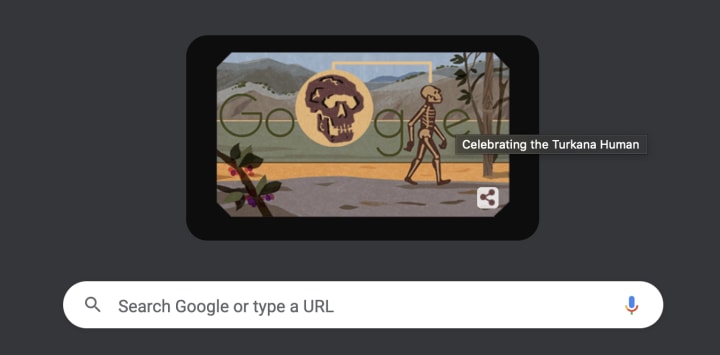
After further investigation, I was hit with a burning question:
Is there another species out there in this big wide world that has the potential of evolving into human-level intelligence?
It’s 9am here. Clearly, I’ve woken up with an overactive brain, but that’s neither here nor there.
Here’s what I’ve learned about Turkana Humans in the last 10 minutes.
Thank God for Wikipedia!
In 1984 Kenya, Kamoya Kimeu discovered what is now known as “the most complete early hominin skeleton ever found”. This fossil of what would later be determined as a boy is known as the Turkana Boy and it’s estimated that his age at his time of death was between 7 and 11 years old.
A large chunk of our history as intelligent beings comes from a 7 to 11 year old kid. A boy at that (we think. It’s hard to tell, apparently). I’m not sure why, but this discovery stuck with me, as sad as it is.
Did he live a full life at just 7 to 11 years old? This was outside of my scope of 10 minutes of research so I can’t answer it, but I would assume yes. Without modern medicine, I’m sure the life expectancy was severely depleted from what it is now.
What were scientists looking for in terms of the Turkana Boy fossil?
The difference between Chimpanzees and modern humans, apparently.
It’s said that one of the key factors of difference between us and chimpanzees (a species we share 99% of our DNA with) is our adolescent growth spurts. At 7 to 11 years old, the Turkana Boy fossil would be right in the thick of that, I assume.
According to my good friend Wikipedia, this is not quite what they found. The paleontologists thought originally that the early human fossil showed a comparable level of growth consistent with modern humans, but they’ve more recently found that the growth spurt we experience as kids were less present in early humans.
What does this mean? That they can’t really know for certain how old this Turkana human was when he died. He (or maybe even she?) could’ve been a fully grown grandparent of their Turkana family for all we really know if all we’re going on is the presence of an adolescence growth spurt.
They aren’t though. Dental and bone maturity also comes into play and continues to place the age at around 8 years old.
Now, on to my lingering question.
All of this research (a whole 10 minutes!) about Turkana Humans still has me wondering:
Are there other animals making their way up the evolutionary chain? Other species that have the potential of human-level intelligence?
Here’s some insight towards this question that I found interesting:
What is intelligence anyway?
Suzana Herculano-Houzel, author of The Human Advantage: A New Understanding of How Our Brain Became Remarkable, says this:
There’s no glitzy answer to this one. First, because it depends on how you define intelligence. Plenty of animals out there have the same capabilities that we have, at least in terms of direct problem solving, visual memory, hierarchical planning, etc. As for what animal comes closest to humans in terms of numbers of cortical neurons — and therefore supposedly in the extent of their biological capabilities — that would be gorillas and orangutans. But notice that they live much shorter lives, and have much more limited cultures; their societies have not been as organized as ours, as complex as ours, for as long as ours has. So there’s really no straightforward comparison.
Are there animals out there that could learn to do things that we do? The answer is definitely yes. Look up Ayumu, the video game-playing Japanese chimpanzee. She beat college students at the game — until somebody decided to give graduate students a fair chance by letting them practice for just as long, and then, it was a tie.
The obvious answer is some sort of monkey.
Julian Keenan, a professor of biology at Montclair State University, has studied the brain and self-awareness for 20 years. Here are their thoughts:
The Chimpanzee (Pan troglodyte) and the Bonobo (Pan paniscus) are typically the first candidates that most cognitive neuroscientists would name as potentially gaining human like intelligence. Why?
While all would identify tool making, tool use, and a higher social hierarchy, it is actually the fact that chimps (and Orangutans: Pongo pygmaeus) have self-awareness that makes them possible candidates. It is not to say that other factors such as counting and communication are not important, they are. However, it is the ability to reflect on their own thinking that drives the difference between them and numerous other cognitively advanced animals.
Maybe dogs and squirrels?
Todd K. Shackelford, a psychology professor at Oakland University who specializes in evolutionary psychology, suggests what we already know. Dogs are obviously smarter than us. We’re simply a speck of dust compared to their greatness.
Many animals already are far more intelligent than humans. Compared to dogs, humans are olfactory idiots. Thirteen-lined ground squirrels can easily detect the difference between a half-sibling and a full sibling, and they don’t need expensive DNA fingerprint analyses to do so.
No animal has a chance…except maybe dolphins?
Robin Dunbar, author of Human Evolution: Our Brains and Behavior and a professor of Evolutionary Psychology at the University of Oxford, provides this wisdom:
No animal will develop human-like intelligence if its circumstances don’t become similar to those that required our ancestors to develop bigger brains. Those circumstances were the need to evolve bigger social groups in order to cope with the new kinds of environments they were invading (more open habitats with many predators). The ones with the best chances are the apes and the dolphins, or maybe the elephants, because they have the biggest brains after us. The apes and the elephants are in danger of going extinct before they have a chance. So maybe the best bet is the dolphin family.
This one grossed me out, but is also quite a timely revelation?
Katerina Johnson, a research associate of Psychiatry at the University of Oxford thinks the next animal to develop human-level intelligence is not actually a human at all:
At its core, we can think of intelligence as an organism’s ability to adapt to its environment. I would argue that in many instances bacteria are already just as ‘intelligent’ as humans in their own way. Although bacteria aren’t animals at all, many of their behaviors have recognizable parallels to our own human societies and other animal societies.
Bacteria are able to communicate with each other using an array of different chemicals and have many genes important for social function. One particular type of communication that they exhibit, known as quorum sensing, is used by bacteria to help make group decisions within a colony and mediate microbial cooperation. They can use quorum sensing to determine their density and then take appropriate action — for example, preventing overgrowth if the colony starts getting too big. Disease-causing bacteria use this special type of communication to know when the population has reached a high enough number to launch an attack on the host.
The answers are mixed, and that’s ok.
I feel like I’ve satisfied my overactive brain this morning, and I learned some very interesting tidbits of information! I call that a win, even if I don’t know for sure whether or not dogs will take over the world 500 years from now.
About the Creator
Adrienne Grimes
A writer and a reader of all the things, Adrienne has thoughts on art, culture, branding, social media, and the book industry. Follow her on Instagram @bookaweekproject and catch her classes in the Ninja Writers Guild.
Keep reading
More stories from Adrienne Grimes and writers in FYI and other communities.
Here’s The Unbelievable Thing We’re All Made Up of.
Did you know that we’re all made up of stardust? Me either, until last night. I’m staying in a hotel as I write this, which you know means either late-night binging of Friends or cheesy Hallmark/Lifetime movies. Last night it was Hallmark.
By Adrienne Grimes4 years ago in FYI
Neutraceutical Packaging Market Size and Forecast 2025–2033
Neutraceutical Packaging Market at a Glance The Neutraceutical Packaging Market is projected to expand from US$ 4.92 billion in 2024 to US$ 7.63 billion by 2033, growing at a CAGR of 4.99% from 2025 to 2033. This steady growth reflects the accelerating global demand for dietary supplements, functional foods, herbal products, and wellness beverages. Rising health awareness, aging populations, sustainability expectations, the rapid growth of e-commerce, and evolving regulatory frameworks are reshaping how nutraceutical products are packaged, protected, and presented.
By Aaina Oberoi4 days ago in FYI


Comments
There are no comments for this story
Be the first to respond and start the conversation.