
Cosmic Close-Up: Black Holes and the Satellite That Saw Too Much
The Brief Life of a Space Observatory and a Glimpse Into Galactic Mysteries

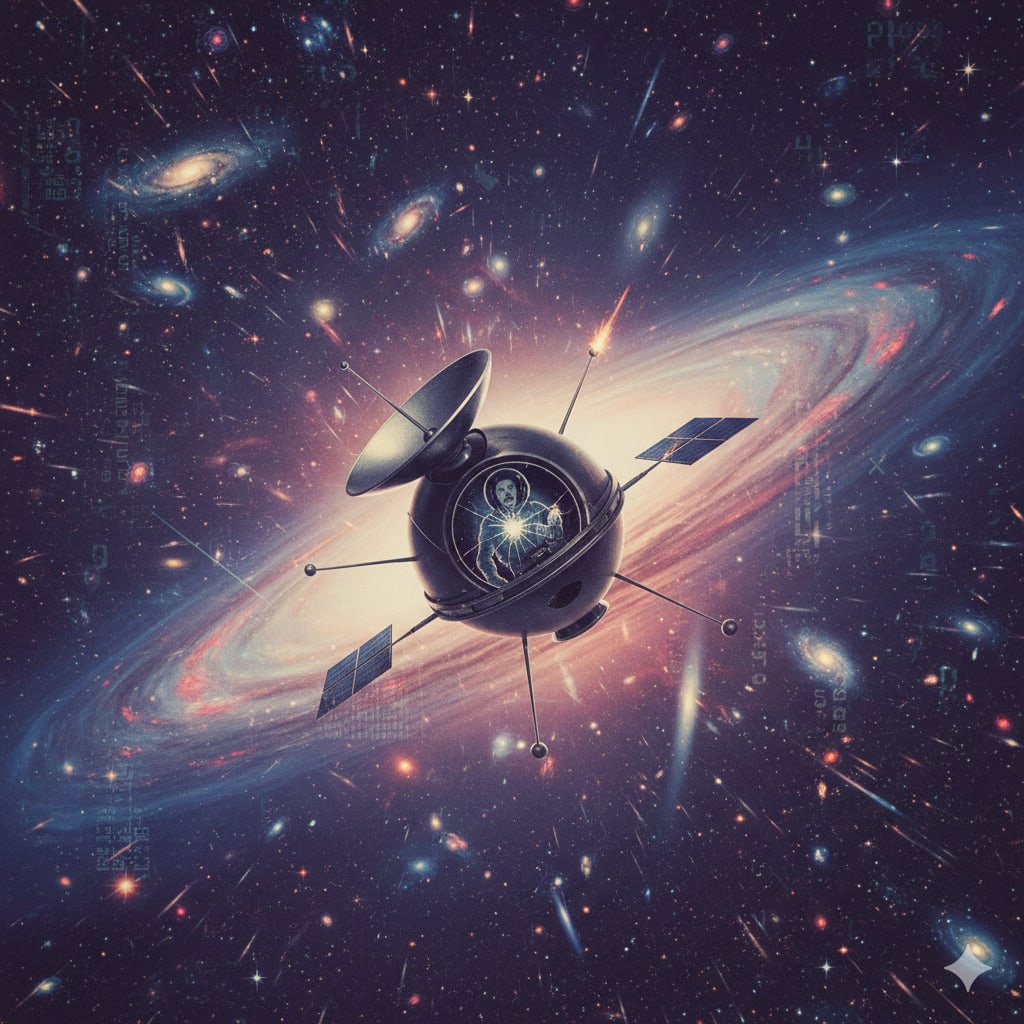
Back in February, the Japanese Aerospace Exploration Agency (JAXA) sent a satellite named Hitomi into space. This observatory was built to do some pretty amazing things, like capture X-rays that usually get blocked by Earth’s atmosphere. The hope was that these X-rays would let researchers see what happens right around black holes and provide critical information on how galaxy clusters form, helping to untangle some of the universe’s biggest questions.
Unfortunately, about a month after its $273 million launch, Hitomi tumbled out of control. It was a perfect storm of human and software errors that ultimately killed it. But before it died, it sent back one final, stunning image.
The Black Hole Whisperer
According to details shared in a Nature paper, that last look was at the Perseus cluster, a group of galaxies about 240 million light-years away, featuring a massive black hole at its center.
Hitomi was able to measure the X-ray activity of the gases 50 times better than ever before. What researchers expected to see was a lot of chaotic movement, hot, dense gases, and general turbulence, all mixed up with a lot of dark matter.
But here’s the surprise: the hot gases were moving much more slowly than anticipated.
This seemingly calm observation is huge. As co-author Brian McNamara of the University of Waterloo noted, this information helps scientists accurately measure the fundamental parameters of cosmology and how structures grow in the universe.
Not only did this peaceful internal state shock them, but it also offered a fresh perspective on how black holes influence the eventual size of a galaxy. McNamara explained that this hot gas is the raw material for the future, the very stuff from which galaxies are formed. The big takeaway? The energy being pumped out of the black hole is being absorbed incredibly efficiently. This, researchers believe, shows that black holes very effectively control the growth rate of galaxies.
Losing the satellite was a major blow, but the little data it managed to collect before going offline has already informed us so much about what we thought we knew about the universe. It truly highlights how much we still have to learn.
The Star Eater’s Jet Stream
We know one thing for sure: black holes eat stars. That brings us to another incredible recent discovery.
Using the European VLBI Network, a system of radio telescopes that essentially act as one massive, Earth-sized observatory, researchers got an unprecedented, close-up look. They saw, for the very first time, a jet of particles shooting out of a supermassive black hole at near-light speed in a constellation 3.9 billion light-years away.
These powerful jets form when a star gets too close to a black hole. The black hole starts to pull the star in, and some of the gas forms a swirling disk around it. As gravitational energy is converted into electromagnetic radiation, some of the star’s matter is then ejected, creating a thin beam of light known as a relativistic jet.
In this instance, researchers measured the jet and found it to be incredibly precise, calling it some of the sharpest measurements ever made by radio telescopes. As astronomer Stephanie Komossa from the Max Planck Institute for Radio Astronomy suggests, the next generation of telescopes will reveal much more about the process of a star being consumed and how these powerful jets form and evolve right next to the black holes themselves.
Ghosts of the Universe
Our fascination with black holes stems from the fact that they are one of the least understood phenomena in space. We know almost nothing concrete about them.
Some common theories suggest their gravitational pull can drastically slow down time (like in the movie Interstellar), and some scientists even speculate that every black hole might contain a universe, meaning we could potentially be inside one right now! We believe their gravity is so strong that not even light can escape. And of course, there was the late Stephen Hawking’s famous suggestion that black holes could be portals to another universe.
They really are the ghosts of the universe, mysterious, powerful, and utterly beyond our current grasp. It makes you wonder: when a black hole eats a star, does it ever… well, you know, poo it out somewhere else?
About the Creator
Areeba Umair
Writing stories that blend fiction and history, exploring the past with a touch of imagination.
Keep reading
More stories from Areeba Umair and writers in FYI and other communities.
The Man Who Lived to 256: Secret to an Impossibly Long Life
If you start researching the oldest people who have ever lived, you’ll find reports from all over the world. There’s the man in Brazil, a father of three, who supposedly reached 131. Then there are stories of a farmer and community elder in Ethiopia who claimed to be 160 years old.
By Areeba Umairabout a month ago in FYI


Comments
There are no comments for this story
Be the first to respond and start the conversation.