
Coffee: The Most Powerful Weapon of the Civil War
For soldiers in the Civil War, coffee was just as important as guns or bullets.
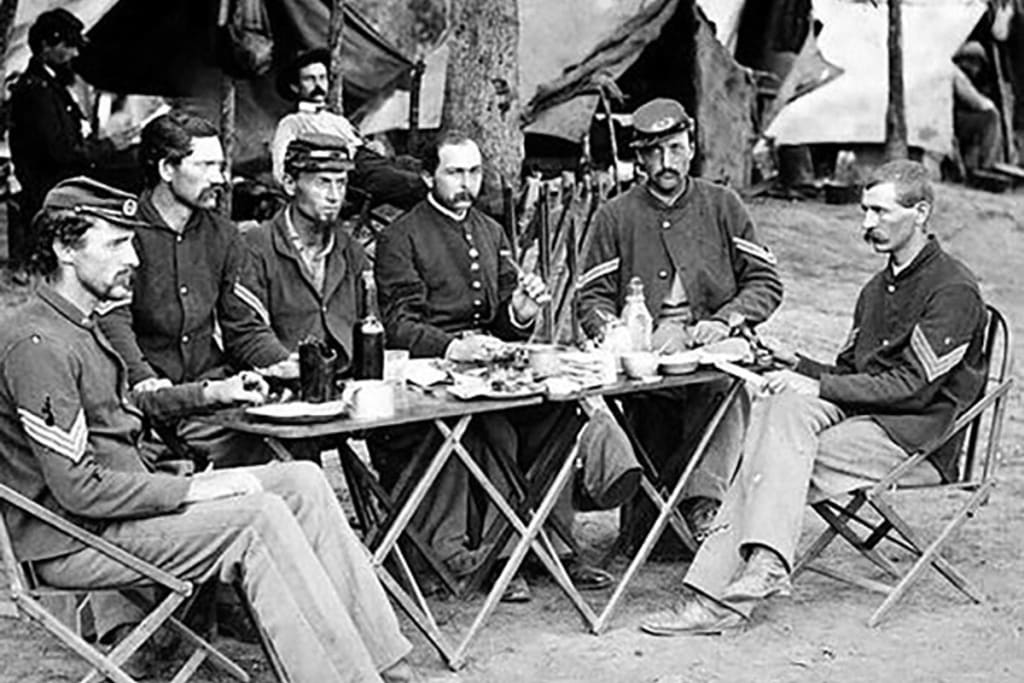
If you drink coffee, think about the last time you really needed a cup. Maybe it was while trying to cure grogginess the morning after a night of partying. Maybe it was halfway through a particularly exhausting shift at work. Maybe it was while frantically cramming the night before a test. Now imagine you are a soldier during the Civil War. Bullets are whizzing past your head. People next to you are screaming in agony after being shot. You frantically reload your burning hot musket and try to fire off as many shots as you can to avoid getting killed. Would you want a cup of coffee?
For the soldiers in 23rd Ohio, the answer would be yes. On September 17th, 1862, while fighting in the battle of Antietam in Sharpsburg, Maryland, the soldiers in the 23rd Ohio indulged in a caffeine fix. They were called to battle early in the morning, before sunrise; without the chance to have breakfast, the soldiers marched on. Throughout the day, they fought in one of the most horrific battles of the American Civil War. This day caused 23,000 casualties, and it is the single bloodiest day in American history. As a Commissary Sergeant, 19-year old William McKinley's job was not to kill; it was the opposite, to give nourishment. He was responsible for feeding each soldier in his unit. As he heard the battle raging on, he knew his troops had to be nearing exhaustion. He knew they needed help. But he did not grab a gun. Instead, he grabbed a pot and began boiling water for coffee. Without orders to do so, he loaded up a wagon lead by mules with coffee and food and gallantly rode to the firing line. Under the threat of fire and with bullets coming within inches of taking his life, he filled each soldier's cup with a piping hot cup of coffee, giving them the strength to continue fighting. This act earned him the nickname "Coffee Bill." After the war, Mckinley would become a Congressmember, Governor of Ohio, and later the 25th president of the United States.
A union soldier was issued 36 pounds of coffee per year and made sure to use every drop of it. Amid all the bloodshed and war, they always found time to brew a piping hot cup of coffee. James Hosmer, a soldier in the 52nd Massachusetts, told of a comrade who filled his canteen, typically used for drinking water, with coffee by mixing beans with water from the hot spring. Union soldiers drank coffee during all three meals. Each time there would be a break from marching, soldiers would hastily gather water, start a fire to make coffee, and hope it would be ready before they had to begin marching again. Fenwick Hedley, a soldier in the 32nd Illinois Infantry, said in his memoirs that "the most disheartening event that could happen to a soldier was to be called into line just as his coffee pot was beginning to bubble." If this was the case, soldiers would often drink their coffee from their open tin cup while on the march. No matter the situation, whether it be on the march or the battlefield, union soldiers always found a way to drink their coffee.
Confederate soldiers' experience with coffee was much different. While the deep-seated hanking for coffee still existed, their coffee supplies were much lower. Coffee in the south was scarce. Confederate soldiers exuberantly jumped at every opportunity to drink some. Soldiers called battlefield truces so Confederate soldiers could trade for coffee with their union counterparts. Soldiers would agree to set down their guns and meet in the middle of the battlefield. Once the trade was made, they would return to their post and begin shooting at each other again. There is even an account of confederate soldiers building a small sailboat to send across the Rappahannock River to union soldiers with tobacco requesting coffee in exchange. If confederate soldiers could not find proper coffee, they would make it out of whatever they had. Coffee beans were substituted with chicory, acorns, sweet potatoes, peanuts- anything they could find. General George Pickett even wrote back to his wife, "well, no Mocha or Java ever tasted half so good as this rye-sweet-potato blend!".
For civil war soldiers, coffee was not just a hot beverage, it was their lifeblood. It did more than energize their bodies, it nourished their souls. With all the loneliness, bloodshed, and heartache civil war soldiers experienced each day, they could always count on coffee to get them through. We will never know for sure what it was in coffee that gave soldiers so much joy. Perhaps it was the caffeine that carried through the many miles they marched. Perhaps it was the warmth that kept them warm when their blanket could not. Perhaps it was the idea that no matter where you are or what you believe, everyone loves a good cup of coffee. It was Ebenezer Gilpin, a soldier in the 3rd Iowa Cavalry who, when complaining about reduced rations, described a soldier's thoughts about coffee best when he said, "and nobody can 'soldier' without coffee."
About the Creator
Keep reading
More stories from writers in FYI and other communities.
Ludacris and Nelly draw backlash over bookings at MAGA-coded music festival
Ludacris and Nelly headlining a mostly right-wing event is good for them. It’s also great for the genre of hip hop. The two rap veterans have showcased their talents on other stages. Why can’t they perform for mostly MAGA folks and grab that bag?
By Skyler Saunders4 days ago in Beat


Comments
There are no comments for this story
Be the first to respond and start the conversation.