
Chinese Science and Technology: From Imitation to World Domination!
China is now one of the superpowers in the field of science and technology. Ignoring all accusations from Western countries, the country of one billion people has had a spectacular transformation.

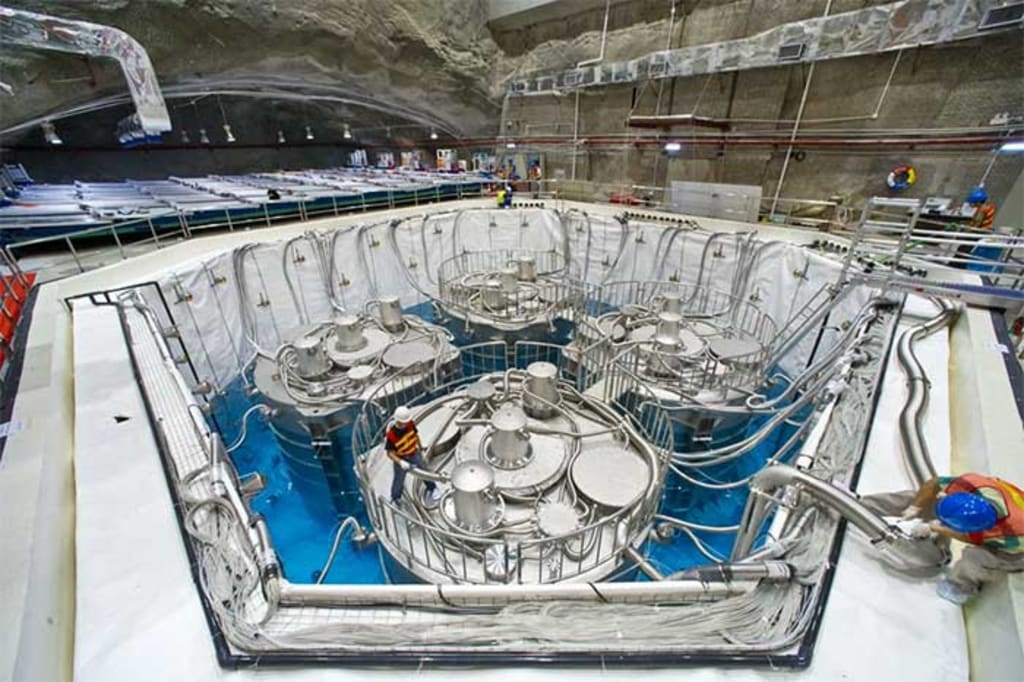
China is now one of the superpowers in the field of science and technology. Ignoring all accusations from Western countries, the country of one billion people has had a spectacular transformation.
China's science and technology has now "transformed" to compete with the world's greatest powers, and the country has even taken a leadership role in certain fields.
This is partly due to the Government's innovation policies, patents in this country are constantly increasing, initially it comes from technology partnerships with Western countries, going to autonomy and finally making a name for itself to dominate the world.
Smart move
In the 1960s, the development of economic relations between China and Western countries began, with agreements focusing on "strategic partnerships" accompanied by the deployment of advanced technologies in China.
This shows that the technology transfer between China in the past decades has paid off.

The nuclear reactor at the Daya Bay power plant in China was built through a technology transfer with the French company Framatome
In France, for example, projects in the railway or nuclear industry with China have led to important contracts, and Western countries have also benefited greatly economically from these diplomatic relations.
Daya Bay is China's first large-scale commercial nuclear power plant. It uses two PWR-900 Pressurized Water Reactors supplied by the French company Framatome.
As the partnership is balanced, China continues to cooperate in technology transfer especially in the aviation industry with Airbus, one of the largest aircraft manufacturers in the world based in France.
Over time, the country of one billion people has absorbed knowledge and accumulated experience. Its science and technology has gradually become less dependent on Western countries, as China has now been able to develop its own technologies.

Shenzhen Special Economic Zone (China).
Along with that, the country also built special economic zones, which contributed greatly to turning China into the "world's factory", it also allowed the country to rotate highly qualified students, creating a very important domestic scientific community.
Typically, Chinese companies specializing in solar panels created by students in the scientific community also research and apply silicon refining methods, allowing better energy storage to solar panels.
According to a report by the Australian Science Policy Institute (ASPI), China leads the global technology competition and is ahead of the United States in 37 out of 44 so-called critical technologies such as radio frequency communications (5G, 6G), hydrogen, electric car batteries, nanomaterials, advanced coatings, supercapacitors, ultrasound...
Experts assess that in the near future, China is fully capable of monopolizing the above 8 technologies.
Rising to become a scientific powerhouse
The strong development of China's science and technology has led to negative consequences for Western companies, namely a decline in the international arena, one of the affected areas being related to wind energy, railways or aviation.
After transferring technology to China, Western companies in these fields have faced strong competition, and even been surpassed by Chinese companies.
In emerging areas, China's growth has been spectacular. The most popular is related to green vehicle technology . In 2022, the country accounted for 60% of the world's electric car market.
China has long been ahead of other countries in patent filings, with the country focusing mainly on the fields of computer science, telecommunications and electronics, according to the World Intellectual Property Office (WIPO).
Today, Huawei (China) has also surpassed Samsung, at one point becoming the largest phone company in the world.
According to WIPO, China is also in the top 11 in the "global innovation index" which includes the political environment, human resource training, infrastructure, and financial markets. Scientific research projects in China are constantly increasing in both quantity and quality.
According to the global ranking of research institutions published by Nature magazine, the Chinese Academy of Sciences (CAS) has surpassed Harvard University (USA), the Max Planck Society and the French National Center for Scientific Research (CNRS).

After a technology transfer partnership with Airbus, China now has its own commercial aircraft models.
CAS has more than 60,000 researchers, twice as many as the CNRS, which has long been considered the world's largest research organization. China's spending on science and technology is close to $5 billion, while the CNRS has a budget of $4.4 billion. In particular, China has invested in building major research infrastructures, including some of the world's most important facilities.
At the individual level, that is, at the researcher level, China has relied on recruiting the best in the world before gradually “producing” a new generation that shines on the international stage.
Today, Chinese researchers are positioning themselves better and better in the world rankings.
The latest list this year shows that there are 304 Chinese researchers in the Top 10,000, 1,982 in the Top 50,000 and 4,178 in the Top 100,000 influential scientists globally. Meanwhile, in France, the number of these scientists is only nearly half of the billion-people country, respectively: 177, 1,214 and 2,856 scientists.

In 2023, China will send its first civilian astronauts to the Tiangong space station built by the country itself
This shows that China's science and technology is now standing out in terms of quality as a scientific powerhouse ahead of most major Western countries.
At the level of higher education and research institutions, international rankings also show a breakthrough from China. For example, 16 Chinese institutions are among the top 25 in terms of scientific influence in the world, according to the Leiden rankings.
All of the above information shows that China has emerged as a country with its own research and innovation capabilities, competing with the world's scientific superpowers, even surpassing them.
About the Creator
Ken Daklak
Telling stories my heart needs to tell <3 life is a journey, not a competition
If you like what you read, feel free to leave a tip,I would love some feedback
https://s.shopee.vn/VwwLTGLe9
Keep reading
More stories from Ken Daklak and writers in FYI and other communities.
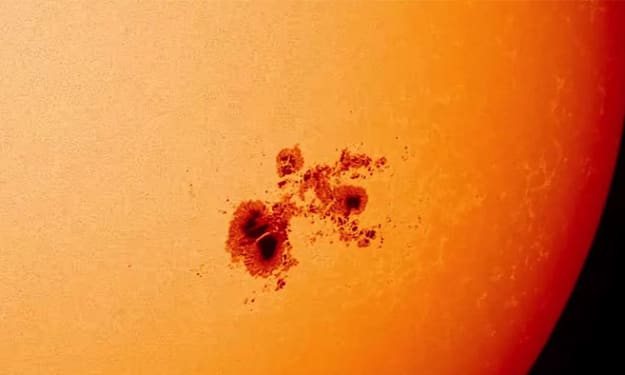
The sun has many unusual sunspots that have shocked and surprised astronomers.
From a distance, the Sun appears calm, shining its radiant light that nourishes all life on Earth. But up close, the Sun is a chaotic battlefield that astrophysicists didn’t expect until about a year ago.
By Ken Daklak2 years ago in FYI
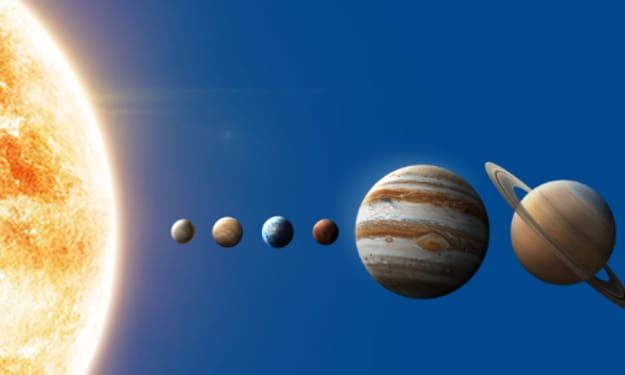
A Planetary Alignment will coincide with Mercury Retrograde
Double phenomena in the heavens Some people say in jest that the planets have aligned in their favor when life works the way they desire. Were you aware that there are seasons when things do line up in the heavens? There will be a planetary alignment AKA a planet parade, on February 28, 2026.
By Cheryl E Preston15 days ago in FYI
When Being “Ugly” Was a Crime: The Forgotten Laws That Targeted Disabled and Disfigured People in America
In modern times, the idea that someone could be arrested simply for being “ugly” sounds shocking and unbelievable. Yet, in the late nineteenth and early twentieth centuries, several cities in the United States enforced laws that effectively criminalized the public presence of people who were visibly disabled, disfigured, or deemed “unsightly.” These controversial rules, commonly known as **“Ugly Laws,”** reveal a troubling chapter in the history of discrimination against disabled individuals.
By Irshad Abbasi 6 days ago in FYI


Comments
There are no comments for this story
Be the first to respond and start the conversation.