
Checksums in the Quran
Patterns prove the Quran was Preserved

In this short article I reason that the few number patterns discovered so far in the Quran serve as a checksum that further adds to the overwhelming evidence that the Quran has not changed since it’s origin. The concept of checksum is explained briefly and then I present multiple examples of known number patterns and explain how they provide evidence of the Quran’s preserved nature in both localized regions and over the entire book.
Introduction:
The concept of a “checksum” is used often in computer science to detect errors. For example, a computer file transferred from one computer to another over the internet can be checked for errors (down to the last bit) to confirm that not a single bit was changed during transfer.
The checksum is computed from the digital contents of the file. You can also compute a checksum on a word or sentence to generate a unique number hash. This number will change if any letters in that sentence change. In this way, one can be sure that the sentence did not change by the act of transferring it from one computer to another.
For more technical reading on checksums please see http://en.wikipedia.org/wiki/Checksum.
Regardless of the technical implementations of checksums, the concept is what matters to this article. Checksums act as a sort of lock that guarantees preservation and integrity of a message.
The Quran:
The Quran was written down by scribes, documented with witnesses who memorized it, and compiled into a book in the years between 609 and 660 CE. The Quran refers to itself as “The Book” and “The Quran”.
Surah al-Baqara is chapter 2 of the Quran and it has 286 verses in total. If you divide 286 by 2, you get verse 143 in the middle of the chapter which states: “Allah has made you a middle nation”. More examples will be given below but notice how any addition or removal of verses in this chapter would have thrown off this hidden checksum.
The chapters, verses, and words of the Quran are all ordered according to divine revelation. Prophet Muhammad, peace be upon him, instructed the scribes to place the verses and chapters in that order even though they may have been revealed in a different order over 23 years.
In the following two verses Allah says that the book’s verses have been perfected:
“Alif, Lam, Ra. This is a Book whose verses are perfected and then presented in detail from one who is Wise and Acquainted.” (Hud 11:1).
“It is He who has sent down to you, [O Muhammad], the Book; in it are verses [that are] precise — they are the foundation of the Book — and others unspecific…” (Al-Imran 2:7)
Actually, the words used here are “uhkimat” and “muhkamaat”. They are derived from “hakam” which means “arbitrator”, “referee” or “judge”. The verb “hakama” could mean “he judged” or “he tied down”.
As well, “muhkam” in the Arabic dictionary carries the meanings of accurate, well-knit, precise, impermeable and tightly sealed. Classical books of interpretation mentioned multiple interpretations for this word (uhkimat). One of the scholars said that the verses have been protected from corruption and they were perfected so you cannot find any crookedness or contradictions. { أُحْكِمَتْ آيَاتُهُ } من الباطل فلم يوجد فيه عوج ولا تناقض.
In short, the Quran speaks of itself and says it is a book that has been locked down and preserved.
Checksums in the Quran:
In this short article we do not go into the debate over ‘numerology’ and accept that there have been some unfounded examples of complex number-miracles in which the authors from certain sects were criticized for bad judgment, fraud, and reading too much into coincidences involving mathematical patterns that can be found universally.
Instead, we give examples that can be easily verified by the reader and that serve the purpose of a checksum. We give examples of local checksums in specific parts of the Quran; and global checksums to show that tampering with the Quran is impossible.
Main Argument for Checksums in the Quran:
Now that we have introduced the concept of checksums and established that the Quran’s verses are in an exact order, we can proceed to the main argument of this article: If anyone were to change a single word in the Quran it would break some of the checksums (not to mention it would be easily detected by memorizers).
Given that many checksums exist and that others are being discovered till today, anyone aiming to corrupt a single verse or even switch the order of two verses would run the risk of being found out since they would break a checksum.
It goes without saying that it is physically impossible to corrupt the Quran because billions of copies exist in Muslims’ homes and mosques all over the world and millions of Muslims have it memorized cover to cover.
Originals are found in museums too. All of this is outside the scope of this article and here we focus only on the checksum examples below as additional evidence that can be used as a post-hoc test for confirming the uncorrupted nature of the Quran.
It is worth noting that a full and complete index of every word in the Quran was not performed until 1945 (Muhammad Fuad Abd Al-Baqi 1364H). A comprehensive online corpus was only created in 2011 (Dr. Kais Dukes, 2011). Thus many of the checksums were discovered much later and can be used as a post-hoc test to confirm that the Quran was unchanged in the 1400 years before.
Examples of Checksums in the Quran:
I start with some simple examples in which a balance of words is required and any corruption on only those words would cause an imbalance.
For example, the words “Angles” and “Devils” both occur 88 times in the Quran. The same is true for “life” and “death” which repeat 145 times. Muslim scholars have found at least 25 such pairs in which the balance is always maintained for things that are often compared and contrasted.
Another example is “man” and “woman” being repeated an equal number of times. This seems to hold for cases where the Quran says one thing is ‘like’ another. Such is the case of Jesus and Adam. They are both created without a father and both appear 25 times in the Quran (see al-Imran 59 for the comparison). These kinds of discoveries act more like a check-digit rather than a checksum.
There are words in which the number of repetitions caries a meaningful figure. For example, “Day” (yawm) is repeated 365 times in singular form, while its plural and dual forms “days” (ayyam and yawmayn) together are repeated 30 times. One might argue that the lunar calendar has fewer than 30days per month and in fact, the word “qamar” (moon) appears 27 times, the moon’s orbital period. The lunar leap year has 355 days and Chapter5 verse 3 contains the word “yawm” twice with the sum of the abjad values between those two being 355. (Note: The abjad values were created before Islam and have been used in poetry and in other Semitic languages as well).
Consequently, the pattern continues with the word “month” (shahr) being repeated 12 times (see Attawbah:36). The word “rasul” (messenger) is repeated 513 times and this is equivalent to the number of prophets’ names mentioned in the Quran.
Moving on to a different kind of checksum: We have all noticed that the Quran’s chapters start long and get shorter but the trend is not perfectly linear. As well, the number of verses in each surah does not seem to follow any pattern. The shortest surah is not the last one and the distribution of even and odd has no apparent pattern either. In the following chart, the argument is made that the number of chapters and their number of verses can be used to calculate a checksum thus proving that the order of Surahs and their verse count has never changed. This would be a global checksum on the entire Quran. The following chart summarizes the findings:
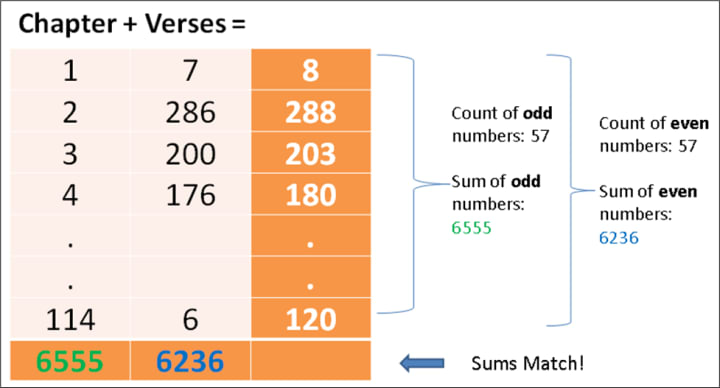
Here we have added the chapter number to the count of verses and we find our first pattern: there is an even split of even and odd numbers (57:57). Next, we create a sum for the odd and even values and surprisingly those match up perfectly with the running totals of the chapter numbers and verse counts (6555 & 6236). This does not happen by chance because it is fairly difficult to get such an array of numbers to follow this pattern. It is not impossible to get it right but you need intentional planning and trial and error in spreadsheet software. Any slight change breaks the combination (Shabir Ally, 2014).
The checksum above was not discovered until ~2013 and it guarantees three things:
1-The number of surah’s has not been altered.
2-The order of surahs has been maintained.
3-The number of verses in each surah is unaltered.
It does not however, guarantee the order of verses within a chapter. Other kinds of checksums will be required to do this. (Not to mention the coherence of the meanings of those verses when read in the right order.)
The prophet Muhammad lived for 63 years. The word نَتَوَفَّيَنَّكَ appears in the Quran only three times: in Chapter 10, Chapter 13, and Chapter 40. The sum of these chapter numbers is 10 + 13 + 40 = 63. This is a checksum that guarantees the order of the chapters to be preserved.
Another example is that Surah TaHa in verse 114, Allah mentions to the prophet not to rush to memorize the Quran until its revelation is completed. Notice how The Quran, once completed, has 114 chapters. This verse was revealed more than 12 years before the Quran was completed making it even more profound.
The day of “Na7r” is the 10th day of the month of Zul-Hijja in the Islamic Calendar; and interestingly, the word “wann7aar” appears in Surah 108 which has 10 words exactly (since it is a short chapter). If you count the dots on the words up to that word, they are also 10. Even more, all three verses in this chapter end with the letter “R” which is the 10th letter in the arabic alphabet. Each Noble Verse is made of 10 unique letters. You might say that the day of Na7r is in the 12th month you could be shocked to learn that is second verse, which directly speaks about Na7r is written with exactly 12 letters.

Surah 57, The Iron, has many such number miracles. The word Iron is mentioned in the 26th verse if we include the Basmallah. This is the atomic number of Iron. Another added point is the fact that the name “Allah” in this verse is the 26th occurrence of the word ‘Allah’ in this Surah (not including the basmallah). The atomic number of Iron is 26 and is the number of protons but one might ask, what about the atomic mass? Iron’s Atomic Mass is 56 amu for the most abundant isotope (with 30 neutrons). There are 30 verses including the basmallah in Surah 57.
Although unrelated to the checksum concept, it is worth mentioning that the abjad value of the word “hadeed” is 26 and for the word “al-hadeed” it is 57.
Another example of a local checksum: The name “arrahman” appears in the first verse of chapter 55. This chapter contains 78 verses. The last chapter to mention this name is chapter 78. There are 18 chapters in which this name is mentioned and 96 in which it is not: 96–18 = 78 again! Chapter 19 has the largest count of “arrahman” (17 times). There are 17 verses before the name is mentioned in verse 18 and the last verse to mention “arrahman” is verse 96. Once again 96–18 = 78. (Khaled Al-Bakkar. 2014).
The story of the seven sleepers of the cave mentioned in Surah 18 (al-kahf) at verse 9 has a local checksum related to the number of men in the cave: the term “as-haba alkahfi” is preceded by 7 unique letters in this verse. If we count starting from this term and until the end of the verse, there are 7 words. This sentence is the 7th sentence on this page (p294). The name “Allah” is repeated 7 times from the beginning of the Surah till the end of this story. The entire story of the sleepers of the cave in chapter 18 is made of 18 verses too. If you continue the story, Allah mentions that they “slept 300 plus 9 years” in verse 25. The last page to mention the sleepers of the cave has 309 pages from it until the end of the Quran. Scholars have mentioned that 300 solar-years is equivalent to 309 lunar-years.
Chapter 22 (al-hajj) has the Quran’s last mention of “al-hajj” in verse 27 and this verse has 14 words. 14X27= 378 and this is the same as the “running sum” of 1 to 27. (For more on al-hajj and 378 see Noon Center publication).
In Surah 2, Al-Baqara, Allah mentions that he has made us the middle-nation. This happens to be right in the center in verse 143 out of 286 verses in this surah.
The word for thunder “ar-ra’d” appears twice in the Quran. In both cases, the verses containing that word have 19 words and 83 letters each even though the words in the verses are different. The first time it appears is in chapter 13, verse 13 and that also happens to fall in Juz’ 13!
Surah 27, an-naml, has 93 verses. These numbers match the number of times the letters “Ta” and “Seen” appear in the surah, respectively. You might ask, why choose to count these two letters? The first verse begins with these two letters as what is known commonly as the “disconnected letters”.

Although it is not clear if all the disconnected letters in other chapters of the Quran have this same purpose, at least in this surah, they act as a checksum because any alteration in the words containing those two letters would throw off the counts for this Surah. Finally, adding 27+93 gives 120. This is the abjad value for this Surah’s name (naml). (Noon Center publication).
The word “maida” (the table) appeared twice in chapter 5 separated by 33 words. This is in reference to the table of food sent down to Jesus and his followers. Notice that Jesus’s age is said to be 33.
The pilgrimage (Hajj) was made compulsory for Muslims approximately 22 years after Prophet Muhammad began preaching. Interestingly, the chapter titled ‘Al-Hajj’ is Chapter 22 of the Qur’an.
chapter 97 talks about the night of Decree. Muslims believe that this night is on the 27th night of the Month of Ramadan ad interestingly, the 27th word in that chapter is ‘it’. The 27th word of sura “The Decree” is a feminine pronoun (هى = Hiya = it) which refers to The Night of Decree: “Peaceful it is until the break of dawn.” (97:5). Further, “Laylatul Qadr” (ليلة القدر = the Night of Decree) is a 9-letter expression that is mentioned 3 times in this chapter (thus, 3 × 9 = 27). It is not mentioned elsewhere in the Quran. Ramadan in the islamic Calendar is also the 9th month of the year.
Conclusion:
Many of the checksums discovered already can be used to provide further evidence that the Quran was unchanged. Some of these checksums guarantee local regions of the Quran while others are of a more macro-level over the entire book.
Classical books of interpretation have always found that every word of the Quran was put there for a reason. The checksum gives this observation a whole new meaning. If anyone were to change a single letter in the Quran it would break some of the checksums and expose their fraud. Further research is needed to find more such checksums as we have only scratched the surface in this short article.
References:
-Dukes, Kais. “The Quranic Arabic Corpus.” School of Computing, University of Leeds, UK (2011). http://corpus.quran.com/
About the Creator
Unclehood
Have a nephew or niece? Transform yourself from a beginner to an Awesome Uncle with my book:


Comments (1)
(Al-Imran 2:7) was supposed to say (Al-Imran 3:7)