
Beneath the Waves: The Undersea Cable Revolution
Unraveling the Global Network Connecting Continents Through Fiber Optic Marvels

Did you know that a staggering 95% of global communications traverse through a network of undersea cables spanning across oceans, with only a mere 5% transmitted via satellite? At this very moment, as you engage with this video, an immense volume of data is traversing thousands of kilometers through these undersea cables. But how does this feat of rapid communication across vast distances occur? Let's delve into the mechanics behind these remarkable man-made marvels.
Before we explore the intricacies of undersea cable technology, let's rewind and grasp a concise history of their evolution over time. Nearly two centuries ago, a significant milestone was marked when two battleships met in the middle of the Atlantic Ocean, connecting the European and North American continents via telegraph. This pioneering endeavor, accomplished with a 4,000 km long cable, allowed Queen Victoria of the UK to send a congratulatory message to US President James Buchanan—a message that took approximately 17 hours to deliver via Morse code. Despite encountering technical setbacks and operational challenges, these early undersea cables sparked a global communications revolution.
Fast forward to the end of the 19th century, where advancements led to the introduction of new cables capable of transmitting over 40 words per minute. The momentum continued to build, culminating in 1956 with the laying of the first underwater telephone cable, TAT-1, followed by the TAT-8 in 1988, which achieved data transmission speeds exceeding 280 megabits per second using fiber optics.
In the realm of modern undersea cable technology, the MARIA cable stands as a testament to progress, stretching across the Atlantic Ocean from Spain to the US with an astounding transmission speed of over 160 terabits per second—a significant leap from conventional internet connections. Today, over 380 undersea cables, totaling approximately 1.2 million kilometers in length, crisscross the ocean floor, forming the backbone of global communication infrastructure.
But how do fiber optic cables, the backbone of undersea communication, function beneath the sea? These submarine communication cables, lying at the ocean floor's bottom, interconnect countries worldwide, facilitating the rapid transfer of vast amounts of data. The process begins by converting data into light signals, which are then transmitted through fiber optic cables. Upon reaching their destination, the light signals are reconverted into their original data form.
A prime example of this technology is the MARIA project, a collaborative effort by Facebook, Microsoft, and Telxius, spanning the Atlantic Ocean between the United States and Europe. Completed in 2017, the MARIA cable system employs state-of-the-art fiber optic technology to achieve unprecedented data transmission speeds, enhancing global internet infrastructure and connectivity.
Undersea cables serve as a critical component of the global information infrastructure, utilized by governments, enterprises, and individuals for internet connectivity, data communications, and telephony. Contrary to popular belief, Wi-Fi networks and mobile data plans also rely on these cables to transmit data globally, underscoring their indispensable role in modern communication.
The process of laying these cables, spanning thousands of kilometers, is a monumental undertaking fraught with challenges. Planning begins with route plotting, ensuring avoidance of hazardous areas such as volcanic regions and underwater elevations. Specialized cable-laying vessels deploy equipment to dig trenches and lay cables, navigating obstacles like undersea mountains and coral reefs. Despite the complexity and costliness of the process, undersea cables offer unparalleled data transfer capabilities at a fraction of the cost compared to satellite alternatives.
The significance of undersea cables in the digital age cannot be overstated. As the world transitions into a new era of digitalization, the demand for fiber optic submarine cables continues to rise. These cables serve as lifelines, connecting continents and facilitating the exchange of data across oceans, fostering global communication and collaboration. In an ever-evolving technological landscape, undersea cables remain steadfast pillars, ensuring the world stays connected.
About the Creator
Briona Whitehead
Hi, I'm Briona Whitehead, a storyteller who specializes in crafting gripping tales of suspense and mystery. Get ready for an unforgettable adventure that will leave you captivated from start to finish.
Keep reading
More stories from Briona Whitehead and writers in FYI and other communities.
Unveiling the Culinary Deception: A Journey Through the World of Food Fraud
Dive into the Intricate World of Food Fraud: From Maple Syrup to Wagyu Beef Prepare to embark on a journey through the intricate world of food fraud, where the quest for authenticity meets the allure of deceit. From the verdant maple forests of Canada to the sun-kissed fields of saffron in Kashmir, the battle between genuine and counterfeit foods rages on, captivating consumers and challenging their palates. Join us as we unravel the mysteries behind some of the most counterfeited delicacies and explore the ingenious methods employed by fraudsters to deceive even the most discerning of taste buds.
By Briona Whitehead2 years ago in FYI
A Failed Artist, A Disillusioned Poet, An Underpaid Game Show Host
I took my son and niece to Gori, a small town in Georgia where Joseph Stalin was born. They talked me into visiting the Stalin's Museum, the largest in the post-Soviet space. I had resisted going there because I just can't stand the monster and know enough about him, or so I thought.
By Lana V Lynx17 days ago in FYI
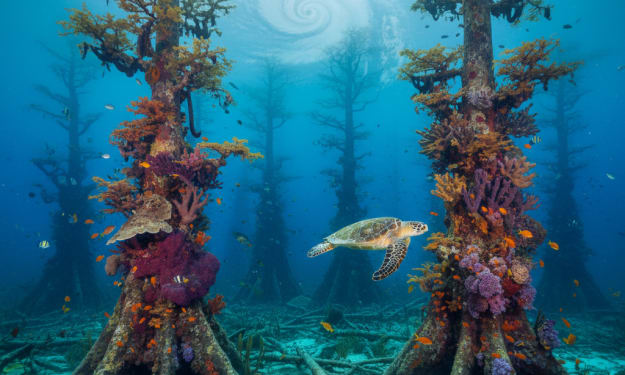
Alabama’s Sunken Secret: The 60,000-Year-Old Forest Hidden Under the Gulf
Imagine diving sixty feet below the surface of the Gulf of Mexico, about fifteen miles off the coast of Alabama. You aren't looking for a shipwreck or buried pirate gold. Instead, as the bubbles clear, you see something much more haunting: the Alabama underwater forest. This is a prehistoric world of giant cypress trees, still rooted in the mud where they grew tens of thousands of years before the Great Pyramids were even built.
By Areeba Umair7 days ago in FYI



Comments
There are no comments for this story
Be the first to respond and start the conversation.