

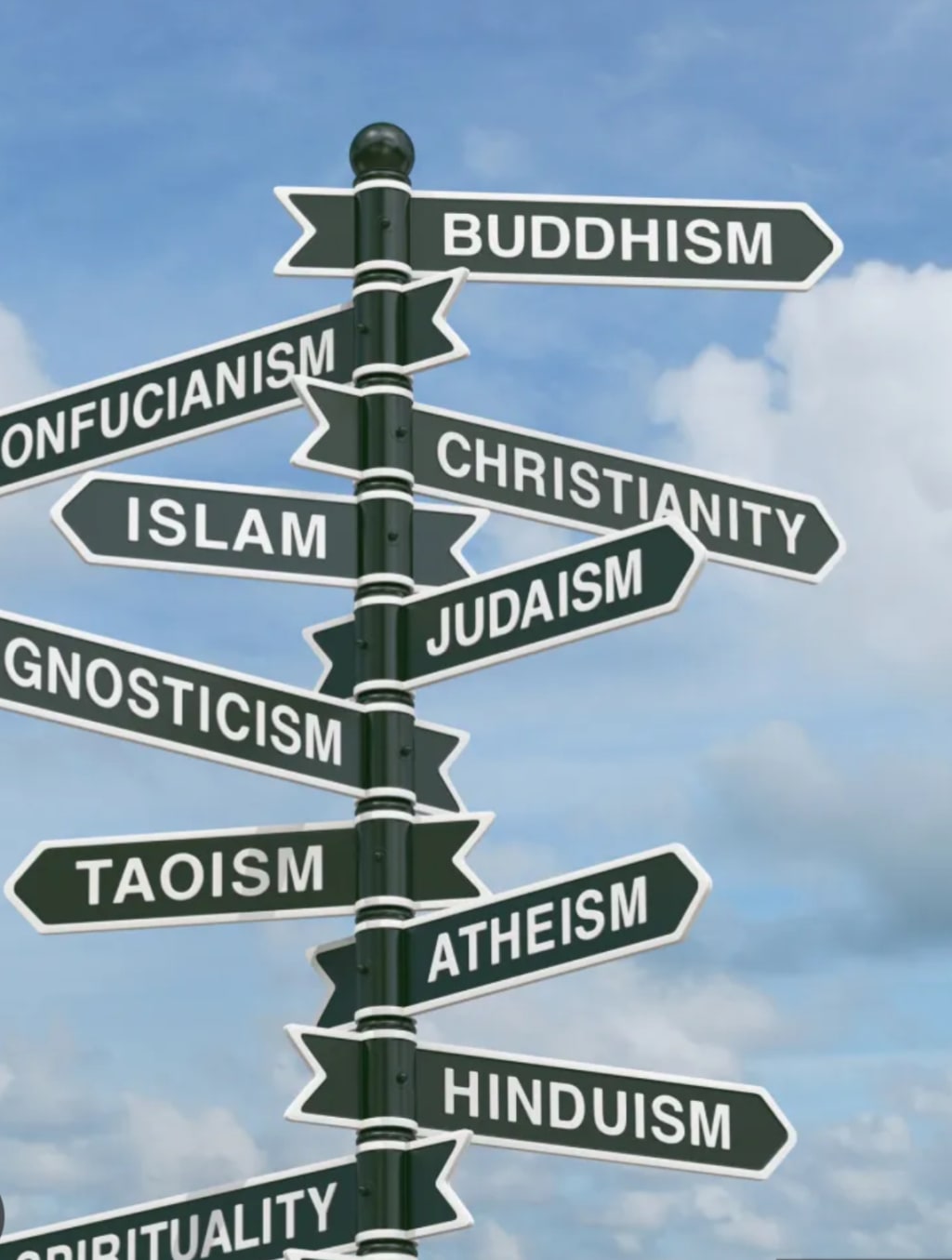
Agnosticism is a philosophical view that the existence of God or the supernatural is either unknowable or not knowable. It's a stance that neither affirms nor denies the existence of such entities, holding that they may be beyond human comprehension or knowledge. Agnostics may also exhibit skepticism towards religious claims and beliefs.
The concept of a "higher power" encompasses a wide range of beliefs, from traditional deities to more abstract ideas like the universe, nature, or the collective consciousness. For some, it's a supernatural entity with influence over human affairs, while for others, it's a force of nature or a spiritual principle.
Religion – the belief in supernatural beings, including gods and ghosts, angels and demons, souls and spirits – can be found throughout history and in every culture. Evidence for beliefs in an afterlife goes back at least 50,000 to 100,000 years. Every known human culture has creation myths, with the possible exception of the Amazonian Pirahã people, who also lack number words, colour words and social hierarchy.
It's hard to get exact data about the number of believers today, but some polls suggest that up to 84% of the world’s population are members of religious groups or claim that religion is important in their lives. We live in a time of unprecedented access to scientific knowledge, which some see as being at odds with religious belief. So why is religion so pervasive and persistent?
Psychologists, philosophers, anthropologists and even neuroscientists have suggested explanations for our natural predisposition to believe, and for the powerful role religion seems to play in our emotional and social lives.
Before delving into modern theories and research, we need to ask how religion came about, what role it fulfilled for our ancestors and what part it may have played in the birth of large, modern societies.
Today, religion and power are still connected. Recent research claims that reminders of God can increase obedience. Even in societies that tried to suppress faith, things were set up in its place - like the cult of a leader or of the state,( like the Soviet Union, or any communist state).The less stable politically and economically a country, the more likely people are to seek comfort in faith. Religious groups are often able to give people who are feeling marginalised the support that the state might not provide, such as food or a support network. So environmental and social factors both help develop and reinforce religious belief. As does the way we relate to the world and others.
In every culture gods are essentially persons, even when they take other forms or no physical form at all.
Many psychologists now think that the belief in gods is an extension of our recognition, as social animals, of the existence of others, and of our tendency to see the world in human terms.
We project human thoughts and feelings onto other animals and objects, and even natural forces, and this tendency is a fundamental building block of religion. It's an old idea, going back to the Greek philosopher Xenophanes, who is quoted as arguing that if animals could paint, they would depict gods in animal shape.
So religious belief may well be founded on our human culture and thought patterns. Some scientists, however, have gone one step further and scanned our brains to look for the legendary "God spot".
The brain is often referred to as a meaning-making machine. As we constantly look for patterns, structures and cause-effect relationships, religion might provide a variety of meaning-making strategies – in particular rituals.
While neuroscience, anthropology or even philosophy can't definitively answer the question "Does God exist?", these disciplines all give insights into how we respond to our deepest human needs. We may not be 'wired' to believe in God or a higher power, but we are social animals who have an evolutionary need to feel connected to the world and to others. Perhaps religions are simply channels for such meaningful connections.
Typically associated with deities in religious contexts, alternative interpretations of higher powers also exist. Higher powers might manifest as cosmic forces, universal energies or abstract principles guiding existence. Individuals may connect with these powers through spirituality, philosophy or personal beliefs, finding solace and purpose in their presence as one would in God and religion.
Higher powers represent forces beyond human control or comprehension that influence the fabric of existence, from nature and the cosmos to human consciousness and collective wisdom.
1. Nature: Revered for its beauty, resilience and transformative power, nature symbolizes the interconnectedness of all life.
2. Karma: The cosmic law of cause and effect, karma governs the consequences of one’s actions, shaping destiny and moral accountability.
3. Universal Energy: An omnipresent force flowing through the cosmos, universal energy sustains life and facilitates spiritual awakening.
4. Collective Consciousness: The shared pool of human thoughts, emotions and experiences, belief in the collective consciousness fosters empathy, solidarity and cultural evolution.
5. Inner Wisdom: Intuitive guidance and self-awareness enable individuals to tap into their inner resources, facilitating personal growth and empowerment.
6. Higher Self: The transcendent aspect of human consciousness, the higher self embodies spiritual enlightenment and divine connection.
7. Truth and Wisdom: Timeless principles and universal truths illuminate the path to enlightenment, guiding seekers Nature: Revered for its beauty, resilience and transformative power, nature symbolizes the interconnectedness of all life.
Transcending traditional monotheistic notions, higher powers encompass a rich tapestry of beliefs and interpretations. Whether found in nature, cosmic energies or the depths of human consciousness, these powers offer meaning, guidance and inspiration to people who are seeking truth and purpose but who are not necessarily part of a traditional religious group.
What do you mean by God? God is love? God of the Bible? Spinosa’s God? Einstein’s? Or do you have a personal God?
Science follows facts. Not find facts to prove an already believed idea. The facts lead to a conclusion. And those facts must be repeatable by other people, often those people try to disprove those facts. By doing this, never has the answer been “God”. When Newton gave up trying to explain gravity, he threw his hands up and said God did it. Century later, someone else came up with the answer. It wasn’t God.
Everything that has been blamed on God that we did find the answer, has never been God. Tides, babies, sunrise, illness, etc all were blamed on God. Now we know what the physical reason was. God continues to shrink, getting smaller every year.
Of course some change meanings or terms. “Well, God doesn’t really pull the sun across the sky with a chariot. But God did make the planets and solar system to look like that, 5,000 years ago.” “ Well, it wasn’t 5,000 years ago, he just made everything look old”. “ Ok, ok, so it was around 13 billion years ago, but God still did it”. “ Evolution is not real”. “ Well, ok, maybe micro evolution is”. “ Fossils are of the Devil! Only there to trick us!” “ well, even the Pope says evolution is real, so it must be. But God did it!”
So no, no scientific evidence for a god, any god. The proper answer to a question we do not know the answer to is “I/we do not know yet. But we have the best minds working on it”. Never is the answer “ Some invisible, magic, spirit in the sky, wished it all into being.” That is not science.
Atheism is the absence of belief in the existence of gods or deities. It's not the same as a belief in the non-existence of gods, nor is it a religious belief system itself. Atheism can be understood as a rejection of the assertion that gods exist, rather than a positive claim about their non-existence.

Sometimes I believe I’m an Athiest, and at other times I’m an agnostic. Either way, I don’t go to church on Sunday.
But I do think it’s a beautiful world we live in, with wonderful life forms inhabitating it, and it’s a fantastic universe our planet is a part of, with life forms living on other planets in it, and if they haven’t visited us in the past, they might in the future, or maybe we will visit them,as our technology evolves. Keep an open mind.
About the Creator
Guy lynn
born and raised in Southern Rhodesia, a British colony in Southern CentralAfrica.I lived in South Africa during the 1970’s, on the south coast,Natal .Emigrated to the U.S.A. In 1980, specifically The San Francisco Bay Area, California.



Comments
There are no comments for this story
Be the first to respond and start the conversation.