
AI and the Dark Side of Technology: The Opening of another Pandora's Box?
Caution and Scepticism are Crucial for Policymakers amid the Boom of AI.
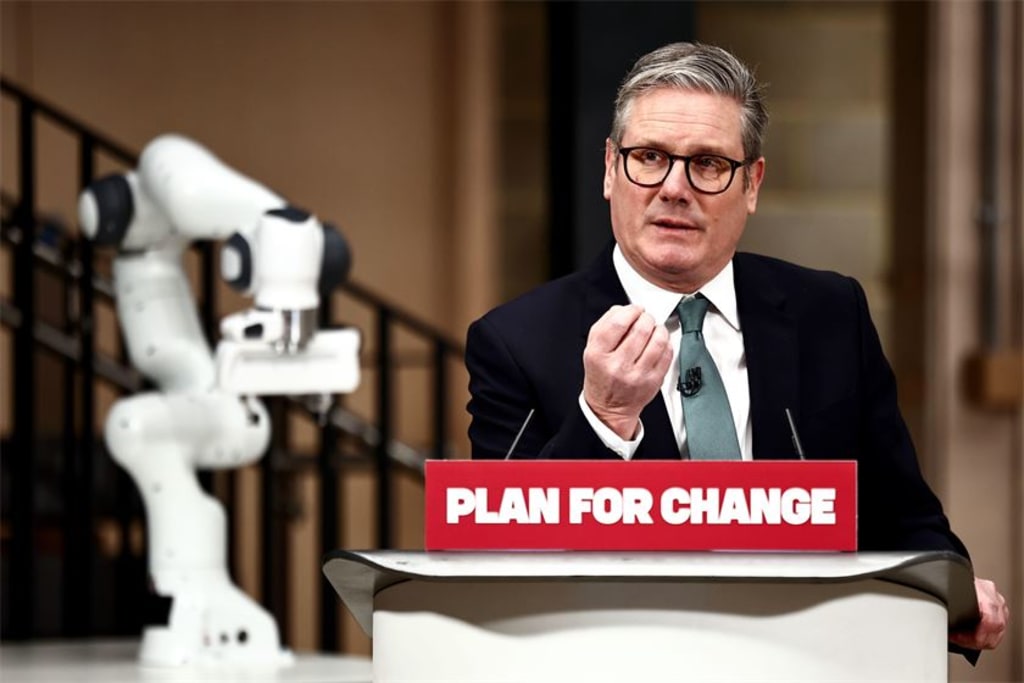
"It’s the present. It’s already here. In Britain. Changing lives. A chance - to turbocharge growth… Create the companies of the future… And radically improve our public services. I mean – we’ve known for a long time that it’s pretty impressive." This statement from the recent Artificial Intelligence (AI) Opportunities Action Plan, on 13th January, demonstrates the Prime Minister's enthusiastic support in the use of AI; rhetorically and symbolically, no doubt, the UK Government's seal of approval to its eventual undertaking by the wider economy and to be dispersed throughout British society. A seemingly strong edict when placed in this frame of context.
To wholly understand the driving force behind the words of the PM - so clearly visceral - one needs to consider both the wider situation and optics of two key underlying factors: where we are and what we stand to gain. The former, to be put in stark terms, relates to the well-known truth that the UK economy has been, and continues to be, in real trouble. At present, consistent growth appears to be a difficult hurdle to achieve, meanwhile the material reality for most would point to the continual ebbing away of the welfare state, a weakened armed forces and defence capability, and the ever-growing list of high-street businesses shutting their doors. It is the talk of the country, let alone the town, thus far. It need not be elaborated in detail by the likes of myself that, as a country, things are not looking or feeling too great.
On the subject of what we stand to gain, however, there is much justification to getting behind the Starmer Administration and its move towards the development and harnessing of AI. As illustrated in the aforementioned 13th January statement, AI is responsible for groundbreaking interventions in medicine and has contributed towards the nourishment in the health of an otherwise ageing and feeble society. This can further alleviate not only the insurmountable pressure placed upon a diminished NHS, but can also serve to reduce human inefficacy within highly intense decision-making environments. Moreover, AI can be the antidote to an impotent economy that has been yearning for a way to bounce back: from micro-level enrichment of innovation and productivity in workplace structures to a macro-level proliferation in growth aimed at marking its presence throughout each corner of the UK. Indeed, "AI adoption could grow the UK economy by an additional £400 billion by 2030... and unlock new growth opportunities across the whole economy, including for [small and medium enterprises]."

Notwithstanding their obstinance to avoid plans that would amount to breaking a manifesto promise, it appears that the Labour Administration are - if AI constituted a set of chips in a poker game - "going all in". On the face of it, AI forms an important facet of the solution to the challenge of how one finds a way out of this national, regional and local predicament. It has potential to simultaneously boost national GDP as well as addressing the UK's dismal record surrounding regional inequality (the continuous economic policies of government after government, red or blue, seemingly construed growth not as a national endeavour, but a South-East, "Loxbridge", one). What is more, devolution could be a great mechanism to implement such a task: grant further powers to cascade down the hierarchical chain of national, sub-national and regional authorities to ultimately ensure AI-based models are appropriately administered in local economies.
Despite the overwhelming optimism of AI, policymakers cannot afford to move too hastily or absent-minded without considering a few central caveats, namely that of safety, competence and legal authority. These, respectively, need to undergird its practice-based use. The rhetorical "go-to" within opponent circles can largely be defined as existential in nature: something along the lines of a declaration that AI will not only make most, if not all, occupations involving risk or intellect obsolete for a favourable, more superior, option, but that it has potential to render its own technological coup d'état into the ranks of power. This dystopian viewpoint considers the potential for humans to become subservient to the rule of "technodome" as an infallible thinking machine. This article does not contend with this train of thought. Of course, the notion of feeling uncertain as to one's job security in light of an increasingly digitised world should be treated with the greatest concern. However, what comes to the fore in my mind - when thinking critically about the spectre of AI - would be more on the lines of another public tragedy, comparable to that of the Post Office Scandal.

The dawn of the 21st century brought with it one of the worst miscarriages of justice to inflict the UK hitherto. The prosecution of some 900+ individuals in charge of Post Office branches throughout the UK, arraigned on charges such as theft and false accounting, stemmed from a series of fundamental flaws experienced in the administrative IT system, Horizon - used by the Post Office but designed and manufactured by one of Japan's powerhouses in technology, Fujitsu.
The phenomenon that saw so many law-abiding and community-serving individuals become de jure criminals in such a short space of time constituted a blatant juxtaposition that raised alarm bells for the few but did not appear to disturb those involved in the prosecuting or, in fact, those at the helm of the ship who had the ability to change course. Before the validity of the technology was even placed into question, they remained indelibly convinced of its algorithmic conclusion - that all those involved were defrauding, or stealing from, the Post Office in some way, shape or form. It was not until the victims of such a scandal had formed a collective alliance to fight against what seemed to be an impossible tide that the truth began to protrude beneath the surface. With extreme gratitude for the emergence of ITV's Mr Bates vs The Post Office, this ignominious affair has now tapped into wider public sentiment to expose the wrongdoings and emphasise the need to be more risk-averse, with the state forced to acknowledge the grotesque actions of the Post Office and thus seeking to make amends.
It must be expressed, however obvious it may be, that the Horizon system is not the same as AI, with the latter being far more sophisticated. However, with sophisticated pioneering comes sophisticated risk. What is to say that something similar cannot happen if reliance on such models becomes too concentrated? We have already seen the potential danger it can pose if used inappropriately; most notably seen in the surge of AI-producing deepfakes, making online content almost indistinguishable and therefore leaving viewers being left unable to discern, at first instance, whether something is real or not. If AI is to be the solution to pull the UK out of its economic hardships, then count me in. But there must be a presumption that such advanced technologies are not infallible. This means that lawmakers and policymakers alike - those who have the ability to enact change - cannot sit back in complacency and do so under the misguided belief that AI models are foolproof. There will likely be flaws and errors during the course of its extended implementation and those in positions of authority must be prepared to encounter them. All in all, if AI is to be the future of the UK, then we must balance the interests of its potential advantages with that of its potential disadvantages.
References
Markson, T., Civil Service World (2025) 'A ‘restless and relentless’ government: Starmer sets out AI action plan': https://www.civilserviceworld.com/professions/article/a-restless-and-relentless-government-starmer-sets-out-ai-plan (Accessed 20 February 2025).
Kleinman, M., Sky News (2024) 'Post Office to set out plans for branch closures and job cuts': https://news.sky.com/story/post-office-to-set-out-plans-for-branch-closures-and-job-cuts-13253218 (Accessed 20 February 2025).
About the Creator
Keep reading
More stories from Brook Moore and writers in FYI and other communities.
A New World Order: The Nail in the Coffin for Restorative Justice?
The dichotomy between the old and new world orders - perhaps most accurately distinguished by way of characterising the former as solidly grounded in liberal ideals and the latter as an aggregate project of revisionism, populism and empirical denialism - have invited swaths of commentary, academic insight and mainstream rhetoric into the temporal challenges that such a transformation engenders. Suffice to say that discussing a topic on a scale as large as this - i.e., from what is new, has changed, or been consigned to the bin labelled "obsolete" - gives rise to a remit unable to be defined in a single article. With that being said, however, the primary concern of this article is to consider the landscape of a project for change in an omnipresent institution: a restorative justice approach in the criminal justice system.
By Brook Moore11 months ago in Criminal
A Failed Artist, A Disillusioned Poet, An Underpaid Game Show Host
I took my son and niece to Gori, a small town in Georgia where Joseph Stalin was born. They talked me into visiting the Stalin's Museum, the largest in the post-Soviet space. I had resisted going there because I just can't stand the monster and know enough about him, or so I thought.
By Lana V Lynx20 days ago in FYI
Is There a Hidden Ocean Inside the Earth, and Are We Running Out of Time?
If you think you understand what’s beneath your feet, science might want a word with you, because recent research suggests our planet may be hiding something massive. And no, this isn’t sci-fi. It’s grounded in real discoveries, strange footage, and unsettling predictions about where humanity is headed.
By Areeba Umaira day ago in FYI




Comments
There are no comments for this story
Be the first to respond and start the conversation.