
7 Parts of a Proper Apology
Merely saying, "I'm sorry" is not a proper apology.


These days, people are apologizing for something they have done to another or for something they have posted on social media about someone. Sometimes politicians and companies have to apologize for a nationwide offense.
What individuals and corporations need to understand is that a proper apology has to include more than making a blanket statement by merely saying, "I'm sorry."
Definitions
Apology is a noun. It is a written or spoken expression of a person's regret, remorse, or sorrow for having insulted, failed, injured, harmed, or wronged another person intentionally or unintentionally.
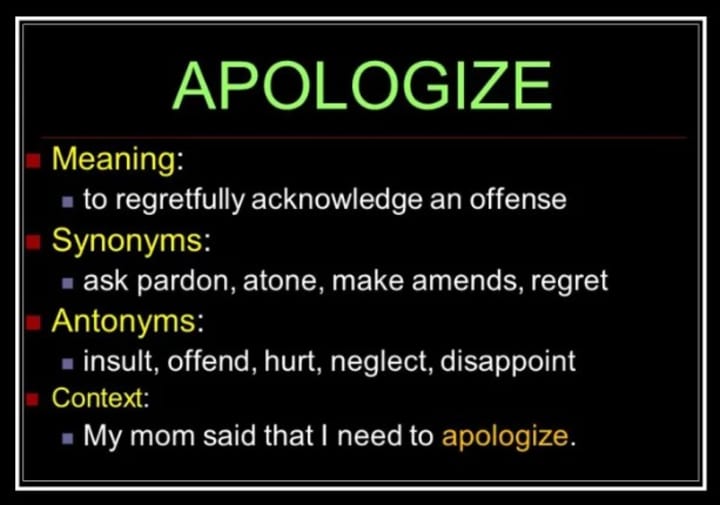
Apologize is a verb. It is what the offending person does to express sorrow and regret to the one offended.
- The offender is the person who has something to apologize for.
- The offended is the person who has been hurt or harmed by someone's words or actions.

Step 1: An Admission
The first step in an apology is the admission that you have done something for which you apologize. Some people begin an apology by saying, "If I have done anything wrong, I apologize." There is no admission in that statement. Both parties must agree on what the offense was. Therefore, the offending party should admit the offense without saying, "If I have done anything wrong."
There is no need to give a long-drawn-out admission. You could say something like, "I apologize for being two hours late while you were babysitting for two young children."
Step 2: An Explanation
It helps the injured person understand when a genuine explanation is offered. The offending person should be courteous enough to offer an explanation and accept responsibility without blaming others. Don't lie and say your boss made you stay late, unless he really did.
A valid explanation provides information on why the offense occurred, whether intentional or by accident.
For example, you could explain to the babysitter that there was a car accident, and you had to detour, and you got lost on your way to her house. If you tell the truth, the babysitter will understand. However, she might not believe you if your tardiness happens regularly.
Step 3: Acknowledgment of Responsibility
This is the step where you take full responsibility for what happened without suggesting that someone else had anything to do with it, including the one who is offended.
Step 4: Promise It Won't Happen Again

Provide details on why this situation won’t happen again. To accept an apology, a person needs to feel like the offense was a rare occurrence, and it isn’t likely to happen again.
You could tell the babysitter that next time you will not head to her house during rush hour when there is a lot of traffic. In fact, you will not hang around the office after work when you know you have to pick up your children.
Step 5: State the Regret
It is only at this step that you should say you are sorry and show remorse. Just say, "I'm sorry" and truly mean it. Your babysitter will sense if you are telling the truth.

Step 6: Ask for Forgiveness
Make sure you ask for forgiveness and be sincere about it. Some experts suggest this step can be added here, combined with Step 5, or added at the end. You ask the person to pardon you for your action concerning the matter.
Step 7: Offer to Make Restitution
It would be a good gesture to offer something for the person's inconvenience. It might be a good suggestion to offer to pay the babysitter extra for arriving two hours late. Ask if there is anything else you can do to make up for inconveniencing her.
About the Creator
Margaret Minnicks
Margaret Minnicks has a bachelor's degree in English. She is an ordained minister with two master's degrees in theology and Christian education. She has been an online writer for over 15 years. Thanks for reading and sending TIPS her way.
Keep reading
More stories from Margaret Minnicks and writers in FYI and other communities.
Post-Brexit Customs Compliance: A 2026 Guide for UK Importers and Exporters
Five years on from Brexit, UK businesses face a customs environment that continues to evolve. While many organisations have successfully adapted to the new normal of customs declarations, tariff classifications, and border controls, 2026 brings fresh developments that demand attention. For importers and exporters navigating this landscape, staying compliant isn't just about avoiding penalties—it's about protecting margins, maintaining supply chain efficiency, and building resilience in an uncertain trading environment.
By Saurav Singh5 days ago in FYI




Comments
There are no comments for this story
Be the first to respond and start the conversation.