
7 Out-of-This-World Animals So Strange They Seem Alien
From a real "flying monkey" to a set of floating buttocks, our own planet has some incredibly weird inhabitants...


Did you know there's predatory caterpillar that wears body-parts as a disguise? How about a sea-snail that builds a raft of bubbles and sails the ocean?
It turns out you don't need to leave Earth to find alien-seeming animals. Let's take a look at:
- The Colugo, a "Flying" Primate: Living in Southeast Asia rather than Oz
- The Bone Collector Caterpillar: Stealing from spiders and wearing corpses
- The Blue Dragon Sea Slug: A floating sea-slug with a stolen weapon
- The Sailing Snails: Mollusks that build bubble rafts and sail the seas
- The Nano Chameleon: Possibly the smallest reptile on Earth...
- The Giant Wood Moth: ... and the heaviest moth
- The Pigbutt Worm: Not what scientists expected to see in the deep ocean
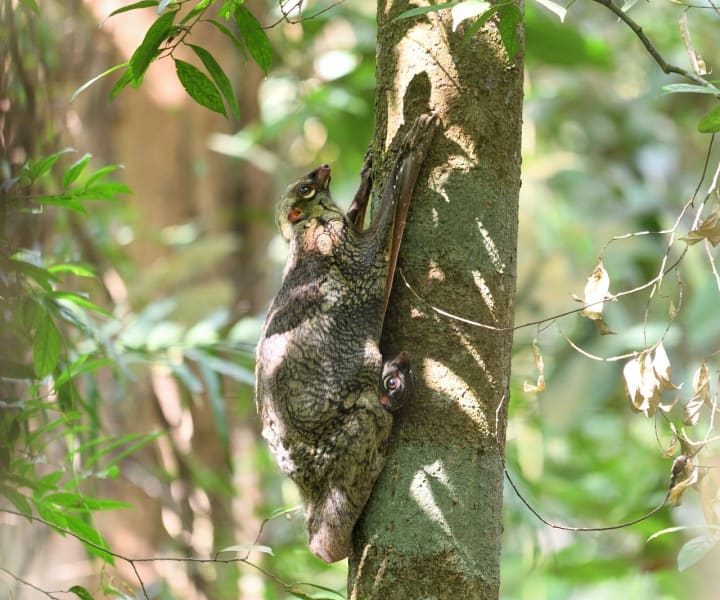
The Colugo, a "Flying" Primate
Resembling a mixture of lemur and bat, colugos are the closest thing we have to a real-life flying monkey.
Closely related to primates, they possess a massive "patagium" or membrane of skin stretched between their limbs like a natural wingsuit. It doesn't allow them to truly fly, but they can easily glide between trees and have been recorded traveling 150m in a single flight - even making 180 degree turns on the wing.
As if the colugo wasn't already enough of a chimera, the creature has a multichambered stomach like a cow and an extended intestine - all to help it break down a fiber-heavy diet of leaves, flowers and fruit.

The Bone Collector Caterpillar
Have you ever read "The Very Hungry Caterpillar" by Eric Carle? There's a very hungry caterpillar in Hawaiʻi as well, but this one is predatory, lives on spiderwebs and wears the body-parts of victims as a disguise!
The bone collector is one of the extremely rare carnivorous caterpillars. Rather than hunting, is scavenges recently dead (or weakened) insects from the webs of spiders - which would doubtless view the caterpillar as a meal even if they weren't being robbed by them.
That's where the "bone collector" part comes in. These caterpillars spin a portable silken sack to hide in, then attach bits of dead insect and spider to complete the ensemble.

The Blue Dragon Sea Slug
If you were an inch-long soft-bodied sea slug, would you want to take a bite out of a Portuguese man o’ war?
This sea slug gets called the blue dragon thanks to a truly alien appearance - a slug-like body with several feathery "wings" on either side, all in shades of electric blue. The slug floats upside down at the surface of the ocean, carried on the currents since it's not much of a swimmer.
The blue dragon seems to be immune to man o' war stings, allowing it to nibble on them without repercussions. Not only does Glaucus atlanticus feast on their tentacles, the slug steals man-o-war nematocysts (stinging cells) and concentrates the stolen weaponry in its wings. When disturbed, the concentrated venom can be used to create a sting around three times more powerful than that of the unwilling donor!

The Sailing Snails
Most people expect snails to crawl, but those in the Janthina genus build bubble rafts and float just beneath the ocean surface!
The snails build their rafts by scooping parcels of air from the surface with their foot - the snail traps the resulting bubble in mucus and adds it to the growing raft. With enough trapped bubbles, the snail can float upside down just beneath the surface - but if the raft is destroyed, the mollusk sinks to a watery grave.
Like the blue dragon sea slug, these strange snails feed on hydrozoa (up to and including the Portuguese man o' war) drifting on the currents. They'll attach themselves and feed, stealing pigment as they do.
The snails also use countershading to camouflage themselves from predators. The surface-facing parts of their shells develop a violet tint that makes them hard for a bird to pick out from the water, while hungry fish are presented with a pale shell matching the ocean surface as they look upwards!

The Nano Chameleon
It may sound like some kind of cybernetic assassin, but the nano chameleon is actually the world's smallest known reptile.
Found in the forests of Madagascar and weighing about as much as a sunflower seed, this tiny lizard can easily fit on a fingertip. Despite their diminutive size, they still possess the projectile tongue of other chameleons... which they use to hunt springtails and mites.
Being tiny makes these guys rather vulnerable - if a predator can find them. They hunt by day on the rainforest floor, then spend the night clutching onto a grass blade. If a predator approaches, the wobbling grass acts as an alarm system for the diminutive reptile and it drops into the undergrowth to disappear!

The Giant Wood Moth
Can you imagine a moth with a 25cm wingspan?
Though Australia has a reputation for deadly beasts, the giant wood moth is harmless to everything except eucalyptus trees (unless it drops on your head, I guess.)
Females are significantly bigger than males and can reach 15cm in length, with the aforementioned 25cm wingspan. They can weigh as much as 30 grams - that's about the same as a house sparrow.
The females are a little too large for their own good and have trouble flying due to their size. The adults only live a few days, surviving on fat reserves from their caterpillar stage - adult females typically climb a tree and wait for a male to find them, lay eggs and die.
While the adults don't feed, the caterpillars are a different story. They bore into the trunks of eucalyptus trees and eat their insides!

The Pigbutt Worm
Yes, really. Scientists named this eerie floating creature Chaetopterus pugaporcinus which roughly translates as pig-rump worm.
It's not a bad description either - this segmented bristleworm may only be around 2cm long, but its middle segments are massively enlarged and resemble two large lobes around a mouth. The end result does indeed look like the backside of a pig drifting through the water.
That's not the only weird thing about this creature. The enlarged segments are thought to be buoyancy aids, allowing the worm to float in the deep ocean. To feed, it spreads out a net of mucous that catches "marine snow" or bits of organic material falling through the water. As if that wasn't enough, both the worm and the mucous are bioluminescent - able to glow blue and green, respectively.
So spare a thought for the researchers who plumbed the crushing depths in the name of discovery... and were confronted by a flying, glowing and disembodied pig rump!
Thanks for reading - perhaps you'd also be interested in...
- A Questioning Parrot, a Cold Reading Horse and a Minecraft Playing Ape
- 10 of the Weirdest Rays and Sharks From Earth’s History
Sources and Further Information:
- Massive eyes, exceedingly long intestines and a flying cloak – meet the almost unfathomable colugo
- Bizarre "bone collector" caterpillar discovered by UH scientists
- Rare Purple Snail Lands Here
- Beachcombing - Purple Storm Snail
- New chameleon species may be world’s smallest reptile
- Giant wood moth: ‘very heavy’ insect rarely seen by humans spotted at Australian school
- Pigbutt worm at Monterey Bay Aquarium Research Institute
About the Creator
Bob
The author obtained an MSc in Evolution and Behavior - and an overgrown sense of curiosity!
Hopefully you'll find something interesting in this digital cabinet of curiosities - I also post on Really Weird Real World at Blogspot
The Power of a Name: 10 Craziest Baby Names That Sparked Legal Battles
What’s in a name? For most of us, our name is a huge part of our identity. It’s how people recognize us, how teachers call on us, how employers scan our résumés, and how friends save us in their phones. Some people even redefine their names with personality and confidence, completely owning them.
By Areeba Umairabout 23 hours ago in FYI




Comments
There are no comments for this story
Be the first to respond and start the conversation.