
17 interesting facts about Leonardo da Vinci that might Surprise You.
Leonardo da Vinci was a multitalented Renaissance man.


Leonardo da Vinci (14th April 1452–2nd May 1519) was an Italian polymath of the Renaissance period and is considered to be one of the most diverse and talented individuals to have ever lived. His initial fame was due to his paintings but later he became famous for his notebooks in which he had made drawings and notes on science and invention involving many subjects like astronomy, anatomy, botany, cartography, painting, and paleontology.
Historians and scholars regard him as a Renaissance man with insatiate curiosity and inventive imagination. Scholars interpret his view as being based on logic though the methods he used were unorthodox for his time. Some of the facts about Leonardo da Vinci are:-
1) Leonardo was an illegitimate child with 12 siblings.
Leonardo da Vinci had 12 siblings, with 9 brothers and 3 sisters. He was born in April 1452 to a fifth-generation notary ‘Piero’ and an unmarried peasant girl called ‘Caterina.’
In Isaacson’s book, he opens up to say that Leonardo had the good luck to be born out of wedlock and if he had been a legitimate child, he would have been expected to follow in his father’s steps and become a notary by being sent to an upper-middle-class school. But instead, he was able to follow his curiosities and learn through experimentation and carry on with his creative arts.
It was called the golden age for bastards and being an illegitimate child did not carry any stigma. Even the ruling families had illegitimate children. His baptism was a large event with 10 godparents present.
2) DA VINCI was not his last name
It is customary nowadays to refer people by their last name. But in his case, Da Vinci just means ‘of Vinci’. During Leonardo’s lifetime Italians began to regularize and register the use of hereditary surnames.
When Leonardo moved to Milan his friend Bernardo Bellincioni referred to him as ‘Leonardo Vinci the Florentine.’ Though it was not a surname it came to be established as some kind of a family name during Leonardo’s lifetime. It was not a convention to use surnames in the fifteenth century.
3) Leonardo da Vinci’s father married 4 times.
Leonardo was much closer to his father than his mother. For the first 5 years, he lived with his mother and then settled with his father. His mother was able to spend her last few years with him.
Leonardo’s father, Ser Piero married 4 times during his lifetime, including his marriage to a seventeen-year-old, but two of the wives died without children. Leonardo’s biological mother was never married to his father. His father was a rich man and after he passed away Leonardo had a hard time with his siblings on the inheritance of wealth.
4) He was almost executed for a Sodomy charge
Leonardo was taken into work by an acclaimed artist Andrea Verrocchio in Florence. He began following his creative pursuits, but they were temporarily halted when he and several young men were charged with sodomy.
During that time it was a serious offense that could have led to his execution. His case was dismissed when there were no witnesses at court hearings. He disappeared for two years and reappeared to take work at a chapel in Florence in 1478.
5) Leonardo da Vinci’s notebook displays his unique view of the world.
Leonardo da Vinci made diagrams, sketches, notes, and observations in his notebooks that offer an insight as to how he saw the world. When he was working for the Duke of Milan, he started to collect his thoughts in notebooks from the mid-1480s. The notebooks contain meticulous diagrams and notes in the Italian mirror writing of the 16th century which is in reverse from right to left. His sketches of tanks, planes, and weapons came to reality a few centuries later.
6) Leonardo dissected corpses for further studies.
Leonardo was very interested in human anatomy. Due to his interest in replicating the sinews and musculature of the human body, he performed many dissections of both humans and animals. His depictions of the heart, vascular system, genitals, and other body parts are some of the first illustrations on record. He claimed to have dissected 30 persons.
7) His biggest project called Leonardo’s horse was destroyed.
Leonardo used to work diligently and spend many years on his piece of art or projects. When he was working for the Duke of Milan he was asked to create a 20 foot plus statue of the Duke’s father on a horseback. Leonardo worked for 17 years on the plans and the model, but before it could be completed the French invaded Milan in 1499 and broke the clay sculpture into pieces.
8) People have many theories about his painting of the Mona Lisa.
Many people think that Lisa Gherardini is Mona Lisa, the wife of Francesco del Gioconda a wealthy Florentine silk merchant. Historians believe Francesco commissioned the painting to celebrate the birth of Andrea, his second son.
Mona Lisa is an oil painting on a poplar wood panel and was painted sometime between 1503 and 1519 when Leonardo was living in Florence. It now hangs in the Louvre Museum in Paris and her mysterious smile has made the painting a source of an ongoing investigation.
The Mona Lisa painting has several theories. The first is that she was pregnant as is made out from her smile. The second is that singers and clowns were entertaining and amusing Mona Lisa when Leonardo portrayed her and the third is that Leonardo himself was slyly hidden in the portrait of Mona Lisa.
A face recognition software determines that Leonardo’s painting Mona Lisa is 83% happy, 9% disgusted, 6% fearful, and 2% angry. The algorithm developed by researchers at the University of Illinois examines key facial features of the Mona Lisa such as the curvature of the lips, crinkles around the eyes, and scores each face to six basic emotions.
On August 21, 1911, Vincenzo Peruggia stole Mona Lisa from the Louvre museum, France, and hid the painting in his apartment in Paris for two years. He wanted to take it back to his homeland, Italy but was caught and arrested. Due to this incident, Mona Lisa became even more popular due to the media attention and the newspaper headlines. Vincenzo said that he was doing it for patriotic reasons, and was released from jail after a short time.
Guinness World Records lists Da Vinci’s Mona Lisa as having the highest ever insurance value for a painting. The Mona Lisa was assessed at US$100 million on December 14, 1962. Taking inflation into account, the 1962 value would be around US$837 million in 2019.
9) The LAST SUPPER has survived through the years.
Leonardo’s depiction of Jesus and his apostles might be his best-known work after Mona Lisa. During his time it had become famous and the Europeans were fascinated by its composition and tried to replicate it in other mediums. It is on display at Milan’s Convent of Santa Maria Grazie.
When France invaded Milan in 1499 there was a discussion of King Louis XII cutting it down from the wall so that he could bring it home. In 1943 during the Allied bombings, the caretakers of the church reinforced the painting wall in the hope to keep it safe.
10) Leonardo da Vinci was a profuse inventor
Leonardo da Vinci was able to draw some of the key developments in mechanical engineering. His technical innovations were significant such as the winged flying machine, diving equipment, self-propelled cart, and many more. There are no signs that he executed them but the meticulous description describes how he conceived these ideas.
11) He liked writing in reverse
The notebooks of Leonardo that have survived reveal a habit of the artist; reversing his handwriting so that it could be readable only if the page was held up to a mirror. Despite suspicions of him trying to be secretive, the truth is that he was a left-hander and he could avoid erasing the chalk by writing in reverse.
12) Bill Gates bought his 72 pages illustrated manuscript for $30.8 million.
In 1994 one of Leonardo’s notebooks went for auction at the Christie’s, titled the Codex Leicester, also known as the Codex Hammer. It was compiled between 1506 and 1510 in Milan and Florence and covers various topics like propagation of light, observations of why the moon is luminous, origins of fossils, and a casual note predicting the invention of the submarine. Bill Gates won the bid for $30.8 million.
13) Leonardo da Vinci had a feud with Michelangelo.
Historians mention that the two greatest artists of their time were rivals. They often criticized each other’s works. Michelangelo criticized Leonardo’s inability to complete some of his works and he, in turn, criticized Michelangelo’s overt muscular sculptures.
14) Sometimes he liked playing pranks on his friends
Leonardo da Vinci dressed up lizards as dragons to frighten people. He would fasten scales to a lizard, dip it in quicksilver so that it trembles as it moved, add larger eyes, a horn, a beard, and after taming it show it to his friends to frighten them.
15) Leonardo da Vinci left many unfinished works
Leonardo da Vinci took his own time to complete his work, due to which he left many paintings and inventions incomplete; which did not materialize during his time.
16) He died of a stroke
On 2nd May 1519 Leonardo da Vinci died of a stroke. He continued with his scientific studies till his death and his assistant Melzi became the principal heir and executor of his estate.
17) Some of the words of Leonardo da Vinci to live by
Some of the words of Leonardo da Vinci which are useful today are ‘A beautiful body perishes, but the work of art dies not’, ‘Simplicity is the ultimate sophistication’,‘ Learning never exhausts the mind’, and ‘It’s easier to rest at the beginning than at the end.’
Through his works, we come to learn that Leonardo da Vinci was one of the most diverse and talented human beings who ever lived. Many of his paintings are cherished to this day. He often believed in perfectionism and took his time to complete his work. His works are a source of inspiration for people to this day.
Sources
1) https://www.mentalfloss.com/article/502202/12-masterful-facts-about-leonardo-da-vinci
2) https://facts.net/history/people/leonardo-da-vinci-facts/
3) Britannica.
About the Creator
Keep reading
More stories from DEEPAK SETHI and writers in FYI and other communities.
The Houdini Act; 18 facts about Harry Houdini a great magician and a complete entertainer.
We have seen many magicians and love been entertained by them. The kids particularly love the magic tricks of the magicians during their birthdays or even during some get-together. If you search the dictionary for the word Houdini act the meaning given is “sudden disappearance, typically so as to escape from someone or something.”
By DEEPAK SETHI5 years ago in FYI
A Planetary Alignment will coincide with Mercury Retrograde
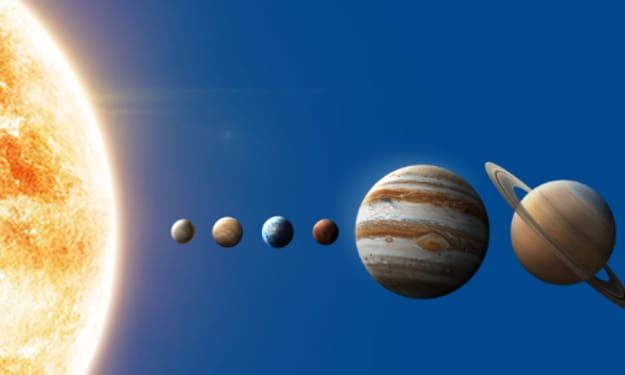
Double phenomena in the heavens Some people say in jest that the planets have aligned in their favor when life works the way they desire. Were you aware that there are seasons when things do line up in the heavens? There will be a planetary alignment AKA a planet parade, on February 28, 2026.
By Cheryl E Preston18 days ago in FYI



Comments
There are no comments for this story
Be the first to respond and start the conversation.