
10 Common History Facts You Learned in School — That Aren’t Actually True
These famous stories were taught as truth. But history says otherwise.

Introduction
We all grew up hearing the same history facts: who invented what, who said what, and who did what. But many of these “facts” are actually myths, misunderstandings, or oversimplified versions of much more complex stories.
Let’s look at 10 common history lessons you probably learned in school — and the surprising truth behind them.
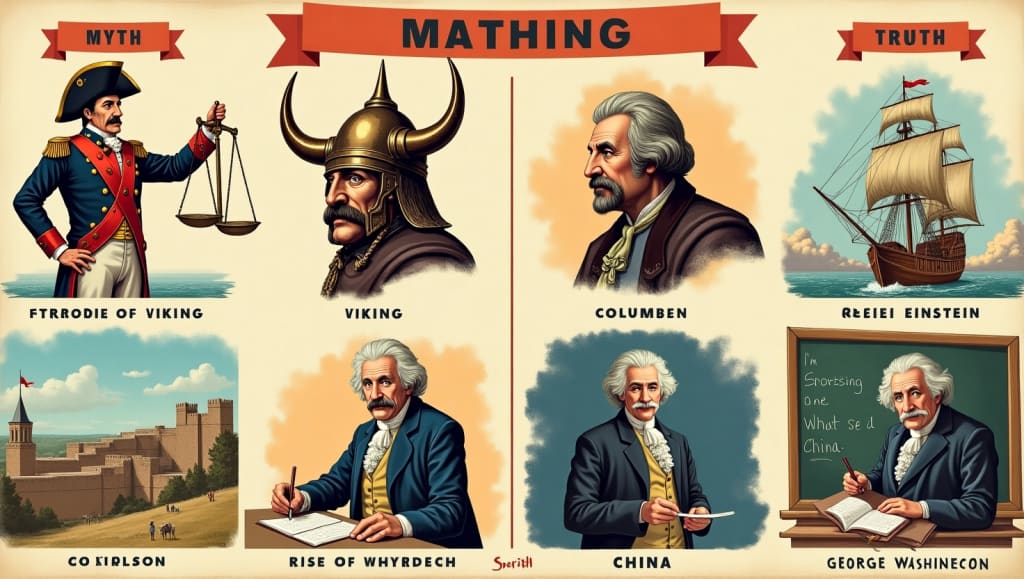
1. Napoleon Was Extremely Short
What you learned: Napoleon Bonaparte was so short that he had "short man syndrome."
The truth: Napoleon was actually around 5'6" or 5'7", which was average height for his time. The myth came from confusion between French and British measurement systems — and British propaganda mocking him.
2. Vikings Wore Horned Helmets
What you learned: Vikings wore horned helmets in battle.
The truth: No evidence supports this. Real Viking helmets were simple and functional, not decorated with horns. The horned image came from 19th-century opera costumes, not archaeology.
3. Columbus Discovered America
What you learned: Christopher Columbus discovered America in 1492.
The truth: Columbus never actually set foot in what is now the U.S. He landed in the Caribbean. Plus, Native Americans were already here, and Leif Erikson likely reached North America centuries earlier.
4. Einstein Failed Math
What you learned: Albert Einstein failed math in school.
The truth: Einstein was actually excellent at math from a young age. He had mastered college-level algebra and calculus by his teens. The myth likely comes from a misunderstanding or a joke he once made.
5. The Great Wall of China Is Visible from Space
What you learned: Astronauts can see the Great Wall from space with the naked eye.
The truth: The Great Wall is very difficult to see from space without aid. It's narrow and blends in with the landscape. Many astronauts have said it’s almost invisible without zoom or filters.
6. Marie Antoinette Said “Let Them Eat Cake”
What you learned: Marie Antoinette mocked the starving poor by saying, “Let them eat cake.”
The truth: There’s no evidence she ever said this. The quote was attributed to her years after her death and was likely used to turn people against the monarchy during the French Revolution.
7. The Salem Witch Trials Burned People at the Stake
What you learned: Witches in Salem were burned at the stake.
The truth: In Salem, none of the accused were burned. Most were hanged, and one man was pressed to death with stones. Burning happened in European witch hunts, not colonial America.
8. Thomas Edison Invented the Light Bulb
What you learned: Edison invented the light bulb.
The truth: Edison didn’t invent it — he improved it. Several inventors created early versions, including Humphry Davy and Joseph Swan. Edison’s version was just the most practical and commercial.
9. People in the Middle Ages Thought the Earth Was Flat
What you learned: People believed the Earth was flat until Columbus proved otherwise.
The truth: Most educated people in the Middle Ages knew the Earth was round. This idea was popularized in the 1800s to make earlier societies seem more ignorant than they were.
10. George Washington Had Wooden Teeth
What you learned: America’s first president wore wooden dentures.
The truth: Washington did have false teeth, but they were made from ivory, gold, and even human teeth — not wood. The wooden teeth myth likely came from the stained appearance of the dentures.
Final Thought
History is full of myths that get passed down for generations — not because people are lying, but because simple stories are easier to remember. But the truth is often more interesting than the myth.
So the next time you hear a famous “fact,” take a moment to ask:
Did that really happen… or is it just the version we were told?
About the Creator
Haq Nawaz
Revealing the hidden, the strange, and the surprising—facts and stories you’ve never heard but won’t forget.



Comments (1)
hmmm...