
Worlds on the Edge: Planets Nearly Torn Apart by Their Stars
Space

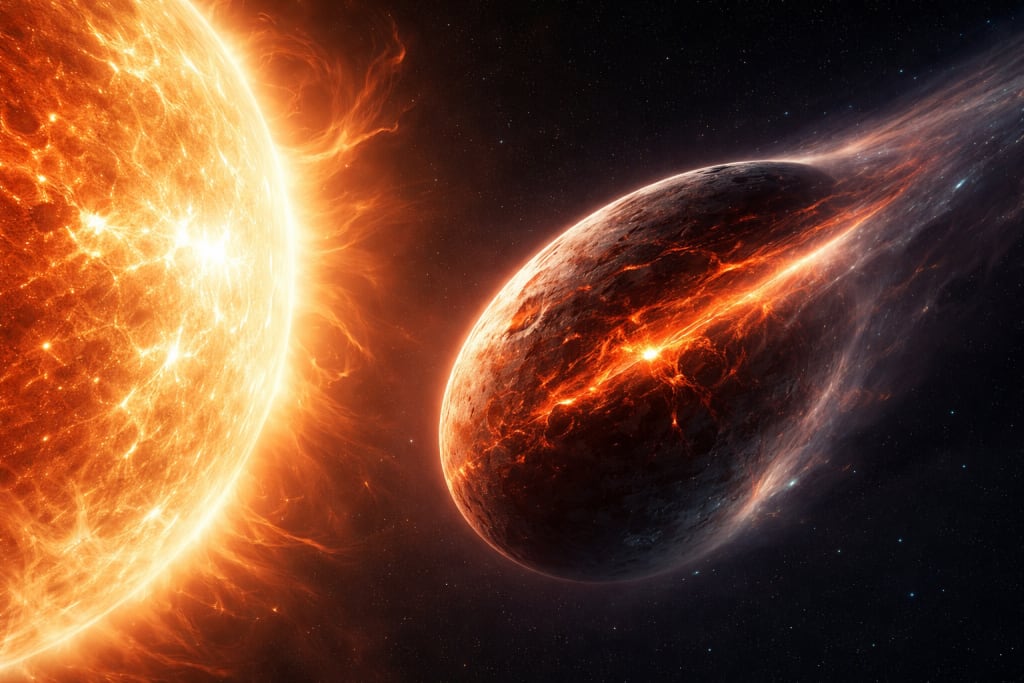
In the vast diversity of planetary systems across the universe, some worlds exist in a state that seems almost impossible. These are planets that orbit so close to their parent stars that gravity itself threatens to tear them apart. They are not science fiction, nor distant theoretical curiosities. Astronomers have already discovered many such worlds, and they are among the most extreme objects ever observed beyond our Solar System.
These planets challenge our understanding of how worlds form, evolve, and ultimately die.
When Gravity Becomes a Destructive Force
Gravity is usually thought of as a stabilizing force. It holds planets together, keeps them in orbit, and gives structure to galaxies. But gravity has a darker side. When a planet ventures too close to a massive star, gravitational forces become uneven across its surface. The side facing the star experiences a much stronger pull than the far side. These differences are known as tidal forces.
On Earth, tidal forces gently move oceans and subtly flex the planet’s crust. Near a star, however, tidal forces can reach catastrophic levels. There exists a critical boundary known as the Roche limit. If a planet crosses this invisible line, its own gravity is no longer strong enough to maintain its integrity. The planet begins to stretch, deform, and may eventually disintegrate into streams of molten rock and gas.
Planets Shaped Like Droplets
Some exoplanets discovered by modern telescopes orbit their stars in just a few hours. These “ultra-short-period” planets are so close that they are no longer spherical. Instead, they are distorted into elongated, teardrop-like shapes by the star’s relentless gravitational pull.
Inside these planets, intense tidal stress generates enormous heat. Even without stellar radiation, this internal friction alone could melt large portions of the interior. Combined with the star’s heat, the result is often a global magma ocean. Volcanoes on these worlds would dwarf anything seen on Earth, ejecting vast amounts of molten material into the atmosphere.
In some cases, the surface itself may be in constant motion, flowing slowly like a viscous liquid rather than solid ground.
Atmospheres That Are Actively Escaping
For planets this close to their stars, holding onto an atmosphere becomes a losing battle. Stellar radiation heats the upper layers of gas until they reach escape velocity. Observations have revealed dramatic, comet-like tails of gas trailing behind certain exoplanets as they orbit their stars.
These tails can stretch for hundreds of thousands of kilometers and are composed of hydrogen, helium, and even heavier elements. In extreme cases, scientists have detected vaporized metals such as sodium, magnesium, and iron. These worlds are literally evaporating.
Over time, this mass loss can dramatically reshape a planet. A once gas-rich world may be stripped down to a dense rocky core, or it may vanish entirely, leaving only a faint disk of debris orbiting the star.
A Tale of Eternal Day and Endless Night
Nearly all planets that orbit this close are tidally locked. One side permanently faces the star, while the other remains in perpetual darkness. The dayside can reach temperatures exceeding 2,500 or even 3,000 degrees Celsius—hot enough to melt rock and vaporize minerals. The nightside, shielded from direct starlight, may be far cooler.
This extreme temperature contrast drives violent atmospheric circulation. Supersonic winds attempt to redistribute heat, carrying vaporized rock from the dayside toward the nightside, where it may condense and fall as exotic precipitation—sometimes described as “rock rain.”
On such worlds, even the concept of a stable surface becomes questionable.
Natural Laboratories of Extreme Physics
Although these planets seem hostile and alien, they are invaluable to science. Worlds on the brink of gravitational destruction allow astronomers to study physical processes that cannot be replicated on Earth. They provide insight into:
- how materials behave under immense tidal stress;
- how planetary interiors respond to constant deformation;
- how atmospheres escape into space;
- and how planetary systems evolve over billions of years.
By observing planets in the process of being stripped, stretched, or destroyed, scientists gain a clearer picture of planetary life cycles—from formation to annihilation.
Why Our Solar System Feels Unusually Calm
Compared to these violent systems, our own Solar System appears remarkably stable. No planet orbits close enough to the Sun to face tidal destruction. Studying extreme exoplanets helps explain why this stability matters. It shows that planetary systems can be radically different from our own, and that survival is often a matter of distance and timing.
These discoveries also remind us that planets are not eternal. They are dynamic objects shaped by powerful forces, and under the wrong conditions, even entire worlds can be reduced to cosmic debris.
Standing at the Boundary Between Existence and Oblivion
Worlds nearly torn apart by their stars occupy a narrow boundary between stability and destruction. They are living demonstrations of gravity’s power—not just to create, but to erase. Each one tells a story of endurance under unimaginable stress, and of a universe where even planets can be fragile.
By studying these doomed worlds, humanity gains not only scientific knowledge, but also a deeper appreciation for the delicate balance that allows planets like Earth to exist at all.
About the Creator
Keep reading
More stories from Holianyk Ihor and writers in Futurism and other communities.
Why Space Technologies Are Increasingly Borrowing Ideas from Biology
For decades, space technology was defined by cold metal, rigid structures, and deterministic engineering. Rockets, satellites, and space stations were designed as machines in the purest sense—precise, predictable, and built to resist failure through redundancy. This approach worked well during the early era of space exploration, when missions were short, environments were relatively well understood, and human presence in space was limited.
By Holianyk Ihora day ago in Futurism
Power Rental Solutions Market Saudi Arabia: Temporary Power, Digital Monitoring & Competitive Landscape
According to IMARC Group's latest research publication, the Saudi Arabia power rental market size was valued at USD 213.5 Million in 2025. The market is projected to reach USD 351.6 Million by 2034, exhibiting a growth rate (CAGR) of 5.70% during 2026-2034.
By Faisal Al-Harbiabout 11 hours ago in Futurism
Best Free Face Swap of 2026 + AI Image Upscaler
Looking for a fun way to create hilarious memes or unique profile pictures? Face swapping lets you place a face from one photo onto another, and the results in 2026 are more realistic than ever. The problem is that many online tools are either hidden behind a paywall, produce blurry results, or are complicated to use.
By Muhammad Owais4 days ago in Futurism
A Letter to the Firestarter
Dear Firestarter, We can all see you, we've been watching you since you began. In case you didn't know we were here before you and we will be here after. We witnessed your rise, your setbacks, your guilt and your lies. We witnessed you start the fire.
By Donny Foley6 days ago in Poets


Comments
There are no comments for this story
Be the first to respond and start the conversation.