
Why Tesla's Robotaxi Vision Is Dividing Wall Street Innovation or Risk?
Elon Musk’s bold leap into autonomous vehicles and humanoid robots has sparked excitement and concern here’s why investors are split on Tesla’s high stakes future

Why Tesla's Robotaxi Vision Is Dividing Wall Street Innovation or Risk?
Elon Musk’s bold leap into autonomous vehicles and humanoid robots has sparked excitement and concern here’s why investors are split on Tesla’s high stakes future.
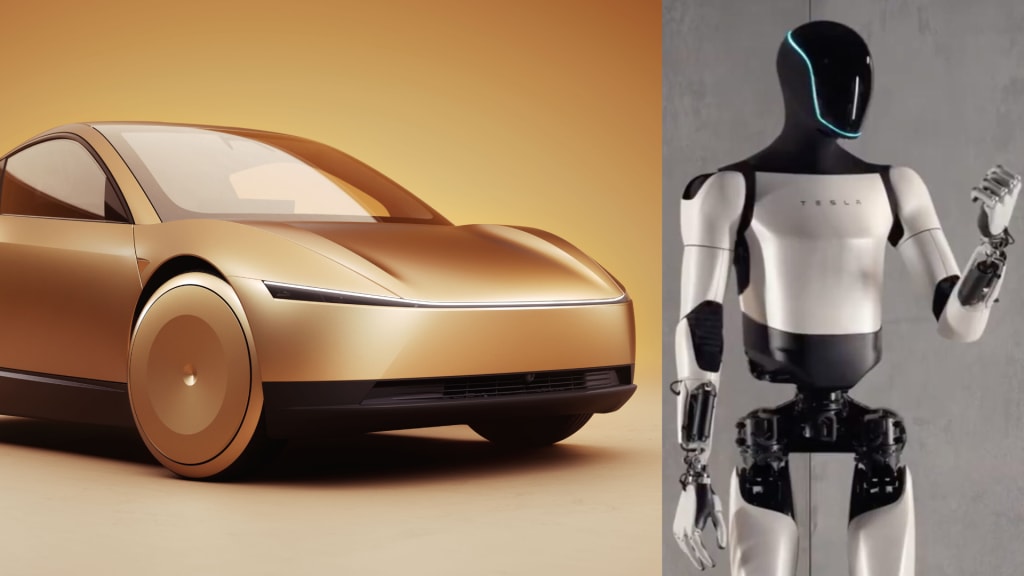
Tesla's recent unveiling of its autonomous vehicle initiative featuring the Cybercab robotaxi has generated significant debate among investors and analysts. While CEO Elon Musk envisions a future dominated by self driving vehicles and humanoid robots the lack of concrete details and immediate practicality has led to a polarized response on Wall Street. At the We Robot event Musk introduced the Cybercab a sleek two seater autonomous vehicle devoid of traditional controls like steering wheels and pedals. Priced under $30,000 and slated for production by 2026 the Cybercab is designed to operate on a ride hailing platform akin to a fusion of Airbnb and Uber. Musk also showcased the Robovan capable of transporting up to 20 passengers and the Optimus humanoid robot which performed tasks such as mixing drinks during the event .
Despite the ambitious presentations many investors expressed disappointment over the absence of detailed plans. Tesla's stock fell by up to 10% following the event reflecting concerns about the feasibility and timeline of Musk's vision. Analysts highlighted the controlled environment of the demonstrations and questioned the readiness of Tesla's autonomous technology compared to competitors like Waymo which already operates a significant number of autonomous rides weekly in major cities .
Design Concerns Practicality vs. Innovation
The Cybercab's design resembling a sporty coupe raised eyebrows among experts who questioned its practicality for everyday use. The vehicle's limited seating and storage capacity may not cater to typical ride hailing scenarios involving families or groups with luggage. Critics argue that a more conventional design might be necessary to appeal to a broader market .
Regulatory and Technological Hurdles
Achieving full autonomy presents significant regulatory and technological challenges. Tesla's reliance on camera based navigation as opposed to the more widely adopted Lidar systems has been a point of contention. Experts warn that without comprehensive safety validations and regulatory approvals the widespread deployment of robotaxis remains uncertain. While some analysts remain skeptical citing the lack of a clear roadmap and potential profitability issues others are more optimistic. Wedbush analyst Dan Ives viewed the Cybercab as a tangible step toward Tesla's autonomous ambitions suggesting that the vehicle's realization could be transformative for the company. Tesla's foray into autonomous vehicles and robotics has undeniably captured attention but the path forward is fraught with challenges. The company's ability to navigate technological regulatory and market acceptance hurdles will determine whether Musk's vision becomes a reality or remains an ambitious dream. As it stands Wall Street remains divided balancing the allure of innovation against the demands of practicality and execution.
SEO KEYWORD:
Tesla Robotaxi, Tesla autonomous vehicles, Elon Musk robot vision, Tesla Cybercab, Tesla robots 2025, Tesla Optimus robot, Tesla vs Wall Street, Tesla stock news, Tesla innovation 2025, Future of self-driving cars.
Repeat
Tesla's recent unveiling of its autonomous vehicle initiative featuring the Cybercab robotaxi has generated significant debate among investors and analysts. While CEO Elon Musk envisions a future dominated by self driving vehicles and humanoid robots the lack of concrete details and immediate practicality has led to a polarized response on Wall Street. At the We Robot event Musk introduced the Cybercab a sleek two seater autonomous vehicle devoid of traditional controls like steering wheels and pedals. Priced under $30,000 and slated for production by 2026 the Cybercab is designed to operate on a ride hailing platform akin to a fusion of Airbnb and Uber. Musk also showcased the Robovan capable of transporting up to 20 passengers and the Optimus humanoid robot which performed tasks such as mixing drinks during the event .
About the Creator
Adnan Rasheed
Author & Creator | Writing News , Science Fiction, and Worldwide Update| Digital Product Designer | Sharing life-changing strategies for success.
Keep reading
More stories from Adnan Rasheed and writers in Futurism and other communities.
Canadian Robot Discovers Hidden Subsea Mass Equal to 250 Million Elephants A Game Changing Geological Find
Canadian Robot Discovers Hidden Subsea Mass Equal to 250 Million Elephants A Game Changing Geological Find Advanced Canadian underwater robot uncovers a colossal ancient mass buried deep beneath the ocean floor, offering new insights into Earth's geological secrets.
By Adnan Rasheed11 months ago in Futurism
5G Enterprise Market to hit USD 152.7 Billion By 2035
5G Enterprise Market Overview The Global 5G Enterprise Market is projected to reach approximately USD 152.7 Billion by 2035, rising from USD 7.3 Billion in 2025, reflecting a strong CAGR of 35.5% during the forecast period from 2026 to 2035.
By Roberto Crum5 days ago in Futurism
Saudi Arabia Power Rental Market: Infrastructure Projects, Temporary Power Demand & Growth Outlook
According to IMARC Group's latest research publication, Saudi Arabia power rental market size was valued at USD 213.5 Million in 2025. The market is projected to reach USD 351.6 Million by 2034, exhibiting a growth rate (CAGR) of 5.70% during 2026-2034.
By Shubham Sharma 4 days ago in Futurism
My First Time Skiing and I Got Lost, Alone, in the French Alps
Looking back, I can trace some of my life’s biggest adventures to a simple action from my sister. She’d introduced me to Tommy (a very long time ago), a colleague of hers, who had overshared his penchant for Italian-looking women, and I ticked that box.
By Chantal Christie Weiss3 days ago in Humans


Comments
There are no comments for this story
Be the first to respond and start the conversation.