
“Why Smart Glasses Will Replace Smartphones (Sooner Than You Think)”
The Quiet Revolution on Your Face
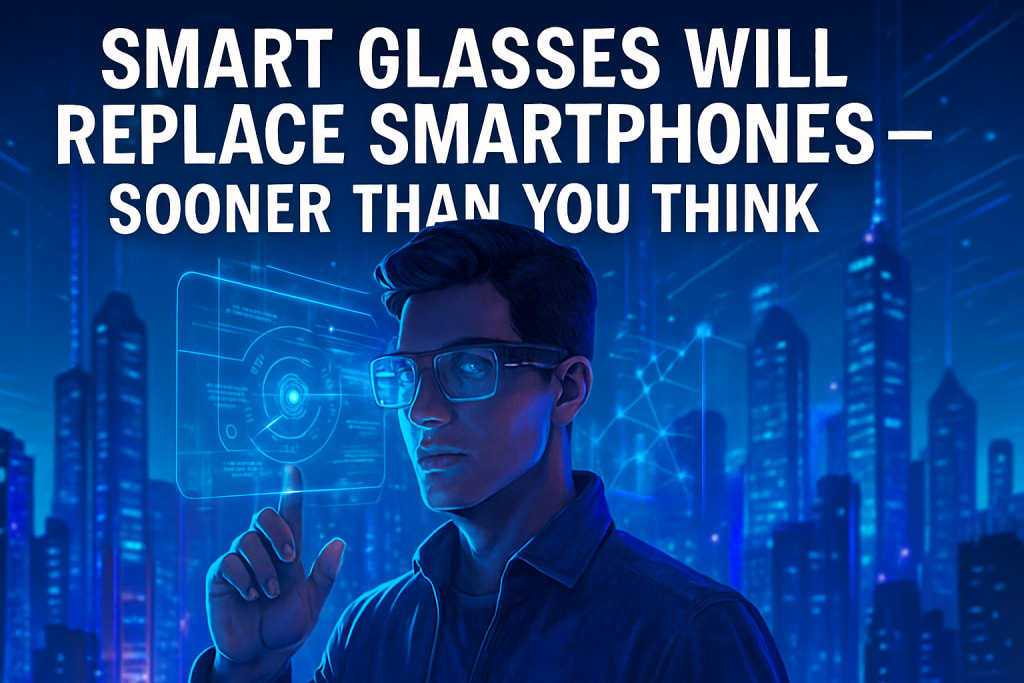
Just a decade ago, the idea of walking around with computers on our faces felt absurd—clunky, geeky, dystopian. Google Glass flopped, and the public laughed it off. But now in 2025, that laughter is fading fast. Thanks to advancements in AI, displays, and wearability, smart glasses are making a comeback. And this time, they're cool, useful, and almost invisible.
Companies like Meta, Apple, Ray-Ban, and Samsung are betting big on this shift. Why? Because your face—not your pocket—is becoming the next digital battleground.
This blog will break down why smart glasses are no longer a gimmick… and how they might just kill the smartphone.
---
🕶️ From Nerdy to Necessary
Let’s get one thing straight: today’s smart glasses aren’t trying to be your phone on your face. They’re smarter. Subtler. And in some ways, more powerful.
Take the Meta Ray-Ban Smart Glasses. At first glance, they look like stylish eyewear. But behind those lenses is a voice-activated assistant, camera, microphone, speaker, and even an AI-powered object recognizer. Ask it what you're looking at. It answers. Want to take a photo without lifting a finger? Just say it. Need turn-by-turn directions while biking? It speaks in your ear.
All of this, hands-free, screen-free, and no awkward wrist twist to check your watch or pull out your phone.
---
🔍 Why Glasses Make More Sense Than Phones
Here’s why the industry believes glasses will eventually replace smartphones:
Hands-Free Everything: Voice, eye-tracking, and gestures make control effortless.
Augmented Reality (AR): Your surroundings become interactive—see overlays, directions, captions, translations, and more in real time.
Contextual Intelligence: Built-in AI understands your environment—offering smarter suggestions and relevant info without distraction.
Less Screen Time: Glasses free you from constant scrolling, while still delivering the info you need.
Fashion Meets Function: Modern designs mean people actually want to wear them.
It’s not about replacing the smartphone entirely—it’s about making the smartphone feel outdated.
---
🧠 AI Makes It Possible
Here’s the real kicker: without AI, smart glasses were dead in the water. But thanks to ChatGPT-style models and on-device intelligence, glasses can now:
Understand natural language
Identify objects, landmarks, and people
Translate speech in real time
Summarize what you’re looking at
Act as personal assistants, coaches, or tutors
Smart glasses no longer need a massive screen because the AI becomes your interface.
---
🏁 Who’s Leading the Race?
Some key players making waves:
Meta x Ray-Ban Smart Glasses – Stylish, social, and AI-integrated.
Apple Vision Pro (Light version coming soon) – Expensive now, but future versions aim to miniaturize.
Xreal Air 2 Ultra – Bringing AR to the masses with spatial computing and cinema-sized virtual screens.
Samsung & Google – Rumored to be working on “Pixel Glass.”
It’s not a matter of if—it’s a matter of when.
---
✅ Pros of Smart Glasses
No more staring at your phone every 3 minutes
Real-time navigation, translation, and contextual help
Private audio without headphones
Stylish designs (finally)
Safer multitasking (e.g., walking, biking, working)
AI-enhanced productivity and creativity
Great for people with disabilities or accessibility needs
---
❌ Cons to Consider
Privacy concerns (camera and mic always on?)
Still reliant on your phone for heavy lifting
Battery life (most last a day or less)
High price tag for early adopters
Social awkwardness—still a stigma in some settings
Requires strong voice AI, which can misfire in loud environments
---
🧨 The Real Disruption: Apps Will Die
Here’s a wild prediction: as smart glasses take over, the app economy will shrink. Instead of tapping through icons, AI-powered glasses will fetch what you need without opening an app.
Example:
> “Hey Meta, what’s that building?”
“That’s the Flatiron Building. It was built in 1902 and…”
No app. Just knowledge.
You don’t need Yelp, Google Maps, or Wikipedia—you just need one intelligent assistant.
---
👓 The End of the Phone Is Closer Than You Think
Look around. In a world where we already wear headphones, rings, watches, and fitness bands, a natural extension is putting intelligence right in our line of sight.
Smart glasses won’t just be gadgets—they’ll be lifestyle devices. Discreet. Useful. Invisible until you need them.
Phones won’t disappear overnight, but they will fade into the background. And in their place, we'll get something more immersive, more helpful, and frankly—more human.
---
🎯 Final Thoughts
2025 is the turning point. As prices drop and AI gets smarter, smart glasses won’t be just for tech nerds. They’ll be for parents, students, travelers, workers, and yes—even your grandparents.
We’re entering a world where your digital life doesn’t live in your pocket—but in your perspective.
Get ready. The revolution won’t be in your hands—it’ll be on your face.
About the Creator
Keep reading
More stories from GadgetGround and writers in Futurism and other communities.
“Why the Meta Quest 3 Might Be the Perfect Father’s Day Gift (Even If He’s Not a Gamer)”
Let’s be honest: buying gifts for Dad is tough. How many grilling tools, socks, or “World’s Best Dad” mugs can one guy really use? This Father’s Day, it’s time to level up—literally.
By GadgetGround9 months ago in Futurism
The Lobster Market: From Ocean Floor to Fine Dining — and Everything In Between
There's something almost paradoxical about lobster. It's a bottom-dwelling crustacean that scavenges the ocean floor, yet it commands some of the highest prices on restaurant menus around the world. It was once so abundant along the northeastern American coast that it was fed to prisoners and indentured servants — considered too common to be worthy of respectable tables. Today, a single lobster dinner can cost more than a week's groceries.
By Frank Morganabout 23 hours ago in Futurism
A Planetary Alignment will coincide with Mercury Retrograde
Double phenomena in the heavens Some people say in jest that the planets have aligned in their favor when life works the way they desire. Were you aware that there are seasons when things do line up in the heavens? There will be a planetary alignment AKA a planet parade, on February 28, 2026.
By Cheryl E Preston5 days ago in FYI



Comments (1)
Smart glasses are finally getting cool. Voice control and AR are game-changers. They'll free us from phones, like Meta Ray-Ban ones already do.