
Why Satellites Don't Crash Despite Earth's Strong Gravity
How Physics Stops Satellites From Falling or Floating Away
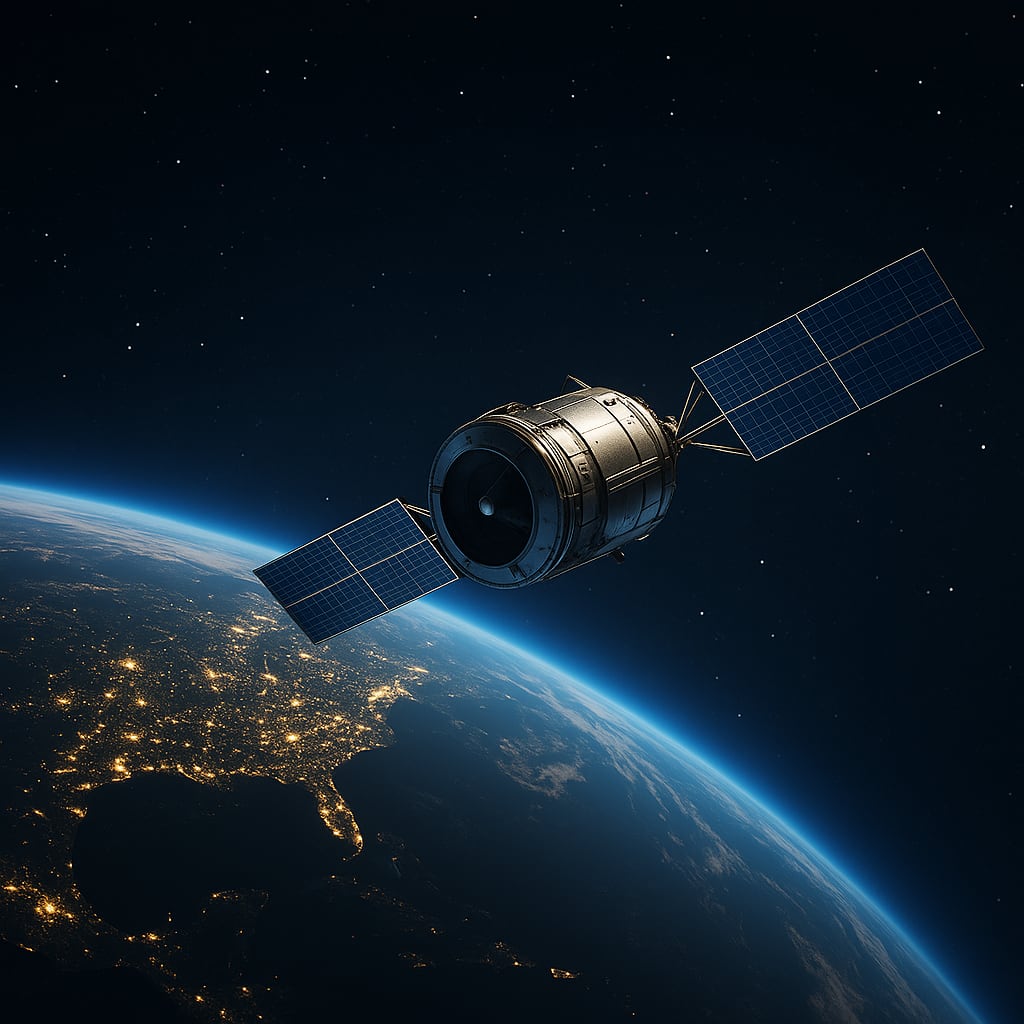
Satellites are one of the greatest wonders of modern science, and they have revolutionized our lives. They constantly revolve around the Earth in a specific orbit—one we cannot see with the naked eye—helping us navigate, forecast the weather, connect with others, and even explore the universe. But have you ever wondered: why do satellites stay up there?
If you think gravity doesn’t work in space, you're holding onto a common misconception. In reality, gravity extends far beyond our atmosphere. It’s the very reason satellites remain in orbit instead of drifting away or crashing back down to Earth. So, how exactly does this invisible force keep satellites circling the planet? The answer lies in a delicate balance between gravity and speed.
---
How Does a Satellite Stay in Orbit?
To understand this, we need to look at Newton’s First Law of Motion. But first, let’s briefly explore how a satellite begins its journey into space.
Satellites are launched using powerful rockets that propel them upward at incredibly high speeds. This speed must be great enough to overcome Earth’s gravitational pull. That required speed is called escape velocity, and it’s around 40,320 km per hour. Once the rocket reaches a certain altitude, it releases the satellite and applies a specific force in a straight-line direction. This sets the satellite into motion at a precise speed needed to stay in orbit.
The velocity required to keep the satellite in orbit is calculated using the formula:
> v = √(g × r)
Where:
v = orbital speed
g = gravitational acceleration
r = distance from Earth’s center to the satellite
---
Newton's First Law in Action
Now, back to Newton's First Law, which states:
> "An object at rest stays at rest, and an object in motion stays in motion at a constant speed in a straight line unless acted upon by an unbalanced force."
In the vacuum of space, there is no air—so no friction. That means once a satellite is set in motion, it should keep moving at the same speed, in the same direction, forever. So why doesn’t it just drift off into space?
That’s where gravity comes in.
Even in space, Earth’s gravity still affects the satellite. It acts as the unbalanced force mentioned in Newton’s law, constantly pulling the satellite toward Earth. But instead of falling straight down, the satellite’s forward motion causes it to continually “miss” the Earth as it falls—creating a curved path around the planet. This is what forms an orbit.
---
A Perfect Balance: Speed vs Gravity
If gravity is pulling on the satellite, why doesn’t it crash into Earth?
Because its momentum—the satellite’s tendency to keep moving forward—is perfectly balanced with Earth’s gravitational pull. It's a cosmic game of tug-of-war. The result? A stable orbit, where the satellite is falling toward Earth but always missing it due to its speed.
---
A Simple Example: Ball on a String
Here’s a simple example to help you visualize it:
Imagine you’re spinning a ball tied to a string. As you whirl it around, the ball moves in a circular path. In this analogy:
The ball = the satellite
The string = gravity
If you let go of the string, the ball would fly off in a straight line. Similarly, if Earth’s gravity stopped working, the satellite would drift away into space. But as long as gravity "pulls" on it, the satellite keeps orbiting—just like the spinning ball.
---
Conclusion
So, the reason satellites don’t fall to Earth or drift away into space lies in a perfect balance between speed and gravity. They continue to orbit smoothly, just like a ball spinning on a string. What once seemed like magic is actually a brilliant application of physics.
But this raises another question: why do planets orbit the Sun in the same way?
Well—that’s a story for my next article.
Written by
ABID HASAN
About the Creator
Keep reading
More stories from ABID HASAN and writers in Futurism and other communities.
SAGITTARIUS THE MANIPULATOR
INTRODUCTION Have you ever looked up at the night sky and wondered why the planets spin in perfect harmony around the Sun? Or why Earth doesn’t simply fall into the blazing fireball at the center of our solar system? Maybe you've heard whispers of time flowing differently in space or of the entire solar system soaring through the galaxy on an invisible path.
By ABID HASAN8 months ago in Futurism
About Binding Prometheus
I want to start actively advocating on behalf of my own work, and the most valuable part of my canon is, without a doubt, Binding Prometheus, the play I have been working on since 2019 and only finished in 2023 as part of my MA. The play itself is an amalgamation of a million different inspirations. On one end, it evokes the Ancient Greek myth-play, deriving its own title from the earliest extant work of Western drama we have, Aeschylus’s Prometheus Bound. On the other end, it borrows significantly from the sci-fi bulwarks from over the years, namely Mary Shelley’s Frankenstein and Karel Capek’s Rossum’s Universal Robots. The play could be an episode of Black Mirror, I fear. I don’t know. I’ve only ever seen one episode of Black Mirror.
By Steven Christopher McKnight26 days ago in Futurism
Building Integrated Photovoltaics Market: Urban Infrastructure, Renewable Facades & Outlook
Rising urbanization, stricter energy-efficiency regulations, and demand for sustainable construction are accelerating adoption of building integrated photovoltaics. Advancements in solar efficiency, declining technology costs, and aesthetic integration into facades and rooftops further support growth. Government incentives, green building certifications, and corporate decarbonization goals are also driving investment, positioning BIPV as a strategic solution for modern, energy-efficient infrastructure development. According to IMARC Group's latest research publication, The global building integrated photovoltaics market size reached USD 26.89 Billion in 2024. Looking forward, IMARC Group expects the market to reach USD 116.17 Billion by 2033, exhibiting a growth rate (CAGR) of 15.76% during 2025-2033.
By James Whitman5 days ago in Futurism
📢 Raise Your Voice Thread: 01/22/2026
Our “Raise Your Voice Threads” are hosted most alternating Thursdays at 12PM ET to offer creators more avenues to uncover exceptional stories on Vocal. As we are continuously searching for fresh creators and inspiring stories, this thread provides an opportunity to exchange and discuss the stories that have moved and motivated us on Vocal.
By Raise Your Voice by Vocal5 days ago in Resources


Comments (1)
Thanks author for the infos✨