
Why Most eCommerce Stores Struggle to Get Steady Organic Traffic?
A quiet look at why most stores rise and fall unpredictably, and how missing structure, rhythm, and identity keep organic traffic from becoming a steady, trustworthy source of growth.


Rain pushed softly against the windows of the small coffee shop where I sat across from a store owner who looked more tired than defeated. She slid her laptop toward me across a metal table still warm from the overhead lights. Her analytics dashboard showed a shape I’ve come to know too well—traffic rising like a spark, then falling abruptly, then drifting through long, quiet stretches where nothing seemed to move at all. She didn’t speak at first. She just watched the graph with the kind of distant stare people reserve for something they’ve tried to fix many times already.
She finally whispered that she didn’t want miracles. She didn’t want viral moments or sudden surges. She wanted predictability. A slow, steady climb. Something that felt alive but not unstable. I could hear a kind of ache behind her words, the same ache I’ve heard from many founders who put their hearts into something that refuses to grow at a pace that makes sense.
I closed the graph and began clicking through her pages. The store was beautiful in fragments. Product pages had clean images. Category pages followed a pattern. A few evergreen blogs sat in a quiet corner of the site, written months apart and never connected to anything meaningful. Nothing was wrong. But nothing spoke to anything else.
And that was the problem.
When a Store Has No Center
Most eCommerce stores begin with momentum. Founders write product descriptions. They publish a few blogs. They plan social posts and hope for organic recognition. But momentum isn’t direction. Stores that want stable search traffic need a center—a theme, a reason for existing, a story that ties every part together. Without it, the site behaves like a collection of pages instead of a destination.
Her store had products people genuinely wanted, yet each page stood alone. Search engines aren’t emotional, but they do feel something when a store lacks continuity. They sense fragmentation. They sense absence of depth. They sense the difference between a store that publishes content and a store that builds knowledge.
You can’t climb a mountain by placing rocks randomly. You climb by creating steps.
When Search Engines See Silence
I showed her a crawl report of her site. Long gaps between updates. Product pages untouched for months. Blog posts written without internal links. Category pages that never changed. The store wasn’t inactive—but to a search engine, it looked like it was sleepwalking. And sleepwalking doesn’t earn steady visibility.
What she needed wasn’t noise. It was rhythm. A gentle hum of activity that search engines could interpret as consistency. I explained that search visibility isn’t just a measure of keywords or backlinks. It’s a measure of life. Stores that return to their content, refine it, connect it, and expand on it send a message that they are growing, not simply existing.
She took a breath, as if hearing that truth made her understand something she had sensed for a long time but never named.
When Content Doesn’t Carry Meaning
Her blogs weren’t bad. They were just alone. A store without thematic content feels like a place with rooms but no hallways, and both users and search engines sense that absence. When I looked at how earlier agencies approached her structure, especially during the period when she invested in eCommerce SEO services, it became clear that the work focused on isolated wins rather than building a connected ecosystem. What she needed wasn’t more pages. She needed meaning—content that carried users from curiosity to understanding without feeling fragmented.
She asked if this meant writing constantly. I shook my head. It meant writing purposefully. It meant giving users a reason to stay on the site long enough to understand what she offered beyond transactions. Stores with steady organic traffic rarely shout for attention. They guide people gently—from information to understanding to trust.
Trust arrives slowly, but once it settles, traffic follows it.
When the Store’s Identity Gets Lost
As we talked, I realized the deeper issue wasn’t the content itself. It was identity. Her store looked like a place that sold products, but not a place shaped by a belief or idea. Search engines interpret structure the way people interpret personality. A store with no clear sense of itself becomes a store with no authority. And without authority, traffic behaves like weather—unpredictable, seasonal, fleeting.
I asked her what she wished her users felt when they entered the site. She looked down at her hands, thinking. She said she wanted them to feel that the store understood what they were searching for, even before they knew it themselves.
That was the moment the room shifted. It wasn’t the rain, or the lights, or the fatigue on her face. It was the realization that her store wasn’t meant to be a collection of products. It was meant to be a place where someone could find the version of themselves they were looking for.
Organic traffic doesn’t grow from technical signals alone. It grows from resonance. From clarity. From emotional alignment with the person searching.
When Small Adjustments Become a New Foundation
We made a plan that didn’t require rebuilding the store. It required weaving it. Connecting product pages to guides. Connecting guides to categories. Connecting categories to each other in subtle ways that explained intent. She didn’t need a flood of new content. She needed a spine—a central thread that held the entire store together.
We refined her categories so they reflected real needs rather than internal labels. We rewrote a few product descriptions so they felt less isolated. We expanded her blog section by anchoring it to the questions users actually brought with them. None of it was dramatic. All of it created momentum.
And slowly, something shifted.
The Moment the Graph Became Steady
A few months later she messaged me a screenshot of her analytics. The graph didn’t spike. It didn’t collapse. It rose gently, almost modestly, the way a tide moves when the moon pulls quietly at the water. She wrote only one sentence:
“It finally feels like the store is breathing.”
That message told me everything. Growth doesn’t have to scream. It just has to move in the same direction long enough to become a pattern.
Quiet Truth
Most eCommerce stores don’t fail to get steady organic traffic because they’re weak. They fail because nothing holds the system together. No structure. No rhythm. No identity. Search engines reward clarity long before they reward volume.
As I left that coffee shop that night, the rain had eased into a soft drizzle. The world outside looked blurred, but somehow more coherent. Just like her store—slowly learning to speak with one steady voice instead of scattered fragments.
Steady traffic isn’t a spike. It’s a heartbeat.
And a heartbeat strengthens only when the whole system learns to move with purpose.
About the Creator
Jane Smith
Jane Smith is a content writer and strategist with 10+ years of experience in tech, lifestyle, and business. She specializes in digital marketing, SEO, HubSpot, Salesforce, web development, and marketing automation.
Keep reading
More stories from Jane Smith and writers in Futurism and other communities.
Voice and AI: New Digital Marketing Services Everyone will want in 2027
Marketing once depended on visibility. Brands competed for attention through search rankings, advertisements, and carefully optimized content designed to capture clicks. Consumers searched, compared, and chose — a process driven largely by human initiative.
By Jane Smith21 days ago in Futurism
Australia Smoothies Market: Health & Wellness Trends, Retail Expansion & Product Innovation
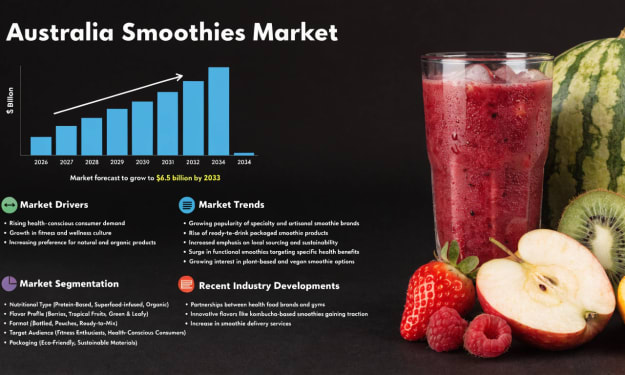
According to IMARC Group, the Australia smoothies market reached USD 504.6 Million in 2025 and is projected to grow to USD 749.1 Million by 2034, exhibiting a compound annual growth rate (CAGR) of 4.26% during 2026–2034. The market’s expansion reflects increasing consumer focus on health, nutrition, and convenience across Australia. Rising demand for nutrient-rich beverages, growing availability of ready-to-drink (RTD) options, and the proliferation of smoothie bars in urban centers are collectively strengthening Australia smoothies market share. As consumers prioritize balanced diets and functional ingredients, smoothies are becoming a mainstream component of daily nutrition.
By Shrestha Roy7 days ago in Futurism
Custom Data-driven Platforms for Business Decision-making and Visualization
The explosion of enterprise data not necessary translates into better business decisions. In practice, many companies now have sprawling data lakes, warehouses, and even AI/ML pipelines, but struggle to turn that data into action. Data by itself has limited value unless users can understand it and act on it. The real bottleneck isn’t the data or even the AI models, but the way people interact with them. This article explores how custom data-driven platforms can bridge the gap between raw data and confident decision-making.
By Sergey Laptick2 days ago in Futurism
📢 Raise Your Voice Thread: 03/05/2026
Our “Raise Your Voice Threads” are hosted most alternating Thursdays at 12PM ET to offer creators more avenues to uncover exceptional stories on Vocal. As we are continuously searching for fresh creators and inspiring stories, this thread provides an opportunity to exchange and discuss the stories that have moved and motivated us on Vocal.
By Raise Your Voice by Vocalabout 16 hours ago in Resources


Comments
There are no comments for this story
Be the first to respond and start the conversation.