
Voice and AI: New Digital Marketing Services Everyone will want in 2027
The moment marketing stopped being something you search — and became something that listens

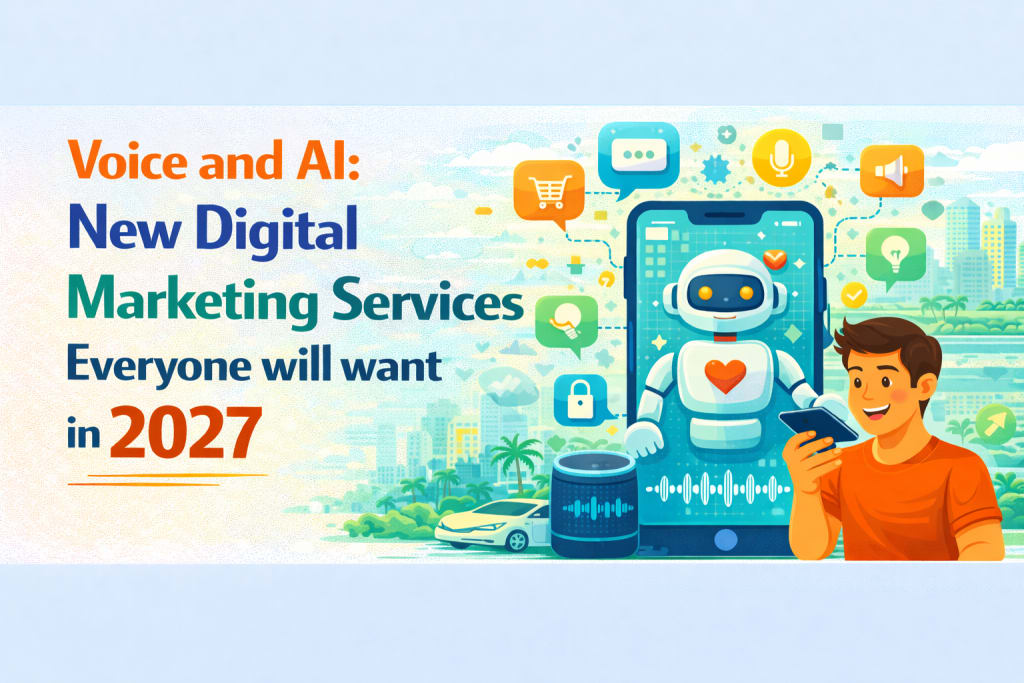
Marketing once depended on visibility. Brands competed for attention through search rankings, advertisements, and carefully optimized content designed to capture clicks. Consumers searched, compared, and chose — a process driven largely by human initiative.
But a quiet transformation is underway.
As voice interfaces and artificial intelligence reshape how people interact with technology, marketing is moving from static visibility toward conversational engagement. Instead of typing keywords into search engines, users increasingly speak naturally to digital assistants, ask complex questions, and expect instant answers tailored to context.
By 2027, this shift may redefine the role of marketing entirely, introducing new services designed not only to attract audiences but to understand and respond to them in real time.
The rise of voice interaction changing consumer behavior
Voice technology has advanced rapidly over the past decade. Improvements in speech recognition accuracy and natural language understanding enable digital assistants to interpret conversational queries more effectively.
Research suggests that a growing percentage of households now use voice-enabled devices regularly, and mobile voice interactions continue increasing as users seek hands-free convenience.
Voice interactions differ fundamentally from traditional search:
- Queries tend to be longer and more conversational.
- Users expect direct answers rather than lists of options.
- Context and intent become more important than exact keywords.
- This evolution requires marketers to rethink how information is structured and delivered.
As Amazon’s Alexa division once described, voice technology transforms computing from “command-based interaction” into “natural conversation.”
AI transforming marketing from reactive to predictive
Artificial intelligence enables marketing systems to analyze vast amounts of data and anticipate user needs. Instead of reacting to user behavior after it occurs, AI predicts preferences and delivers proactive recommendations.
Examples include:
- Personalized content recommendations.
- Automated campaign optimization.
- Dynamic pricing adjustments.
- Real-time customer support through conversational agents.
Studies indicate that AI-driven personalization can increase engagement rates significantly, demonstrating how predictive systems reshape customer relationships.
Marketing increasingly becomes a process of guiding conversations rather than broadcasting messages.
Conversational discovery replacing traditional search funnels
Traditional marketing funnels relied on structured stages: awareness, consideration, and conversion. Voice and AI disrupt this linear model.
When users ask digital assistants questions such as “What’s the best option for…?” or “Which service should I choose?” they expect curated answers rather than multiple steps of research.
This creates new challenges:
- Brands must position themselves as trusted sources.
- Content must answer specific questions clearly.
- Messaging must align with conversational language patterns.
Experts often describe this shift as the rise of “answer-based marketing,” where success depends on providing valuable insights rather than simply ranking for keywords.
The evolution of internet marketing toward AI-first strategies
As conversational interfaces grow, businesses increasingly seek specialized digital marketing services capable of navigating AI-driven ecosystems.
Key emerging areas include:
- Voice search optimization.
- AI content structuring for conversational discovery.
- Data analytics driven by machine learning.
- Conversational UX design.
Rather than focusing solely on traffic acquisition, marketers now prioritize becoming part of the answers users receive from intelligent systems.
Industry surveys suggest that companies investing in AI-driven strategies experience improved customer engagement compared to traditional approaches.
Hyper-personalization reshaping customer expectations
Consumers increasingly expect brands to understand individual preferences. AI enables hyper-personalization by analyzing behavioral data and delivering tailored experiences.
Examples include:
- Personalized email campaigns adjusting content dynamically.
- Voice assistants remembering user preferences.
- Context-aware recommendations based on location and timing.
Research indicates that personalized experiences improve conversion rates significantly, highlighting the importance of adapting to evolving expectations.
However, personalization must balance relevance with privacy considerations to maintain user trust.
Multimodal experiences blending voice, visuals, and automation
Future marketing may not rely on a single interaction channel. Instead, experiences will combine voice commands, visual interfaces, and automated workflows.
For example:
- A user asks a voice assistant for product recommendations.
- The assistant displays visual options on a connected device.
- AI completes checkout steps automatically based on saved preferences.
This multimodal approach requires integrated strategies spanning multiple platforms simultaneously.
The role of content in a conversational world
Content remains central to marketing, but its purpose evolves. Instead of creating material solely to attract clicks, brands must produce resources answering real questions clearly and authentically.
Effective conversational content emphasizes:
- Clarity and simplicity.
- Structured information easily interpreted by AI.
- Expertise-driven insights.
High-quality content helps AI systems identify authoritative sources, increasing the likelihood of inclusion within conversational responses.
A content strategist recently noted, “The future isn’t about writing more content — it’s about writing smarter content.”
Ethical considerations shaping AI-driven marketing
As AI systems influence consumer decisions, ethical questions become increasingly important.
Key concerns include:
- Transparency regarding automated recommendations.
- Avoiding algorithmic bias.
- Respecting user privacy.
Responsible marketing practices ensure that technology enhances user experiences without manipulating or misleading audiences.
Industry leaders emphasize that trust will become a defining factor in successful AI-era marketing strategies.
Challenges businesses face adapting to voice-first environments
Transitioning to voice and AI-driven marketing requires significant strategic shifts.
Common challenges include:
- Understanding conversational search patterns.
- Measuring performance using new metrics.
- Integrating AI tools into existing workflows.
Organizations must adopt flexible approaches, recognizing that technology continues evolving rapidly.
The future of marketing: from campaigns to conversations
Looking ahead, marketing may become less about campaigns and more about ongoing dialogue between brands and consumers.
AI agents capable of continuous interaction will guide users through discovery, evaluation, and purchase decisions seamlessly.
In this environment, marketing success depends on building relationships rather than capturing fleeting attention.
A new era where brands must learn to listen
The rise of voice technology and artificial intelligence signals more than a technological trend; it represents a fundamental change in how people interact with information.
By 2027, marketing strategies may revolve around understanding intent, responding intelligently, and delivering meaningful value through conversation.
Brands that adapt to this shift position themselves not just as advertisers but as trusted participants in the digital dialogue — ready to meet audiences wherever questions begin and answers take shape.
About the Creator
Jane Smith
Jane Smith is a content writer and strategist with 10+ years of experience in tech, lifestyle, and business. She specializes in digital marketing, SEO, HubSpot, Salesforce, web development, and marketing automation.
Keep reading
More stories from Jane Smith and writers in Futurism and other communities.
Ranking in ChatGPT: The New Goal of Expert SEO Services in 2027
For decades, digital visibility followed a simple rule: if your website ranked high on search engines, users would find you. Businesses invested heavily in search engine optimization, chasing page-one rankings and carefully studying algorithm updates.
By Jane Smith3 days ago in Futurism
Diethylene Glycol (DEG) Market Outlook: Industrial Demand and Growth Opportunities
Rising demand from polyester resins, antifreeze, plasticizers, and industrial solvents is driving growth in the diethylene glycol (DEG) market. Expansion of construction, automotive, and packaging industries supports consumption. According to IMARC Group's latest research publication, The global diethylene glycol (DEG) market size was valued at 3.38 Million Tons in 2024. Looking forward, IMARC Group estimates the market to reach 4.74 Million Tons by 2033, exhibiting a CAGR of 3.8% from 2025-2033.
By James Whitman6 days ago in Futurism
Biocides Market: Agriculture & Crop Protection, Biosecurity Measures & Growth Outlook
According to IMARC Group's latest research publication, global biocides market size reached USD 9.5 Billion in 2024. Looking forward, IMARC Group expects the market to reach USD 13.9 Billion by 2033, exhibiting a growth rate (CAGR) of 4.12% during 2025-2033.
By sujeet. imarcgroup4 days ago in Futurism
Diaries to Nietzsche
Quotation from Friedrich Nietzsche "He who wrestles long with monsters should beware lest he himself become a monster. And if you gaze long into an abyss, the abyss also gazes into you. Man is not destroyed by suffering, but by the meaning he makes of it."
By LUCCIAN LAYTH3 days ago in Critique




Comments
There are no comments for this story
Be the first to respond and start the conversation.