
Why Black Holes Don’t Suck in Everything: Debunking a Cosmic Myth
Space

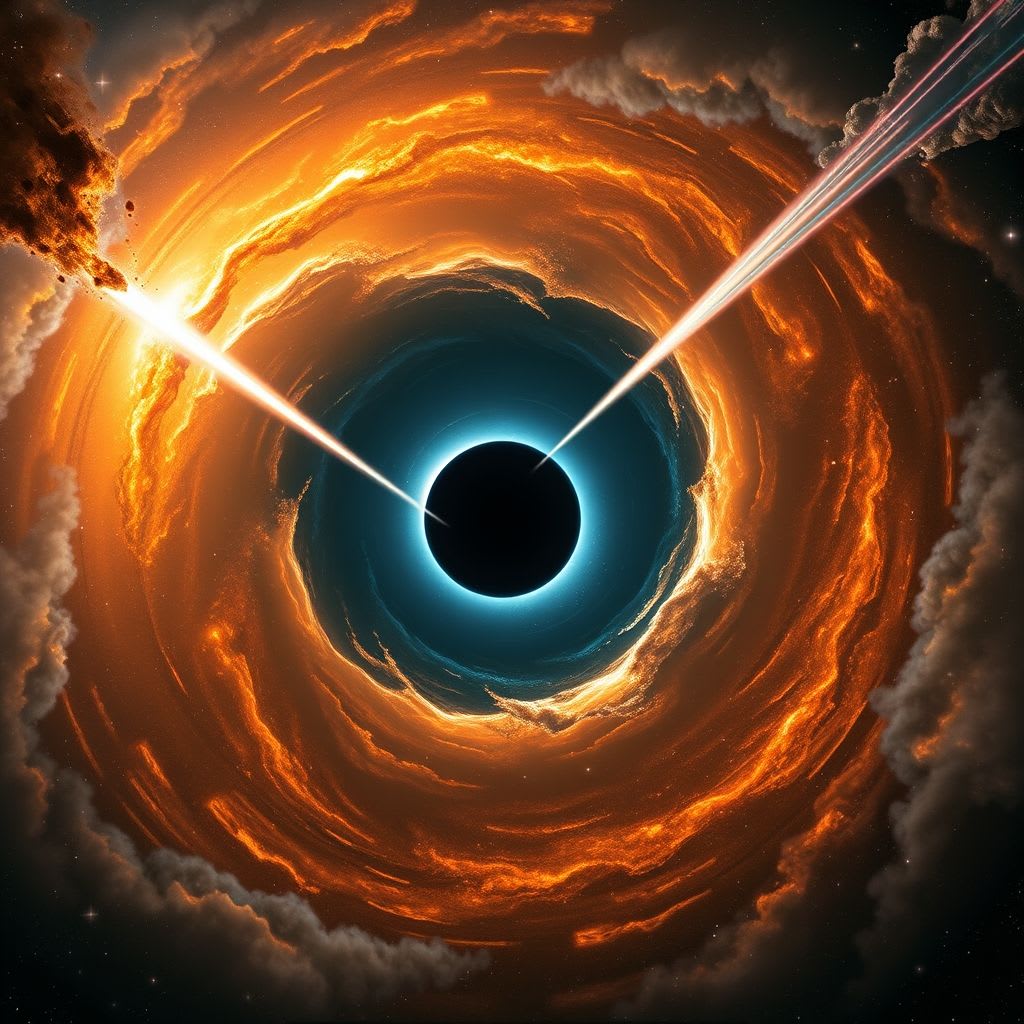
Black holes are, without exaggeration, some of the most mysterious and frightening objects in the universe. They are often imagined as insatiable monsters that devour everything nearby — stars, planets, even light itself. In popular culture, black holes are frequently portrayed as cosmic vacuum cleaners, sucking in anything that dares come close. But the truth is far more fascinating — and less catastrophic. In reality, black holes do not pull in everything indiscriminately. Let’s explore why.
What Is a Black Hole, Really?
A black hole is an object with incredibly strong gravity — so strong that even light cannot escape its boundary, known as the event horizon. Black holes form when a very massive star undergoes gravitational collapse, essentially collapsing under its own weight.
But it’s important to understand: a black hole does not act like a vacuum cleaner. It’s simply an object with mass. For example, if the Sun were suddenly replaced by a black hole of the same mass (don’t worry — this won’t happen), the Earth would continue to orbit it just as before. Why? Because the mass remains the same, and the gravitational pull at that distance doesn’t change.
Gravity Works Over Distance
Gravity’s force decreases with distance. The farther an object is from a black hole, the weaker the pull it feels. For most black holes, the radius around them where gravity becomes overwhelmingly dominant is relatively small. Only near the event horizon does gravity become so strong that nothing can escape.
This means objects far away face no special threat. Entire galaxies can peacefully coexist with black holes for millions of years without being swallowed.
Orbits and Stability
A black hole can have an entire system of objects orbiting it, much like planets orbit a star. For instance, at the center of our Milky Way galaxy lies a supermassive black hole called Sagittarius A*. Around it, stars orbit safely on stable paths without falling in.
How is this possible? It’s simple: these stars move fast enough that the outward centrifugal force balances the black hole’s gravitational pull. If they didn’t have sufficient speed, yes — they would fall in. But since they’re moving, they stay safely in orbit.
What Actually Gets Consumed?
A black hole can only consume objects that cross its event horizon — the so-called point of no return. Before reaching this boundary, nothing is doomed. Matter approaching the event horizon accelerates, heats up, and starts emitting light. This glowing matter forms an accretion disk, a swirling cloud of gas falling inward. It’s this light from the accretion disk that helps astronomers detect black holes — not the black hole itself, since it emits no light.
Sometimes, matter near a black hole doesn’t fall in at all. Instead, some of it is blasted out in the form of powerful jets shooting from the black hole’s poles, extending thousands of light-years into space.
The Bottom Line: Black Holes Are Not Cosmic Vacuum Cleaners
To sum up, black holes do not indiscriminately suck in everything around them. They are objects with extreme density and gravity. If you are far away, a black hole is no more dangerous than any other star of the same mass. If you orbit steadily, you are safe. Only when you get too close to the event horizon do you reach the point of no return.
This breaks the scary myths but makes black holes no less fascinating. Far from being malevolent devourers, they are extraordinary cosmic laboratories where physics pushes beyond our everyday understanding. And that is exactly what makes black holes some of the most captivating objects in the entire universe.
About the Creator
Keep reading
More stories from Holianyk Ihor and writers in Futurism and other communities.
Is Time Travel Possible Within the Framework of Space?
Time travel is one of the most thrilling ideas humanity has ever imagined. From ancient myths to 21st-century science fiction, the dream of peeking into the future or changing the past has fascinated scientists, writers, and philosophers alike. But does this fantasy have any real scientific foundation? Especially when considered within the vast and mysterious backdrop of space — the grandest stage for such journeys?
By Holianyk Ihor7 months ago in Futurism
About Binding Prometheus
I want to start actively advocating on behalf of my own work, and the most valuable part of my canon is, without a doubt, Binding Prometheus, the play I have been working on since 2019 and only finished in 2023 as part of my MA. The play itself is an amalgamation of a million different inspirations. On one end, it evokes the Ancient Greek myth-play, deriving its own title from the earliest extant work of Western drama we have, Aeschylus’s Prometheus Bound. On the other end, it borrows significantly from the sci-fi bulwarks from over the years, namely Mary Shelley’s Frankenstein and Karel Capek’s Rossum’s Universal Robots. The play could be an episode of Black Mirror, I fear. I don’t know. I’ve only ever seen one episode of Black Mirror.
By Steven Christopher McKnight16 days ago in Futurism
Saudi Arabia Bedsheet Market: Comfort Preferences, Design Evolution & Industry Growth
According to IMARC Group's latest research publication, the Saudi Arabia bedsheet market size reached USD 1,037.78 Million in 2024. Looking forward, IMARC Group expects the market to reach USD 1,415.62 Million by 2033, exhibiting a growth rate (CAGR) of 3.51% during 2025-2033.
By Abhay Rajputabout 18 hours ago in Futurism


Comments
There are no comments for this story
Be the first to respond and start the conversation.