
Where do the elements that make up our bodies come from?
"We are the broken stars" - this is one of the most beautiful sentences I have ever read in my life. Carl Sagan wrote and concluded

The nitrogen in our DNA, the calcium in our teeth, the iron in our blood, the carbon in our apple pie are all formed from the inner elements of stars, so we are made of stars."
The Orion Nebula, one of our closest stellar nurseries. (Photo credit: Peresanz/Fotolia)
The building blocks of life are the ashes of stars that have suffered terrible explosive destruction. So, in a way, they died so that you and I could be born. However, not all elements in the periodic table are created at the center of stars. Some form naturally outside the stars, and the rest are created by us. So let's first understand how some of the basic elements are created in the core of a star, which first requires us to understand the life course of a star.
Natural elements
The lightest elements, hydrogen and helium, were created when dust settled after the Big Bang. A newborn star is made mostly of this hydrogen gas collapsing on itself. This collapse heats the gas and forces its atoms into violent collisions. The collisions further heat up the gas, and eventually the hydrogen atoms don't collide and bounce back, but fuse to form helium atoms!
The mass of helium is less than the sum of the masses of two hydrogen atoms. The remaining mass is released as energy, the magnitude of which is given by Einstein's mass-energy equation, E= MC ^2. While that might be small for a single fusion reaction, the cumulative amount is huge, and the process is called fusion. This principle, which makes stars shine, is replicated in a controlled way in a devastating hydrogen bomb.
Diagram: Hydrogen fusion reaction
Eventually, the star runs out of fuel -- all its hydrogen. However, high pressure and heat now force helium atoms to fuse and form beryllium! Finally, the beryllium atoms are fused at high temperatures and pressures to form carbon, then oxygen, and so on, until iron is synthesized in the core. At this point, the star is incredibly massive, two to three times the mass of the Sun. However, it can no longer counteract the compression of gravity because the iron cannot fuse any further. In the absence of fuel and heat to cause expansion, the star begins to cool and contract.
At the end of a star's life, because all the heavier elements are packed into a sphere with a radius of just 10 miles, the density of a star can reach millions of tons per cubic inch. However, further contraction would compress the star to a point of infinite density! But before collapsing into a black hole, it explodes violently with the energy of about a million (10^27) atomic bombs!
Illustration: Most distant gamma-ray bursts - Supernovae release enormous amounts of energy for a short period of time, making them the most energetic events in the universe. (Photo credit: ESO/A.Roquette/Wikipedia Commons)
The explosive death of a star is called a supernova, and it's the biggest explosion we can see in space. All elements within the core are violently dispersed into the surrounding environment. What's more, the heat released is so high that the elements undergo nuclear reactions that were not possible in the previous core. These elements are bombarded with free neutrons to produce more elements. Iron turns to gold, and then to lead, until uranium is formed, the heaviest naturally synthesized element. Thus, destruction begets creation.
Artificial elements
The entire solar system formed from similar debris scattered by supernovae. Can you imagine the incredible amount of dust and debris that accumulated to form not only the sun, but also eight planets and a dwarf star orbiting the sun?
However, as I said, not all elements are formed in the core or outside the star. Uranium is the 92nd element, so how did the other 27 elements come about? While plutonium and neptunium can be synthesized in supernovae, trace amounts of them may not be abundant. These elements can be synthesized naturally. It may be that stars create elements that are much heavier than we can create, but those elements don't hold for more than a few microseconds -- because they immediately decay into lighter elements.
Illustration: americium decay
When technology is sufficient, man has mastered the laws of nature. Elements heavier than uranium are created by simply bombarding uranium with high-speed neutrons in a cyclotron. A chain reaction ensues, possibly involving as many as 17 neutrons. However, the process could also occur in "natural" nuclear reactors or in heavy deposits of uranium under the Earth. The only bits of plutonium and cesium on Earth are found in uranium deposits, which were formed when uranium collided with free neutrons billions of years ago.
However, fermium (100) is a kind of can be created by nuclear bombardment of the last element. Superheavy elements can only be produced when particle accelerators become more advanced than cyclotrons. New elements are created not by simply bombarding existing atoms with neutrons, but by using whole atoms. For example, helium (2) and einsteinium (99) or Nano (102), neon (10) and uranium (92) fuse to make Mendelevium (101). Or, the final 118th element, Qi 'o, is formed by the fusion of californium (98) and calcium (20).
Graphic: Iron Man 2 Particle accelerator scene - Tony Stark builds a particle accelerator in his home to synthesize vibranium, the most powerful element in the Marvel universe. If only it were that simple. (Photo credit: Ironman 2 / Marvel Studios)
The question that remains to be answered is whether there are limits to the synthesis of heavy elements and heavy elements. It is common to ask how protons can get so close to the nucleus when electromagnetic repulsion is sufficient to cause them to split. However, the forces binding them are stronger than the electromagnetic repulsive forces. In fact, this force is the strongest of the four fundamental forces that govern the way the universe works. It's called -- extreme lack of creativity -- what a powerful force.
But even great power has its limits. The truth is, of course, that the protons in the nucleus have a structure such that the sum of the repulsive forces between them is enough to override the powerful forces that bind them. So, the key to creating new elements is to avoid this kind of structure. This is our limit, because beyond this limit the laws of physics no longer apply. However, we don't seem that far away from completing the periodic table. All we need to solve this puzzle is a little revelation.
About the Creator
Keep reading
More stories from writers in Futurism and other communities.
About Binding Prometheus
I want to start actively advocating on behalf of my own work, and the most valuable part of my canon is, without a doubt, Binding Prometheus, the play I have been working on since 2019 and only finished in 2023 as part of my MA. The play itself is an amalgamation of a million different inspirations. On one end, it evokes the Ancient Greek myth-play, deriving its own title from the earliest extant work of Western drama we have, Aeschylus’s Prometheus Bound. On the other end, it borrows significantly from the sci-fi bulwarks from over the years, namely Mary Shelley’s Frankenstein and Karel Capek’s Rossum’s Universal Robots. The play could be an episode of Black Mirror, I fear. I don’t know. I’ve only ever seen one episode of Black Mirror.
By Steven Christopher McKnight17 days ago in Futurism
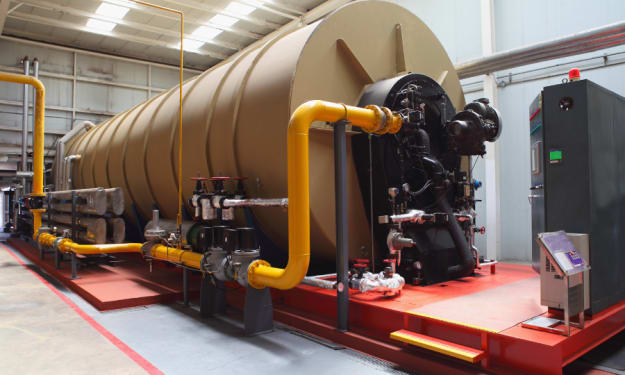
Saudi Arabia Boiler Market: Clean Energy Transition, Vision 2030, Emission Control & Modern Heating Systems
Saudi Arabia's boiler market grows through Vision 2030-driven industrialization, with rising demand in petrochemicals and power plants. Innovations like energy-efficient and biomass-fired models support sustainability goals, while Aramco expansions boost adoption of advanced systems amid rapid infrastructure projects. According to IMARC Group's latest research publication, Saudi Arabia boiler market size reached USD 902.70 Million in 2024. The market is projected to reach USD 1,631.91 Million by 2033, exhibiting a growth rate (CAGR) of 6.10% during 2025-2033.
By Jeffrey Wilson5 days ago in Futurism



Comments
There are no comments for this story
Be the first to respond and start the conversation.