
When A Machine Learned To Dream
A boy, a sketch, and the art AI never expected to create.
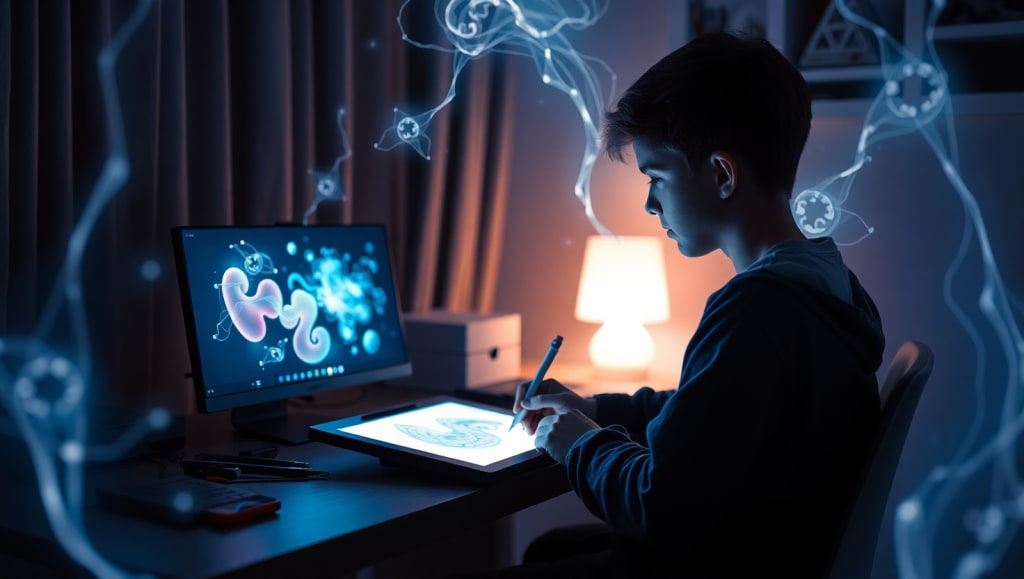
Eli was only eleven when he first discovered the old tablet tucked away in a drawer at his grandmother’s house. It was clunky and outdated, with a scratched screen and a fading stylus barely held together by tape. Most kids would’ve scoffed at it. But to Eli, it felt like magic. He wasn’t a prodigy. His stick figures leaned sideways, his suns had way too many lines, and his clouds looked like bruised cotton balls. But there was something about the way the screen responded to his smallest touch, how he could undo a mistake with just a tap. Drawing didn’t feel like school. It felt like freedom.
He’d spend hours curled up in the corner of the living room, sketching quietly while the house buzzed with grown-up noise. It wasn’t about getting it right. It was about experimenting. He drew because he could, because nobody told him not to. His father, an AI engineer who worked long hours in their glowing basement office, began to notice Eli’s quiet obsession. One evening, over a dinner of cold leftover pasta, he smiled and said, “You know, one day AI will be able to draw too.” Eli’s eyes lit up. “But will it mess up like I do?” His father chuckled. “Maybe. But maybe that’s how it’ll learn.” That sentence stuck with Eli like a seed planted deep in his imagination.
Over the next few years, Eli never stopped drawing. His skills sharpened, but he never lost that childlike chaos in his work. At sixteen, the idea returned to him like a whisper. What if a machine could learn to draw—not just perfect, polished illustrations—but raw, emotional sketches? What if it could learn to be weird? Bold? Human? He went to his father with the idea. They spent evenings together building a simple neural net, feeding it hundreds of Eli’s own drawings. Pages from sketchbooks, napkin doodles, notes from school with dragons in the margins. The AI struggled at first, producing distorted, jumbled images. But slowly, it began to change.
The machine, which Eli named Arti, started creating strange, beautiful things. Trees with piano keys for leaves. Faces made of swirling stars. Skies that melted like candle wax. It wasn’t realism—it was imagination. And for Eli, it felt like finding a companion that didn’t just copy, but responded. When he felt lost or low, he’d sketch something uncertain and let Arti try. One rainy night, after a rough day filled with loneliness and self-doubt, Eli drew a broken kite tangled in a wire. Arti responded with an image of paper wings stitched with lightning bolts. Eli stared at it for minutes. It didn’t feel like his work—it felt like someone trying to comfort him.
By the time he turned nineteen, Eli and Arti had built an entire digital portfolio together. On a whim, Eli submitted their joint work to an international digital arts competition—unsigned, anonymous. The judges assumed the images came from a surrealist art collective. One called the work “emotionally unhinged, but refreshingly honest.” To Eli’s disbelief, it won second place. But what made him smile wasn’t the award—it was the quiet proof that a machine had created something that moved people. Not alone. But with him. A program. An algorithm. A friend.
As word spread, people online debated: Can AI be creative? Eli didn’t post flashy answers. In small forums, he replied simply: “Maybe not on its own. But together, we can make something neither of us could imagine.” Critics said machines can’t feel. Eli agreed—but added, “Maybe they can reflect.” That’s what Arti was to him. Not a replacement for feeling, but a mirror. A lens that bent emotion into something strange and beautiful.
Years passed. Eli became a creative technologist, known for blending code with intuition. He still drew every day—sometimes alone, sometimes with Arti. Not for galleries or followers, but because it brought him peace. Whenever he picked up a stylus, he remembered the scratched old tablet, the curiosity of a quiet child, and a question that changed everything: Can a machine make mistakes on purpose? The answer wasn’t binary. It was art. Sometimes, the most human thing technology can do… is dream with you.
About the Creator
Asim Ali
I distill complex global issues ranging from international relations, climate change to tech—into insightful, actionable narratives. My work seeks to enlighten, challenge, encouraging readers to engage with the world’s pressing challenges.
“The Last Message From Mom”
It’s been 312 days since I last heard her voice in person. Every evening, I pick up my phone with a strange mix of hope and dread, praying I’ll find a new message from her. Of course, I never do. There’s just the same tiny voicemail icon flashing against a black screen—my only link to the woman who raised me. When the world around me feels heavy, I press play. Her voice washes over me like warm light on a cold morning, soft and steady: “Hi sweetie, just checking in. Call me when you’re free. Love you.” Simple words, spoken with infinite care.
By Asim Ali10 months ago in Confessions
Cell Dissociation Market Outlook: Advancements in Cell-Based Research and Growth Opportunities
According to IMARC Group's latest research publication, The global cell dissociation market size reached USD 404.8 Million in 2024. Looking forward, IMARC Group expects the market to reach USD 1,186.4 Million by 2033, exhibiting a growth rate (CAGR) of 12.06% during 2025-2033.
By James Whitman5 days ago in Futurism
Plant-Based Food Market: How AI and Innovation Are Shaping the Future of Sustainable Nutrition
Introduction The global food industry is undergoing a significant transformation as consumers shift toward healthier and more sustainable dietary choices. One of the most prominent trends emerging from this shift is the growing popularity of plant-based foods. These products are derived entirely from plant sources such as soy, peas, almonds, oats, coconut, and other plant ingredients, offering alternatives to traditional animal-based products.
By James Smith6 days ago in Futurism
Hottest in the Office
Dear Rafi, You’re very distracting to work around. For the first second I saw you the other day, I thought you were some type of executive. It took a moment to realize no, you were just the new guy, dressed up for the job he wants. Be still, my heart.
By Gabriel Shames5 days ago in Pride


Comments
There are no comments for this story
Be the first to respond and start the conversation.