
What If You Fell Into A Black Hole?
Do black holes even exist?

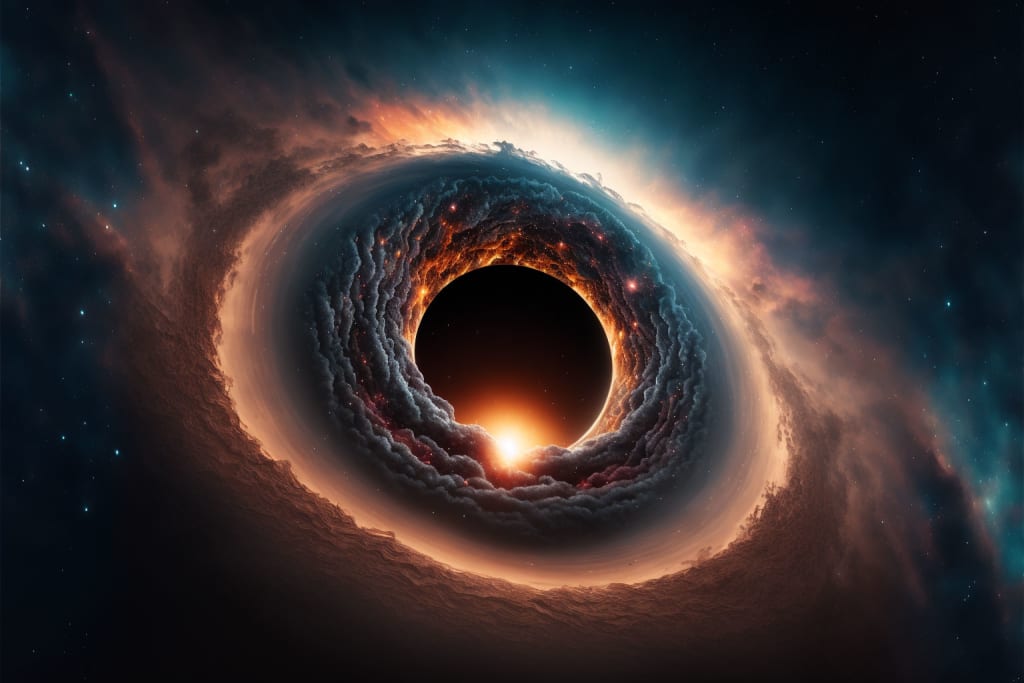
Do you want to know more about black holes? What happens if you are caught in one? Envision travelling through space to find a new home for humanity. Suddenly, you stumble upon a black hole. Overwhelmed by curiosity, why not look into it? Is it possible to survive? Are you able to escape? Is there a way to reach a different universe?
Though it is "black" and a "hole," a black hole is not a void. In his theory of relativity, Einstein predicted how black holes form. A smaller core remains after a large star dies. Gravity overcomes all other forces if the mass of the core is at least three times that of our Sun. As a result, the core becomes a black hole. But a black hole isn't really a hole at all. It is a substantial volume of matter crammed into a small area.
The gravitational field of the Sun is 28 times stronger than that of Earth. On the Sun, you would be 28 times heavier than on Earth. Imagine packing four Suns into a 15-mile radius—a drivable distance in thirty minutes. How much gravity would there be? The gravitational pull of a black hole is so great that even light cannot escape. Although a black hole cannot be seen, its presence can be identified by gamma-ray bursts, which bear Stephen Hawking's name.
According to Stephen Hawking, black holes can act as portals to other universes. Would someone find oneself in a different dimension if they were to fall into a black hole? Every black hole has an event horizon, which is the point at which gravity becomes too great to escape. The term "point of no return" refers to this. A complete circle of darkness surrounded by twisted stars would be visible to anyone looking in from outside this location. The force of gravity would cause someone to accelerate as they got closer to a black hole. For any brave astronaut, this is the first bad news they will encounter in space.
The gravitational force of a black hole is extremely strong. Your body would be stretched apart if you fell into one because the pull of gravity would be greater on your legs than on your head. A "stellar" black hole, the most common kind, can weigh up to 20 Suns and have a diameter of roughly 9 miles (15 km). Before you could reach the event horizon, you would be ripped apart if you were drawn in the direction of a stellar black hole. Hence, selecting a supermassive black hole—which is a million times heavier than the Sun—is advised!
Your body wouldn't be in pain as you reached the event horizon because in this situation, gravity would be pulling on your head and feet with almost equal force. In case you were wondering, you don't need to look far to find a supermassive black hole. One is situated precisely in the Milky Way galaxy's centre. Fortunately, since it is 165 quadrillion miles (or 265 quadrillion km) from Earth, it won't destroy the Sun or the planets. Don't start packing up though, because the challenge doesn't finish until the event horizon is reached.
There is a gravitational singularity at the heart of the black hole where density is infinite. That black hole would squeeze you into its core and combine you with it. You couldn't possibly tell others about your crazy encounter. But a third party observing you from beyond the event horizon would see things quite differently. As you slowed down and turned redder and dimmer, they would see you fall slowly into a black hole. In the end, you would simply freeze and never be able to cross the event horizon. The reason for this is that within a black hole, space and time alternate roles.
On the other hand, time pauses at the event horizon, but space moves forward. Time travel would not be feasible, nor could one turn around and escape the black hole. It would be hard to distinguish between you and any other particles the collapsing black hole had ingested, and the particles it was spewing forth. Your body would become a part of it. Stephen Hawking did, however, find a way to stop the information in your body from being lost. He proposed the hypothesis that there are parallel universes with different histories. This suggests that in one universe you fell into a black hole, while in another, there wasn't one to begin with.
It is hard to tell for sure whether a black hole exists until one goes below the event horizon. But even if you were in an alternate world or some other reality without a black hole, you would still be alive. You could not return to your previous life in any manner. Even in that scenario, would you be brave enough to look into the possibilities and investigate the potential?
About the Creator
Rose Goldstein
I'm an aspiring storyteller, researching tales and interesting topics that resonate with me and hopefully, you too.
Keep reading
More stories from Rose Goldstein and writers in Futurism and other communities.
The Strange Science Of Dreams
The dream in which August Kekule discovered the chemical structure of benzene is one of the most well-known dreams in history. But for most of us, dreaming is more than just finding new chemistry. People have been trying to figure out why we dream for years and we have yet to find the answer.
By Rose Goldstein2 years ago in FYI
About Binding Prometheus
I want to start actively advocating on behalf of my own work, and the most valuable part of my canon is, without a doubt, Binding Prometheus, the play I have been working on since 2019 and only finished in 2023 as part of my MA. The play itself is an amalgamation of a million different inspirations. On one end, it evokes the Ancient Greek myth-play, deriving its own title from the earliest extant work of Western drama we have, Aeschylus’s Prometheus Bound. On the other end, it borrows significantly from the sci-fi bulwarks from over the years, namely Mary Shelley’s Frankenstein and Karel Capek’s Rossum’s Universal Robots. The play could be an episode of Black Mirror, I fear. I don’t know. I’ve only ever seen one episode of Black Mirror.
By Steven Christopher McKnight24 days ago in Futurism
UAE Food Waste Composting Machine Market Size and Forecast 2025–2033
UAE Food Waste Composting Machine Market Outlook The UAE Food Waste Composting Machine Market is undergoing a rapid transformation as the country accelerates its transition toward a circular and sustainable economy. According to Renub Research, the market is expected to reach US$ 432.63 million by 2033, rising from US$ 222.95 million in 2024, growing at a CAGR of 7.64% from 2025 to 2033.
By Renub Research2 days ago in Futurism




Comments