
What If We Never Went to War? A Look at the World That Might Have Been
A contrast article exploring the alternate timeline where wars never happened—and how that might have changed the speed, ethics, and soul of our civilization.

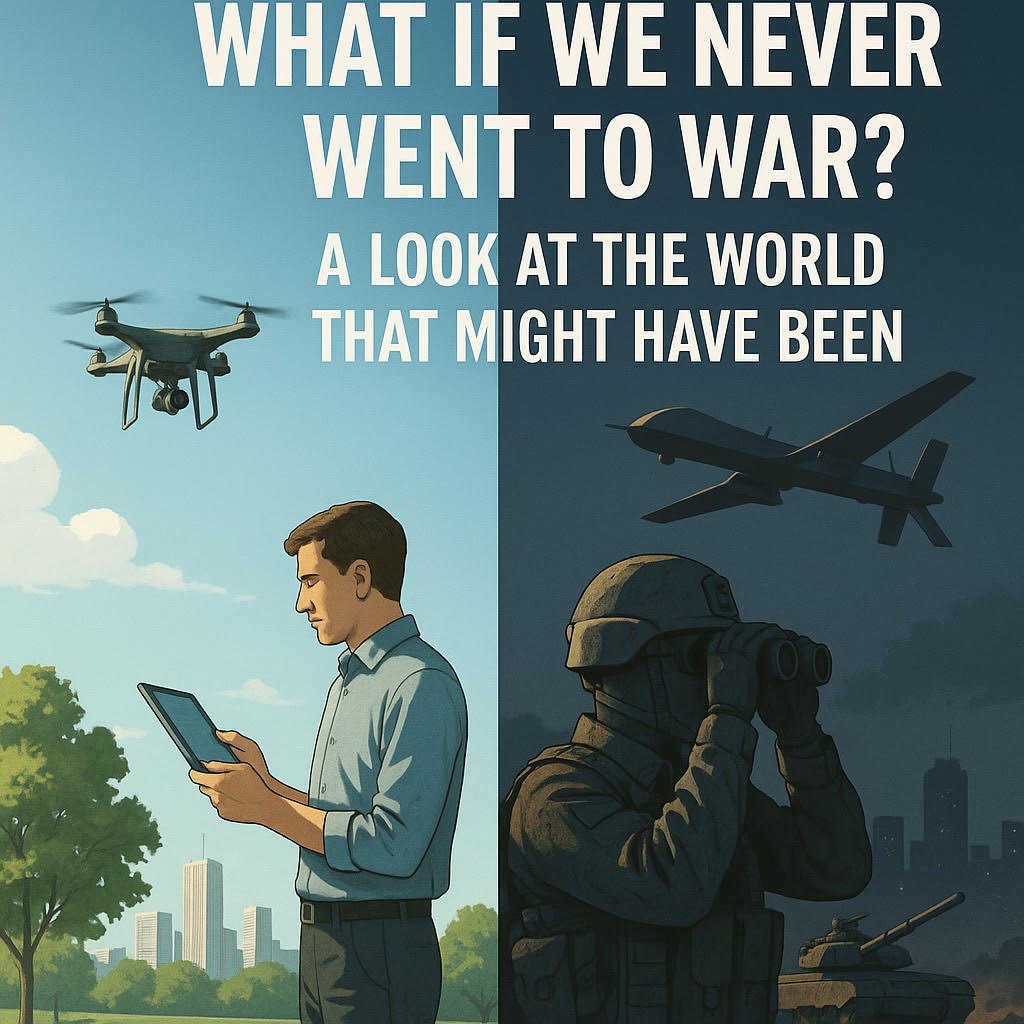
War gave us the internet, GPS, antibiotics, and jet engines. But what if it never happened? Would we still have reached today’s modern world—or would we be stuck in a slower, safer past?
It’s a question that haunts history lovers, futurists, and philosophers alike: Where would humanity be if we had never gone to war?
The 20th century was defined by catastrophic conflict—but those same wars also triggered explosive innovation. They reshaped our technology, medicine, culture, and global systems. It’s a tragic paradox: war destroys—but it also drives.
So let’s imagine an alternate reality.
🕊️ A World Without War: Slower, Softer, More Human?
In this alternate timeline, the two World Wars never happened. No Cold War. No arms race. No global proxy conflicts.
Here’s what that world might look like:
🚀 Technology Would Evolve—But Slower
Without the arms race, we wouldn’t have poured billions into rocketry, computing, and radar.
- The internet might still be limited to university campuses.
- GPS might have evolved only through civilian aviation—not missile guidance systems.
- AI and robotics would be tools for farming and medicine—not war zones.
We’d likely still reach similar innovations—but through slower, more ethical civilian demand rather than wartime urgency.
🧬 Medicine Might Be More Compassion-Driven
War rushed the development of:
- Penicillin mass production
- Emergency medicine and trauma surgery
- Advanced prosthetics and rehab
- Plastic surgery and skin grafts
In a peaceful world, these advances might still emerge—but from humanitarian efforts, not military need. We’d likely see more equitable health systems, less skewed toward combat readiness.
🌍 Global Politics Would Be Less Reactive
No war means:
- No United Nations (which formed to prevent another WWII).
- No Cold War alliances like NATO.
- Possibly no European Union, since WWII pushed Europe toward unity.
Would the world have found better ways to cooperate—or would we be even more fragmented, isolated, and distrustful?
🎨 Culture Might Be More Innocent—Or Less Self-Aware
Much of modern art, literature, and music comes from reckoning with war:
- The poetry of World War I.
- Anti-war music during Vietnam.
- Post-WWII existentialism.
- Feminism and civil rights movements accelerated by war-era workforce shifts.
In a war-less world, culture might feel less fractured—but also less critical, less raw.
⚖️ Would We Be More Ethical—Or Less Ready?
Without war, innovation might emerge in ways that prioritize ethics over dominance:
- AI built for care-giving, not surveillance.
- Drones designed for farming, not targeting.
- A world where tech is meant to uplift, not overpower.
But there’s a catch: we might also be dangerously unprepared for pandemics, disasters, or aggression—because we never built the emergency systems war forced into being.
🔄 So… Would It Be Better?
It’s not a simple answer.
A world without war might be:
- More peaceful
- More emotionally whole
- More ethical in its innovation
But it might also be:
- Technologically slower
- Politically fragmented
- Less prepared for global threats
It would be softer. Maybe kinder. But also less united by shared struggle.
🌱 The Future Is Still Ours to Shape
Here’s the key takeaway:
We don’t need war to drive progress anymore.
We can choose to invest in climate tech, health innovation, and global collaboration with the same intensity we once reserved for arms races.
Imagine a world where the next “arms race” is about curing cancer, extending life, or solving world hunger.
We’ve already proven what humans can do under pressure.
The question now is: Can we do it without the destruction?
💬 What Do You Think?
Would a world without war be better? Or did conflict push us forward in ways we couldn’t replicate otherwise? Let’s talk in the comments.
About the Creator
Corey
Curious thinker, observer of the human condition.
About Binding Prometheus
I want to start actively advocating on behalf of my own work, and the most valuable part of my canon is, without a doubt, Binding Prometheus, the play I have been working on since 2019 and only finished in 2023 as part of my MA. The play itself is an amalgamation of a million different inspirations. On one end, it evokes the Ancient Greek myth-play, deriving its own title from the earliest extant work of Western drama we have, Aeschylus’s Prometheus Bound. On the other end, it borrows significantly from the sci-fi bulwarks from over the years, namely Mary Shelley’s Frankenstein and Karel Capek’s Rossum’s Universal Robots. The play could be an episode of Black Mirror, I fear. I don’t know. I’ve only ever seen one episode of Black Mirror.
By Steven Christopher McKnight18 days ago in Futurism
Wood Vinegar Market: Agroforestry Integration, Sustainable Practices & Adoption Trends
According to IMARC Group's latest research publication, the global wood vinegar market size reached USD 5.21 Billion in 2024. Looking forward, IMARC Group expects the market to reach USD 8.32 Billion by 2033, exhibiting a growth rate (CAGR) of 5.30% during 2025-2033.
By Andrew Sullivan3 days ago in Futurism


Comments (1)
You've really made me think about how war has shaped our world. I wonder if we'd have found other ways to drive innovation without the urgency of war. And in medicine, would the focus on compassion have led to even more widespread and equal healthcare? It's fascinating to consider this alternate reality where war didn't play such a huge role.