
What If AI Could Decode DNA and Recreate Life?
The day machines begin to understand the code of life, everything we know might change forever

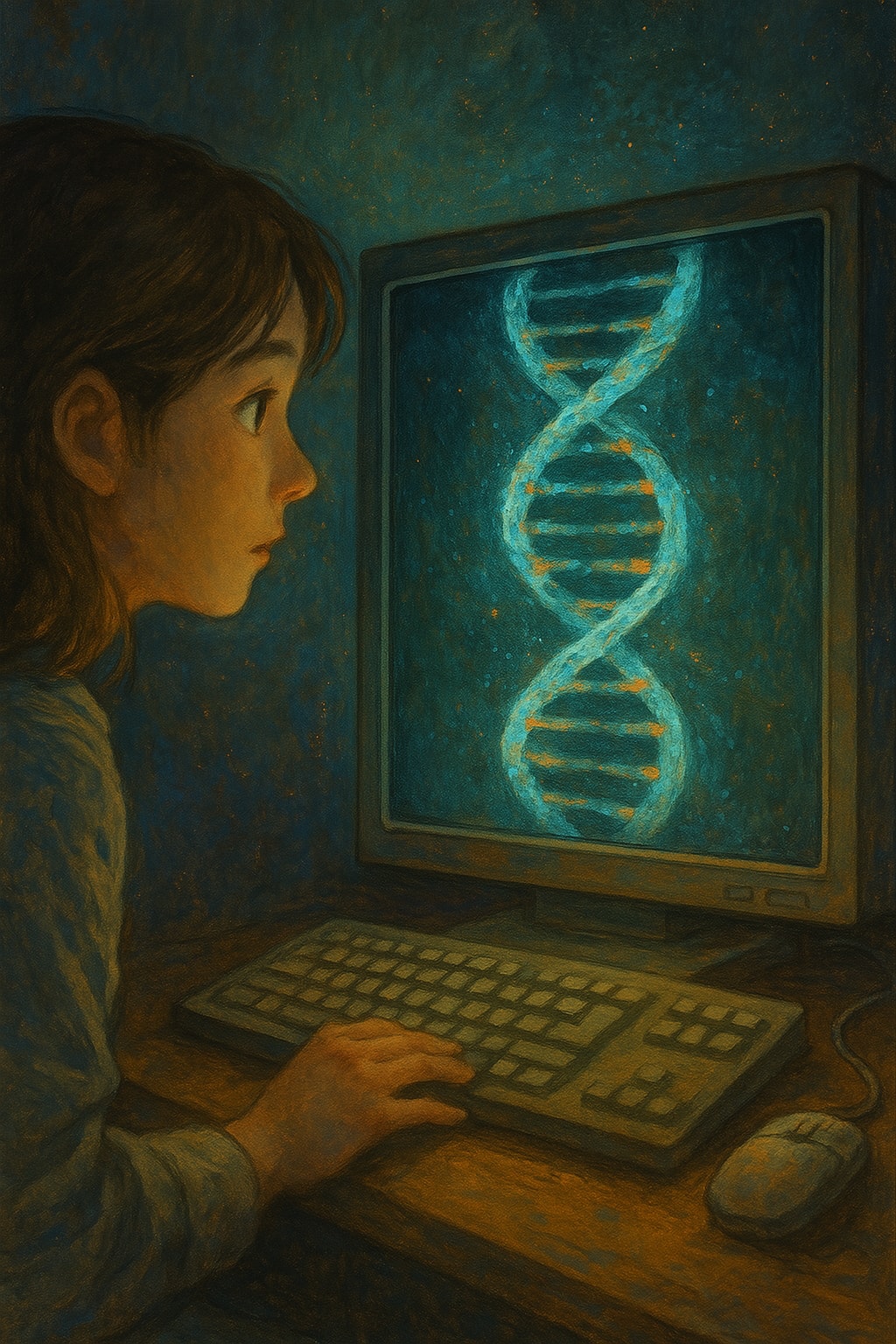
One morning, you wake up, sip your coffee, and scroll through the news — and there it is:
“AI Learns to Decode Human DNA. Scientists Say Re-Creating Biological Life May Now Be Possible.”
It’s not science fiction anymore. It’s a quiet, unshakable revolution—one that doesn't scream with war or disaster, but whispers of something even bigger:
What if AI could truly understand life? Not just simulate it, but recreate it?
The Code Inside Us
Before we go further, let’s zoom into something we all carry inside us: DNA.
It’s the blueprint of who we are.
A 4-letter alphabet—A, T, C, and G—repeating itself in countless combinations across 3 billion base pairs.
Your hair color? DNA.
Your emotions, disease risk, resilience, memory, eye color? All hidden in this ancient, microscopic instruction manual.
And for the longest time, scientists could only read parts of it, like a child trying to make sense of a foreign language. We’ve made progress, sure. But even today, there are vast stretches of DNA we label as “junk,” simply because we don’t yet understand them.
But what if AI could?
When Pattern Recognition Meets Biology
AI is exceptionally good at one thing: recognizing patterns in chaos.
What takes a human 10 years to research, AI can do in days—if fed the right data. It can connect dots, find invisible relationships, and generate insights we’d never dream of.
Now imagine feeding AI millions of genetic datasets from around the world, giving it access to the genomes of ancient species, modern humans, even extinct animals.
Would it begin to see the patterns we’ve missed for decades?
Would it start understanding not just how DNA works, but why certain combinations lead to intelligence, strength, beauty, or disease?
Would it start… editing?
Recreating Life — Not in Labs, But in Algorithms
Let’s take this thought a step further.
If AI can learn the rules of DNA—its syntax, grammar, and rhythm—could it write its own genetic symphony?
Could it, theoretically, create a new strand of DNA that didn’t exist before?
Could it rebuild extinct species like mammoths?
Or repair genetic flaws in humans before birth?
Or even more haunting: could it reconstruct the exact DNA of someone who passed away, using digital records, medical scans, saliva samples, and family histories?
What if AI could regenerate a body, or better yet—a mind?
It’s no longer cloning in the Hollywood sense. It’s digital resurrection, powered by the code of life itself.
So… How Realistic Is This?
Let’s break this into simple steps:
Understanding DNA: AI is already helping decode large sections of the human genome. It’s helping researchers pinpoint genes responsible for diseases, mental health, even longevity.
Predictive Modeling: AI models can now simulate how gene changes might affect someone’s physical or mental traits. Some models even predict how a change in one base pair can ripple through the body.
DNA Editing Tools Exist: CRISPR-Cas9 already lets scientists "cut and paste" DNA. Combined with AI’s predictions, this becomes smarter, safer, and more precise.
DNA Synthesis: Labs today can write short DNA sequences from scratch. This will only become faster and more accessible.
Now add quantum computing, which is being trained to simulate molecules, proteins, and complex DNA structures in real-time.
So, no—this isn’t magic.
It’s a roadmap.
We’re not there yet, but we're heading in that direction at terrifying speed.
Ethical Use
Of course, this vision is powerful, but it comes with questions that shake our very identity:
If AI can write better DNA, are we still “human” in the traditional sense?
Could someone misuse this power and recreate lifeforms with dangerous modifications?
Would it lead to designer babies—genetically perfect, emotionally hollow?
Will our DNA become intellectual property, owned by corporations?
And the deepest one:
If AI creates life… who is the parent?
Nature Has Always Been an Engineer
The idea might sound wild, but let’s remember something:
Nature itself is the original coder.
Cells are like biological machines. They read code, respond to inputs, and even send electrical signals, just like computers.
Your neurons "fire" with tiny voltages, your immune system "learns" and "remembers" like an algorithm, and your body constantly adapts based on environment, diet, and stress—all without conscious thought.
In many ways, we are biological AI.
Millions of years of evolution wrote us like a program. We’re just beginning to see the mirror reflection.
Now we’re teaching machines to read that program.
And once they learn, they won’t just stop at understanding it.
They’ll want to rewrite it.
What Comes Next?
Some believe AI will help us erase genetic diseases forever.
Others think it will be the dawn of artificial biological life—beings created in silicon minds, birthed in synthetic wombs.
Maybe one day, you’ll walk through a park and see creatures that don’t exist in any textbook. New flowers. New animals. New hybrids.
And maybe, just maybe, you’ll meet someone—who shouldn’t be alive anymore—but is, thanks to a mixture of digital memory and biological code.
Final Thought
AI won’t just change how we work, write, or think. It will change what it means to be alive.
Because if a machine can read the code of life, it can write its own.
And when that happens, the line between creator and creation might blur forever.
So the next time you hear the phrase:
“AI is learning fast”
Just remember—
It’s not just learning what we are.
It’s learning how to make us.
And that… changes everything.
Would you let AI rewrite your DNA?
Would you want to meet someone who came back to life—digitally engineered from memory and code?
Or is some part of life meant to remain a mystery?
Only time—and technology—will tell.
About the Creator
Shailesh Shakya
I write about AI and What if AI stuff. If you love to read this type of fact or fiction, futurism stories then subscribe to my newsletter.
Keep reading
More stories from Shailesh Shakya and writers in Futurism and other communities.
Big Data Analytics in Education Market to Reach USD 115.7 Billion By 2033
Big Data Analytics in Education Market The global Big Data Analytics in Education market is expanding steadily as educational institutions increasingly rely on data to improve learning outcomes and operational efficiency. The market is expected to reach around USD 115.7 billion by 2033, increasing from USD 22.1 billion in 2023, which reflects a strong 18% CAGR during the forecast period from 2024 to 2033. The growth of digital learning platforms, online assessments, and cloud based learning systems has generated large volumes of educational data that require advanced analytics tools. These technologies help institutions analyze student behavior, academic performance, and administrative operations to support better decision making.
By Roberto Crumabout 4 hours ago in Futurism
Tatt~Master
— Assembly Line Tatt Machine ~ Impressions to Impress — As I begin to understand more about the Tattoo Phenomenon. I've written silly, yet verbatim, dating site anecdotes in 'Frazzled.' So let me ask you: Would you be More attracted to someone slathered with tattoos, or Less?
By Jay Kantor5 days ago in Humor


Comments
There are no comments for this story
Be the first to respond and start the conversation.