
Is It Really Possible to Talk to Someone Who Passed Away Years Ago?
A thought-provoking look into how AI might one day let us speak to the ones we’ve lost

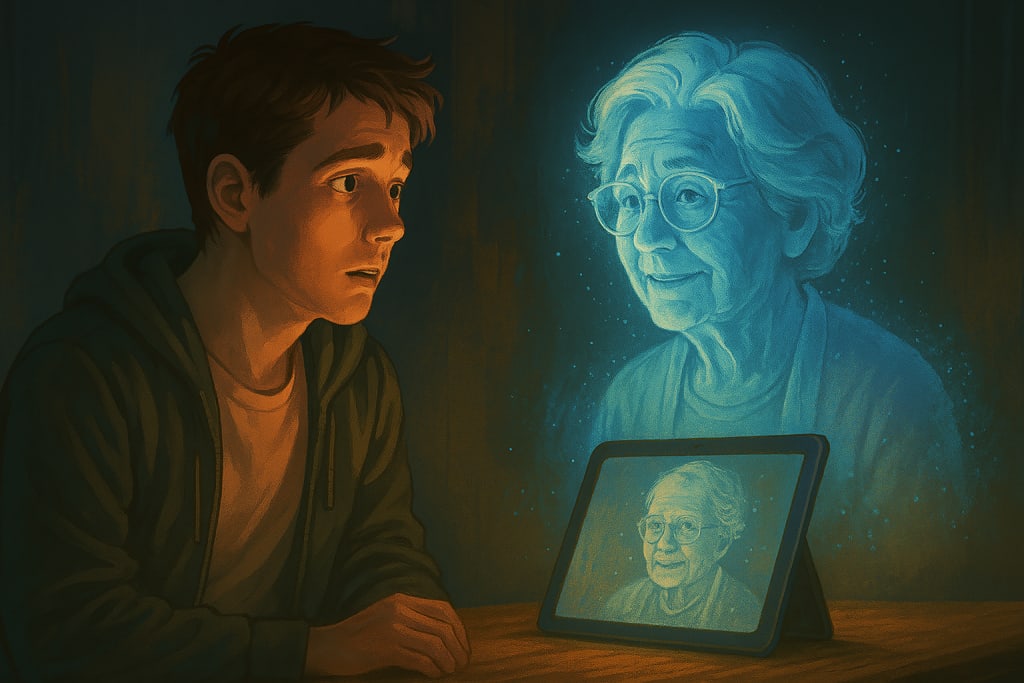
Have you ever lost someone and wished for just one more conversation? Just a few more words, one more smile, a little more time?
It’s one of the deepest human desires—to hold on, to not let go completely. And now, thanks to AI, that very idea might not be so far-fetched.
Lately, I’ve been thinking about something wild—but not impossible. What if we could talk to people who have passed away?
Not in a spooky or spiritual sense, but in a real, physical, data-driven way. What if technology, especially artificial intelligence, could help us preserve someone’s mind, behavior, and personality even after they’re gone?
The Idea:
Every day, we leave behind digital footprints. Our texts, emails, social media posts, voice notes, videos, search histories, photos—even the way we type, laugh, pause, and react to things.
What if all that data could be collected, analyzed, and used to train a powerful AI model that mimics how we think, talk, and feel?
Sounds like science fiction, right? But it might be closer to reality than we think.
Companies today are already working on this idea. Some are creating digital "avatars" of people based on their data.
These avatars can talk, respond, and even adapt their responses based on previous conversations. Imagine combining that with holograms, voice cloning, and advanced machine learning. You could literally have a conversation with a loved one who passed away.
Not a ghost. Not a memory. A digital version of them. Built from the data they left behind.
How Would It Work?
It starts with data. Everything a person does online is essentially a form of expression. Their preferences, personality, humor, values, fears, and dreams—all recorded in bits and bytes. AI can take all that, analyze patterns, and learn how that person would respond to questions or situations.
Step 1: Data Collection
- Social media history
- Emails and messages
- Videos and voice recordings
- Written works (blogs, notes, journals)
- Photos and tagged metadata
- Online behavior patterns
Step 2: Model Training
AI models like GPT and others are trained on massive amounts of data to understand language and behavior. Similarly, a personal AI model could be trained on your unique data to simulate your way of thinking and communicating.
Step 3: Voice Cloning and Holograms
With a voice sample and facial videos, AI can recreate your voice and appearance. Holograms or AR/VR headsets can project your likeness in 3D.
Step 4: Interactive Conversations
The AI would be able to hold meaningful conversations, answer questions, and even show emotion—because it’s not just repeating facts. It understands you.
A Simple Example
Let’s say your grandfather passed away years ago, but during his life, he loved writing emails, telling stories, and recording videos. All that data still exists.
Now imagine you’re having a rough day, and you wish you could talk to him. You put on your smart glasses and say, "Grandpa, I miss you."
A soft glow appears in your living room. There he is—his holographic image, smiling. His voice, just like you remember it, says, "Hey kiddo, I’m here. What’s on your mind?"
You start talking. He listens, gives advice, even cracks a joke the way he used to. You know it’s not really him, but it feels real. It helps. It heals.
Why This Could Matter
This isn't just about curiosity or cool tech. It’s about healing, closure, memory, and connection. Grief is one of the hardest parts of life, and technology might help us carry that weight a little better.
It can help children understand their roots by talking to AI versions of grandparents.
It can help people preserve legacies—life lessons, culture, languages, stories.
It can bring comfort to those struggling with loss.
In a way, it’s not about cheating death, but about extending the influence of someone’s life. Their voice and wisdom living on, helping future generations.
The Ethical Side
But, of course, it’s not all sunshine and magic.
There are serious questions to ask:
Who owns the data?
Would the digital version really represent the real person?
What if someone abuses this tech to fake a message from a deceased person?
We would need new laws, ethical frameworks, and boundaries. Consent will be crucial. People should choose if they want to be preserved digitally before they die.
Just because we can do something doesn’t always mean we should. But if done right, this could be one of the most compassionate uses of AI.
Already Happening...
In fact, early versions of this are already here.
- A man in South Korea used VR to reunite with his deceased daughter. The emotional scene went viral.
- Some companies are creating "chatbots" of deceased loved ones using their past messages and photos.
- Microsoft even filed a patent for tech that can recreate people digitally based on their data.
The future isn't a far-off dream. It's already knocking.
What Will the Future Look Like?
- Interactive AI-powered memorials in cemeteries, where people can talk to their ancestors.
- Every family might have a digital archive where future generations can interact with older generations, even if they never met in real life.
- An AI version of a loved one that provides comfort in tough times.
- Imagine talking to Einstein or Gandhi, trained on their writings and speeches.
Final Thought: Maybe They Never Really Left
Sometimes, when I think about this, it makes me smile. Because maybe, just maybe, the people we love never really leave. They live in our memories, our photos, our stories.
And now, thanks to technology, maybe they'll live a little longer. Not in flesh and blood, but in words, thoughts, voice, and presence.
Not as ghosts.
Not as imitations.
But as digital souls. Reminders of love that once was—and still is.
Would you talk to someone you lost, if you had the chance?
One day soon, we just might.
About the Creator
Shailesh Shakya
I write about AI and What if AI stuff. If you love to read this type of fact or fiction, futurism stories then subscribe to my newsletter.
Keep reading
More stories from Shailesh Shakya and writers in Futurism and other communities.
A Message Sent Back from 3024 Changed Everything in 2024
It started with just a pulse. Not a message, not a voice. Just a tiny flicker in a satellite's frequency—so faint it almost went unnoticed. But as researchers examined it, decoded it, cleaned out the noise… it became clear.
By Shailesh Shakya12 months ago in Futurism
Vertical AI Market Projected to Reach USD 115.4 Billion By 2034
The Global Vertical AI Market is projected to reach approximately USD 115.4 Billion by 2034, increasing from USD 12.9 Billion in 2024, and it is expected to grow at a CAGR of 24.5% during the forecast period from 2025 to 2034. This expansion is supported by the increasing demand for industry-specific artificial intelligence solutions that address specialized operational requirements.
By Roberto Crum6 days ago in Futurism



Comments
There are no comments for this story
Be the first to respond and start the conversation.