
What I Think About Mars
Is the Red Planet Our Future Home or a Distant Dream?

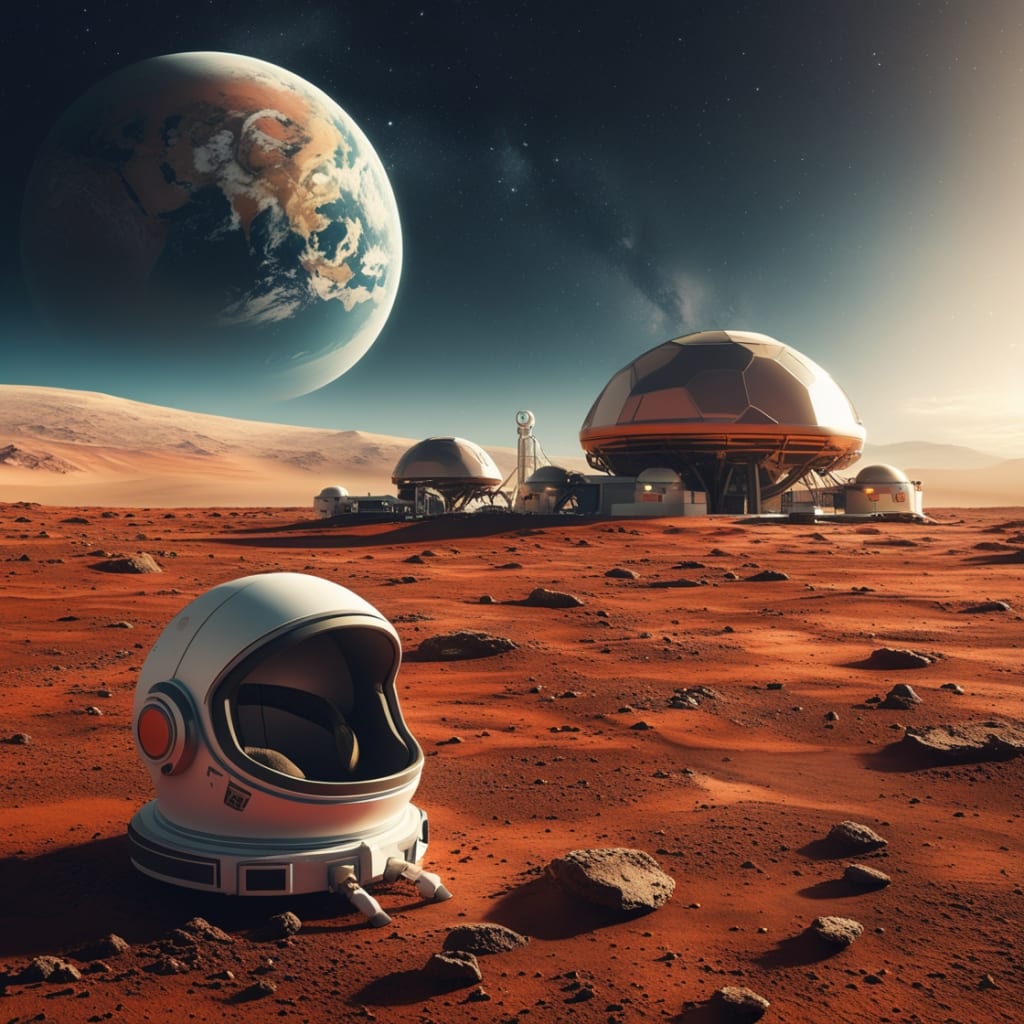
Ever since I first saw a photo of Mars in a school science book, something about that dry, red world pulled at my imagination. It looked empty yet mysterious, dead yet powerful—like a silent witness to a billion years of cosmic secrets. As I grew older, I watched documentaries, followed NASA missions, and read the news about billionaires trying to reach it. And now I often find myself asking: Is Mars really our next home? Or just another unreachable dream?
The Fascination with the Red Planet
Mars has always been part of our imagination. Ancient civilizations saw it as a god of war, maybe because of its red color. In modern times, it’s become a symbol of science fiction, possibility, and survival beyond Earth. But now, it’s more than fiction—it's a goal.
Rovers like Curiosity and Perseverance are exploring its soil. Space agencies are spending billions. Elon Musk’s SpaceX talks about humans landing there in our lifetime. But why? What makes Mars so special?
Why We Dream About Mars
From a scientific point of view, Mars is the closest planet that could be made livable—at least someday. It has seasons, polar ice caps, and even traces of ancient rivers and lakes. If there was water, maybe there was life. And if life existed once, it could happen again.
From a survival point of view, Earth isn’t as safe as we’d like to believe. Climate change, nuclear threats, overpopulation—we’ve got problems. Some scientists say having a colony on Mars is like having a “backup hard drive” for humanity. If something terrible happens to Earth, we might still survive... on Mars.
But it’s not that easy.
The Harsh Truth About Living on Mars
The reality is that Mars is not Earth. Not even close. Its atmosphere is 100 times thinner, and mostly carbon dioxide. You can’t breathe there. Temperatures can drop below -100°C. There’s no food, no oxygen, and no natural protection from solar radiation.
To survive, we’d need sealed habitats, space suits, artificial farms, and constant support from Earth. Even getting there is risky—it takes 6–9 months, and that’s just a one-way trip.
And that brings me to my deeper thought…
Should We Fix Earth Before We Escape It?
Sometimes I wonder: Why are we spending billions on Mars while people on Earth don’t have clean water or enough food? Shouldn’t we focus on healing this planet before dreaming about another?
I believe exploration is important. Mars teaches us about space, science, and even ourselves. But we shouldn’t use Mars as an excuse to give up on Earth.
Our planet is beautiful. It’s green, blue, full of life. Maybe the better goal is to protect what we already have—not just to search for another home, but to make sure we never need one.
Mars in My Imagination
Still, Mars continues to call me. Not because I think it’s paradise, but because it represents human courage. The idea that we dare to go where no one has gone before—that we want to build something new, even in the harshest conditions—is powerful.
If humans really do walk on Mars in my lifetime, I know I’ll be watching, probably crying, filled with awe. Because whether we end up living there or not, the journey to Mars shows what we are capable of: curiosity, unity, imagination, and endless hope.
Final Thoughts
Mars is a planet of dust, silence, and mystery. But in our minds, it’s alive with possibilities. Whether or not humans ever build cities there, the very act of dreaming about it pushes our science forward and inspires the next generation.
As for me? I’ll keep watching the sky, reading the news, and imagining the first footprint on Martian soil. Because Mars might be far away—but our dreams can go even farther.
About the Creator
Atif jamal
I write heart-touching stories and thought-provoking articles inspired by nature, emotions, and everyday life
Keep reading
More stories from Atif jamal and writers in Futurism and other communities.
Walking the Tightrope
Walking the Tightrope Finding My Rhythm in a World That Keeps Moving When I was ten years old, my school held a "Dream Career Day." Everyone had to dress up as the person they wanted to be when they grew up. Some kids came dressed as astronauts, others as firefighters, doctors, or singers. I came wearing two different name tags—one read “Engineer,” and the other said “Author.” My classmates laughed and asked if I’d forgotten to choose just one. But I remember standing there, proud and certain, saying, “Why can’t I be both?”
By Atif jamal 7 months ago in Writers
About Binding Prometheus
I want to start actively advocating on behalf of my own work, and the most valuable part of my canon is, without a doubt, Binding Prometheus, the play I have been working on since 2019 and only finished in 2023 as part of my MA. The play itself is an amalgamation of a million different inspirations. On one end, it evokes the Ancient Greek myth-play, deriving its own title from the earliest extant work of Western drama we have, Aeschylus’s Prometheus Bound. On the other end, it borrows significantly from the sci-fi bulwarks from over the years, namely Mary Shelley’s Frankenstein and Karel Capek’s Rossum’s Universal Robots. The play could be an episode of Black Mirror, I fear. I don’t know. I’ve only ever seen one episode of Black Mirror.
By Steven Christopher McKnight16 days ago in Futurism
United Kingdom Digital Signage Market Size and Forecast 2025–2033
Introduction The United Kingdom Digital Signage Market is expected to experience tremendous growth and is anticipated to expand from US$ 1.07 billion in 2024 to US$ 1.84 billion by 2033, at a Compound Annual Growth Rate (CAGR) of 6.23% during 2025–2033. This growth is being driven by the increasing need for interactive displays, continuous technological advancements, and the expanding focus on dynamic advertising solutions across industries such as retail, transportation, hospitality, healthcare, and corporate communications.
By Aaina Oberoi7 days ago in Futurism



Comments
There are no comments for this story
Be the first to respond and start the conversation.