
What are the celestial bodies we see in the night sky? How far away are they from us?
The stars we see in the night sky are all celestial bodies

In a night sky with good observation conditions, we can always see the sky full of stars, and it seems to us that the whole universe is at our fingertips. The stars we see in the night sky are only a very small part of the Milky Way, and there are trillions of galaxies in the observable universe, of which the Milky Way is only one.
What are the stars we see in the night sky? How far away are they from us?
Most of the stars visible to the naked eye are stars. According to the inverse square law, the intensity of light decays linearly with the square of the distance, so when the stars reach a certain distance from us, it is difficult to see them with the naked eye.
If the star itself is very luminous, this range can be even larger, for example, "Seamount II" at the base of the ship (note: this is a star system with at least two stars), whose overall luminosity is about 5.9 million times that of the Sun, so that we can see it even if it is 7,500 light-years away from us, and "Seamount II is often considered to be the farthest star visible to the naked eye from us.
The smaller the apparent magnitude, the brighter the object is, and it can be taken as a negative number, with a difference of 2.512 times the brightness of the object for every 1 difference in value.
According to astronomers' statistics, there are about 7000 stars in the sky that can meet this requirement. Considering that we can only see half of the starry sky from any position on the earth's surface, the number of stars we see is only about 3000.
In addition to the stars, we see in the night sky among the stars also include the planets running in the solar system, although the planets themselves are not luminous, they can reflect the light from the sun, plus they are very close to us (compared to other stars), so in our eyes, these planets and other stars in the sky is no different, are stars.
Among the planets in our solar system, we can see Mercury, Venus, Mars, Jupiter, and Saturn with our naked eyes alone (Uranus and Neptune are not visible to us because they are a bit far from Earth), with Venus being the closest (just over 40 million kilometers from Earth at its closest) and the brightest (up to -4.92 magnitude apparent).
In addition, we may also see two special "stars" in the night sky, the first is artificial satellites, artificial satellites are generally equipped with solar panels, when the sun, artificial satellites and standing on the surface of the Earth to form a specific angle, the light from the sun will be reflected through the artificial satellite's solar panels to Our eyes, so we may think we see a star.
It is worth mentioning that because artificial satellites are always in motion, this particular angle usually does not last long, so the artificial satellite's light is usually in the night sky flicker, and also has some kind of motion, so in some cases, they will be mistaken for "UFO" (unidentified flying object).
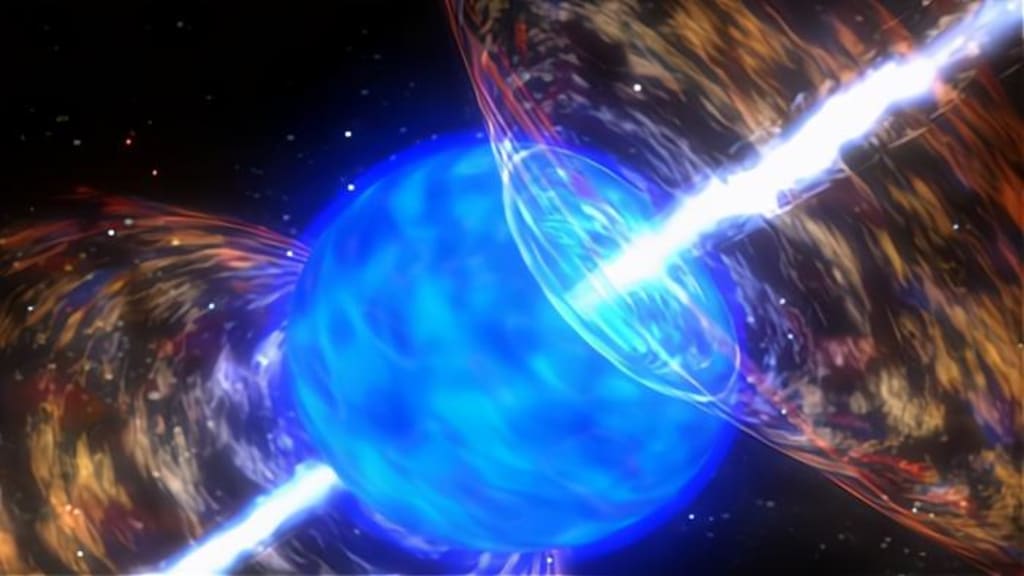
The second type is the visible light produced by high-energy events in the universe in a short period. When high-energy events such as supernova explosions and neutron star collisions occur in the universe, they produce powerful gamma-ray bursts and material jets. Gamma rays are invisible to us, but very high-velocity material jets will hit nearby interstellar matter with unusual ferocity, thus producing large amounts of visible light.
This super bright light can be seen directly even if it is very far away from us, for example, in 2008, scientists observed a high-energy event numbered "GRB 080319B", which showed that the source of the burst was located in the direction of Makemake, about 7.5 billion light years away. The source of the event was located in the direction of Makemake, about 7.5 billion light years away, but its apparent magnitude reached 5.8 magnitudes.
In other words, if a person with good eyesight on Earth was looking up at the sky, he might have seen "GRB 080319B", but in his eyes, it was just a faint star in the night sky, and he would not have noticed it.
About the Creator
Sukkning
Science will give mankind's greatest gift is? Is to make the power of humans believe that truth。
About Binding Prometheus
I want to start actively advocating on behalf of my own work, and the most valuable part of my canon is, without a doubt, Binding Prometheus, the play I have been working on since 2019 and only finished in 2023 as part of my MA. The play itself is an amalgamation of a million different inspirations. On one end, it evokes the Ancient Greek myth-play, deriving its own title from the earliest extant work of Western drama we have, Aeschylus’s Prometheus Bound. On the other end, it borrows significantly from the sci-fi bulwarks from over the years, namely Mary Shelley’s Frankenstein and Karel Capek’s Rossum’s Universal Robots. The play could be an episode of Black Mirror, I fear. I don’t know. I’ve only ever seen one episode of Black Mirror.
By Steven Christopher McKnight19 days ago in Futurism
Smart Lock Market Size to Surpass USD 9.9 Billion by 2033 Driven by IoT Integration & Connected Living Trends
According to IMARC Group's latest research publication, global smart lock market size reached USD 2.7 Billion in 2024. Looking forward, IMARC Group expects the market to reach USD 9.9 Billion by 2033, exhibiting a growth rate (CAGR) of 15.43% during 2025-2033.
By Suhaira Yusuf6 days ago in Futurism
Ludacris and Nelly draw backlash over bookings at MAGA-coded music festival
Ludacris and Nelly headlining a mostly right-wing event is good for them. It’s also great for the genre of hip hop. The two rap veterans have showcased their talents on other stages. Why can’t they perform for mostly MAGA folks and grab that bag?
By Skyler Saunders5 days ago in Beat


Comments
There are no comments for this story
Be the first to respond and start the conversation.