
Web3 Development: Unleashing the Power of Decentralized Web
In this blog post, we will delve into the world of Web3 development, exploring its key concepts, technologies, and potential applications.

Introduction:
The evolution of the internet has brought about significant changes in how we interact, share information, and conduct business. With the advent of Web3, a new era of development is upon us, one that promises to revolutionize the digital landscape through decentralization, blockchain technology, and enhanced user control. In this blog post, we will delve into the world of Web3 development, exploring its key concepts, technologies, and potential applications.
Understanding Web3 Development:
Web3, short for Web 3.0, represents the next phase of the internet, where decentralized protocols and blockchain technology empower users with greater control over their data and digital assets. Unlike its predecessors, Web3 aims to eliminate middlemen, enhance privacy, and foster trust through peer-to-peer interactions. It leverages decentralized applications (dApps), smart contracts, and interoperable blockchain networks to reshape various industries.
The Pillars of Web3 Development:
a) Blockchain Technology: At the core of Web3 development lies blockchain technology, which enables transparent, secure, and immutable record-keeping. It eliminates the need for intermediaries and enables decentralized consensus mechanisms such as Proof of Work (PoW) or Proof of Stake (PoS).
b) Decentralized Applications (dApps): dApps are the building blocks of Web3, enabling developers to create innovative solutions that operate on blockchain networks. These applications leverage smart contracts to automate processes and ensure trustless interactions.
c) Interoperability and Interchain Protocols: Web3 development emphasizes interoperability among various blockchain networks. Interchain protocols like Polkadot and Cosmos facilitate seamless communication and asset transfers between disparate blockchains, fostering collaboration and scalability.
d) Decentralized Identity (DID) and Self-Sovereign Identity (SSI): DID and SSI play a crucial role in Web3 development by enabling users to have control over their identities and personal data. These technologies replace centralized identity systems with secure, verifiable, and user-centric identity management solutions.
Tools and Frameworks for Web3 Development:
To develop Web3 applications, developers can leverage a variety of tools and frameworks, including:
Ethereum Development Tools: Truffle, Remix, and Ganache provide essential functionalities for Ethereum-based dApp development, including smart contract compilation, deployment, and testing.
Smart Contract Development Frameworks: Tools like Hardhat and Brownie simplify the development and testing of smart contracts, offering features like debugging, automated testing, and deployment scripts.
Web3.js and Other Libraries: JavaScript libraries like Web3.js, ethers.js, and Web3.py facilitate the integration of dApps with blockchain networks, enabling developers to interact with smart contracts and handle transactions programmatically.
Solidity and Programming Languages: Solidity, a smart contract programming language for Ethereum, is widely used in Web3 development. Other languages like Rust, Vyper, and JavaScript are also employed for smart contract development on different blockchain platforms.
Enhancing User Experience in Web3:
While Web3 development holds tremendous potential, user experience (UX) remains a critical factor for widespread adoption. Designing intuitive user interfaces (UI) that seamlessly integrate with decentralized systems, improving transaction speed and efficiency, and prioritizing user security and privacy are key considerations in creating compelling Web3 experiences.
Security and Regulatory Considerations:
As with any emerging technology, security and regulatory compliance are crucial in Web3 development. Smart contract vulnerabilities, secure key management, and wallet security must be addressed to mitigate risks. Furthermore, navigating the legal implications and regulatory landscape surrounding cryptocurrencies, decentralized finance (DeFi), and data privacy is essential for successful Web3 projects.
Conclusion:
Web3 development is ushering in a new era of the internet, empowering users with control, transparency, and trust in their digital interactions. With blockchain technology, decentralized applications, and interoperability protocols, Web3 is poised to disrupt traditional industries and reshape the way we conduct business, handle identities, and exchange value.
As developers delve into the world of Web3, they have access to a wide range of tools, frameworks, and programming languages that facilitate the creation of decentralized applications and smart contracts. These technologies, combined with a focus on enhancing user experience and ensuring security and regulatory compliance, pave the way for the widespread adoption of Web3 solutions.
While challenges such as scalability, UX/UI design, and legal considerations remain, the future of Web3 looks promising. As the technology continues to mature, we can expect to see innovative applications in finance, supply chain management, healthcare, and other sectors, transforming the way we interact and transact in the digital realm.
In conclusion, Web3 development represents a paradigm shift in the internet's evolution, offering a decentralized, secure, and user-centric alternative to traditional web applications. By harnessing the power of blockchain, dApps, and decentralized identity, Web3 has the potential to reshape industries and empower individuals in unprecedented ways. As developers embrace this new frontier, they hold the keys to unlocking the full potential of Web3 and driving the future of a decentralized web.
About the Creator
Keep reading
More stories from writers in Futurism and other communities.
About Binding Prometheus
I want to start actively advocating on behalf of my own work, and the most valuable part of my canon is, without a doubt, Binding Prometheus, the play I have been working on since 2019 and only finished in 2023 as part of my MA. The play itself is an amalgamation of a million different inspirations. On one end, it evokes the Ancient Greek myth-play, deriving its own title from the earliest extant work of Western drama we have, Aeschylus’s Prometheus Bound. On the other end, it borrows significantly from the sci-fi bulwarks from over the years, namely Mary Shelley’s Frankenstein and Karel Capek’s Rossum’s Universal Robots. The play could be an episode of Black Mirror, I fear. I don’t know. I’ve only ever seen one episode of Black Mirror.
By Steven Christopher McKnight26 days ago in Futurism
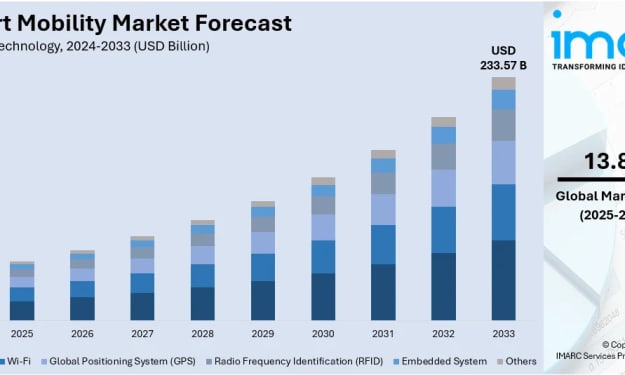
Smart Mobility Market: Sustainable Transport Solutions & Technology Advancements
Driven by urbanization, smart city investments, EV adoption, connected technologies, and supportive government policies, demand is rising for efficient, sustainable, and data-driven transportation solutions worldwide. According to IMARC Group's latest research publication, global smart mobility market size was valued at USD 68.53 Billion in 2024. Looking forward, IMARC Group expects the market to reach USD 233.57 Billion by 2033, exhibiting a growth rate of 13.87% during 2025-2033.
By Andrew Sullivan4 days ago in Futurism



Comments
There are no comments for this story
Be the first to respond and start the conversation.