
Wearable Medical Devices Market Trends: Remote Patient Monitoring, AI Integration & Forecast to 2033
How remote patient monitoring, AI-powered analytics, and connected health platforms are transforming diagnosis, treatment efficiency, and continuous care delivery across global healthcare systems

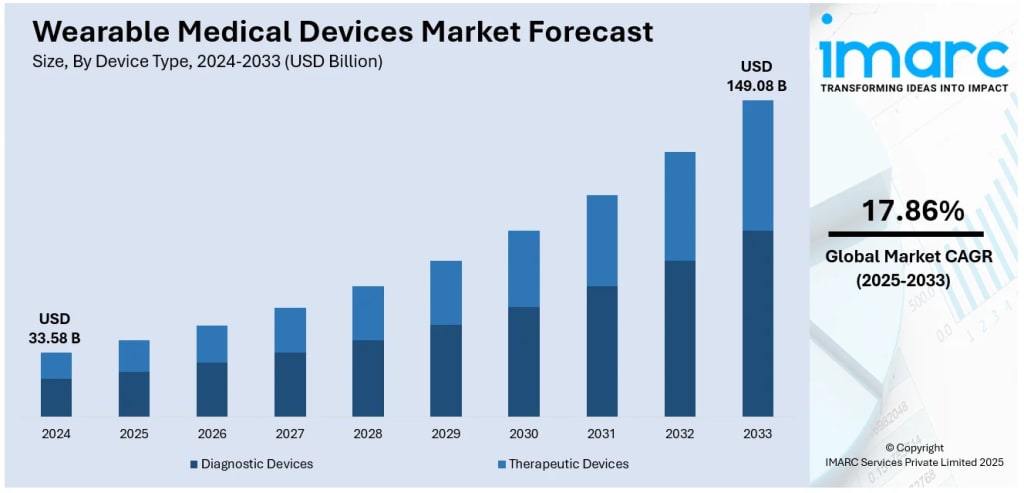
Rising prevalence of chronic diseases, accelerating shift toward remote patient monitoring and telehealth services, and rapid advances in sensor technology, wireless connectivity, and AI-driven analytics are driving explosive growth in wearable medical devices, supported by expanded reimbursement policies and increasing consumer health awareness. According to IMARC Group's latest data, the global wearable medical devices market size was valued at USD 33.58 Billion in 2024. Looking forward, IMARC Group estimates the market to reach USD 149.08 Billion by 2033.
Wearable medical devices have emerged as transformative tools bridging consumer wellness and clinical healthcare. These sophisticated gadgets—ranging from smartwatches and fitness trackers to specialized biosensors and continuous glucose monitors—enable real-time tracking of vital signs, chronic disease management, and preventive health interventions. What distinguishes modern medical wearables from simple fitness trackers is their clinical-grade accuracy and regulatory approval for medical applications. The market has evolved far beyond step counting, now encompassing ECG monitoring, sleep apnea detection, blood oxygen measurement, and even blood pressure tracking. Healthcare providers increasingly integrate these devices into care protocols, using continuous data streams to make timely treatment adjustments and reduce hospital readmissions.
Wearable Medical Devices Market Growth Drivers:
- Chronic Disease Epidemic and Continuous Monitoring Needs
Six in ten American adults live with at least one chronic disease while four in ten manage two or more conditions, according to the Centers for Disease Control and Prevention. Managing diabetes, cardiovascular disease, respiratory disorders, and hypertension requires continuous vigilance that traditional healthcare visits cannot provide. Wearable devices fill this critical gap by monitoring glucose levels, detecting irregular heartbeats, tracking blood pressure fluctuations, and measuring oxygen saturation around the clock. This constant data stream enables early detection of complications before they escalate into medical emergencies. Patients receive real-time alerts about concerning trends while healthcare providers can remotely monitor multiple patients simultaneously and intervene promptly when metrics deviate from safe ranges.
- Aging Population and Healthcare Cost Pressures
Global demographics are shifting dramatically, with the population aged sixty and above projected to double to 2.1 billion, while those aged eighty and over will reach 426 million, according to the World Health Organization. This aging wave creates unprecedented healthcare demands at precisely the moment when systems face rising costs and capacity constraints. Wearable medical devices offer a practical solution by enabling aging-in-place strategies that reduce expensive hospital stays and nursing home admissions. Remote monitoring allows seniors to maintain independence while ensuring medical oversight. The technology has proven particularly effective in preventing costly hospital readmissions by catching health deterioration early.
Request Your Free “Wearable Medical Devices Market” Report Sample
- Regulatory Approvals and Clinical Validation
Regulatory agencies have accelerated approval pathways for wearable medical devices, lending clinical credibility to consumer-grade health tracking. The FDA approved seventeen AI and machine-learning-enabled wearable devices between 2022 and 2024, primarily focused on cardiovascular and anesthesiology applications. Major smartwatch manufacturers have secured clearances for features like electrocardiogram monitoring, irregular heart rhythm notifications, and sleep apnea detection. These regulatory stamps transform devices from wellness tools into legitimate medical instruments that physicians can confidently incorporate into treatment plans. Healthcare providers now prescribe specific wearables for post-surgical monitoring, cardiac rehabilitation, and chronic disease management.
Wearable Medical Devices Market Trends:
- AI-Driven Predictive Analytics and Personalized Insights
Artificial intelligence is transforming raw sensor data into actionable health intelligence through sophisticated pattern recognition and predictive modeling. Advanced algorithms analyze millions of data points to establish individual baselines, detect subtle deviations, and predict health events before symptoms appear. Sleep tracking has evolved beyond simple duration measurement to identify specific sleep stages, breathing disturbances, and optimal bedtime recommendations. Cardiac monitoring systems now detect atrial fibrillation episodes with clinical-grade accuracy, potentially preventing strokes through early intervention. The technology learns from continuous data streams to provide increasingly personalized recommendations on exercise intensity, stress management, and medication timing.
- Integration with Telehealth and Remote Care Platforms
Wearable devices are becoming essential infrastructure for telehealth ecosystems, enabling virtual care that rivals in-person clinical assessment. Healthcare systems can now monitor patient vitals continuously rather than relying on sporadic clinic visits that provide only snapshot data. Cloud-integrated platforms automatically transmit blood pressure readings, glucose levels, and cardiac rhythms directly to physician dashboards, triggering alerts when intervention is needed. This seamless data flow proved critical during the pandemic and continues driving the expansion of hybrid care models. Clinicians can adjust medications, modify treatment protocols, and prevent emergency situations based on real-time rather than retrospective information. The technology particularly benefits rural populations and those with transportation challenges, democratizing access to specialist care regardless of geographic location.
- Expansion Beyond Wrists: Patches, Rings, and Smart Clothing
Medical wearables are diversifying beyond traditional wrist-worn formats into discrete patches, fashionable rings, and sensor-embedded clothing. Smart rings have captured particular attention, with the US market alone expected to generate substantial revenue while global shipments project millions of units. These compact devices offer continuous health tracking without the bulk of smartwatches, appealing to users seeking subtle monitoring solutions. Biosensor patches adhered directly to skin provide hospital-grade vital sign tracking for post-surgical patients recovering at home. Smart clothing with embedded sensors tracks breathing patterns, posture, and muscle activity, finding applications in cardiac rehabilitation and physical therapy. This form factor diversification addresses different user preferences and medical applications some patients prefer inconspicuous monitoring while others need specific placement for accurate readings.
Recent News and Developments in Wearable Medical Devices Market
- September 2024: Apple Inc. launched the Apple Watch Series 10, featuring a slimmer design with the largest display ever offered on an Apple Watch. The device introduced groundbreaking sleep apnea notifications using advanced sensing capabilities, along with faster charging, water depth and temperature sensing, and refined health and fitness insights through watchOS 11, available in both aluminum and titanium finishes.
- July 2025: Samsung Electronics Co., Ltd. acquired Xealth, a US-based digital health company, to integrate wearable wellness data directly into clinical workflows. This strategic acquisition enables healthcare providers to seamlessly incorporate patient-generated health data from Samsung wearables into electronic health records, facilitating more informed clinical decision-making and personalized care plans.
- November 2024: Dexcom, Inc. partnered with OURA to distribute the OURA Ring through health programs covering 75 million participants. This collaboration combines Dexcom's continuous glucose monitoring expertise with OURA's advanced sleep and recovery tracking technology, offering comprehensive metabolic and wellness insights to a massive user base across employer and health plan networks.
Note: If you require specific details, data, or insights that are not currently included in the scope of this report, we are happy to accommodate your request. As part of our customization service, we will gather and provide the additional information you need, tailored to your specific requirements. Please let us know your exact needs, and we will ensure the report is updated accordingly to meet your expectations.
About the Creator
Andrew Sullivan
Hello, I’m Andrew Sullivan. I have over 9+ years of experience as a market research specialist.
Keep reading
More stories from Andrew Sullivan and writers in Futurism and other communities.
Robotic Vacuum Cleaner Market Analysis: IoT Connectivity, Mapping Technology & Industry Forecast to 2034
Global automation trends, busy lifestyles, and growing demand for smart home technologies are driving robust expansion in the robotic vacuum cleaner market, supported by innovations in AI navigation, obstacle detection, and expanding online and offline retail channels. According to IMARC Group’s latest data, the global robotic vacuum cleaner market size was valued at USD 10.6 Billion in 2025. Looking forward, IMARC Group estimates the market to reach USD 40.7 Billion by 2034.
By Andrew Sullivanabout 5 hours ago in Futurism
Archaeologists Uncover Pieces of Lost Monumental Doorway at the Legendary Lighthouse of Alexandria
The Lighthouse of Alexandria, one of the Seven Wonders of the Ancient World, continues to captivate archaeologists and historians alike, even centuries after its destruction. Recently, a team of archaeologists made a remarkable discovery that could rewrite the history of this legendary structure. While lifting massive stones weighing 70 to 80 tons from the depths of the Mediterranean Sea, the team uncovered pieces that appear to be part of a monumental doorway—potentially linking them to the lighthouse's long-lost entrance. This discovery has sparked excitement across the archaeological community, offering a tantalizing glimpse into the grandeur of the lighthouse that once stood as a beacon for ancient sailors.
By Ayesha Lashariabout 16 hours ago in Futurism
Egypt Natural Gas Market: Industry Overview, Key Players & Future Outlook
According to IMARC Group's latest research publication, Egypt natural gas market size reached USD 3.8 Billion in 2025. The market is projected to reach USD 7.1 Billion by 2034, exhibiting a growth rate of 6.69% during 2026-2034.
By Abhay Rajput6 days ago in Futurism




Comments
There are no comments for this story
Be the first to respond and start the conversation.