


I can’t tell you the exact day I realized time was slipping through my fingers. I can only tell you the day I first slipped. But that story comes later. The truth is, it wasn’t sudden. It was a slow unraveling, like the unraveling of a favorite dress—the kind you save for special occasions. At first, you barely notice. Then time pulls harder, and suddenly, you’re somewhere else entirely.
You open your eyes and there you are, so far from home. So far from familiar. In this place there’s too much of everything—too many people, too much sound, too much time. Yet somehow, it feels like less. Like you are less. Less important, less relevant, a second class citizen in a world you carried on your back and delivered from your very womb.
The process is gradual, but that realization, the realization you’ve crossed into tomorrow and can never go back is devastating.
“I’m losing time.”
At first it was the edges, simple things like where I put my car keys, phone numbers, dates. I made excuses. “Who was meant to remember numbers?” Numbers come and go. Numbers are transient.
Then this fleeting worry sank deeper, spreading like ink through water, staining faces, events, and memories I thought were safe.
It was Emma that finally openly voiced the concern, making it tangible, pressing. “Mom, we need to take you to a doctor.” She said, stirring her coffee across from me at the small diner on.. Maple? – Or maybe Ash? Some tree-street I knew I’d walked a thousand times before.
“I’m fine!” I said, waving off her concern, pretending I couldn’t see the fear in her eyes, while I wrestled the panic filling my own throat. Dementia was a disease for the old. I wasn’t old.
“It’s 2050, mom.” Emma said gently. “Treatments have gotten better. If we start now…” her voiced trailed off as she looked away, swallowing tears. “If we start now it won’t be like dad. We can have more time.”
More time. I wondered what we would’ve done as a family if Jack had more time. So we made the appointment.
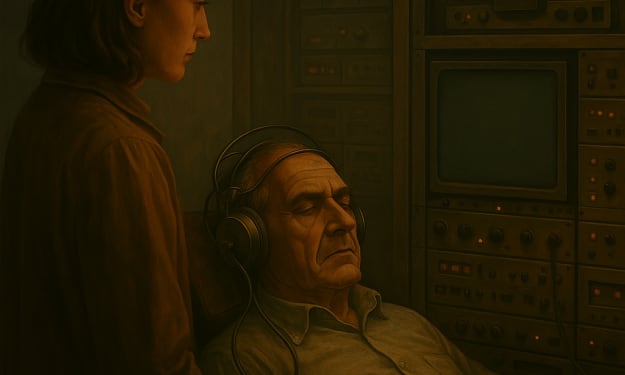
The doctor’s Voice became our war room, the place we planned battles and reviewed the latest defeats. The neurologist pulled up scans, showing images of my shrinking gray matter, visual evidence of the shifting battle lines in the war of attrition time was waging on my brain and body.
He spoke in calm, measured tones, tossing in words like “prognosis” and “disease progression,” as if they were neutral, clinical facts. But to me, they were casualties, stark reminders of what I’d already lost. But all I could hear was the tally of moments slipping away: “The summer of 2015. Our family cheesecake recipe. Emma’s first tooth.”
I could still see her standing in the kitchen, grinning up at me with that gap-toothed smile, holding the tiny prize in her palm like it was treasure. “Do you think the Tooth Fairy will know?” she asked, her eyes wide with wonder. The memory was vivid, alive, but I felt it loosening, the edges blurring. Time wasn’t just stealing my future—it was reaching back into my past, erasing pieces of me one by one.
The neurologist went on about treatment options, clinical trials, and the careful management of decline, but all I could think was,
How do you fight a war when the enemy is time itself?
I left the oOice that day carrying more pamphlets than answers. They fanned out in my lap like paper shields, as if the brightly colored brochures could hold back the coming storm. I tried not to let my fear show, for Emma’s sake. I hadn’t seen her this determined, this hopeful, in years.
We stopped by the pharmacy for my new medication, part of some experimental clinical trial. As we drove, I rolled the blue-and-yellow pill between my fingers, its smooth surface catching the light. Emma’s voice hummed in the background, explaining how lucky I was to qualify. “Side eOects can include…” she began, her voice faltering as she handed control of the car to the AI driver. The moment her hands left the wheel, a soft ping sounded, and the automated system took over.
Emma flipped through one of the brochures, triggering a holographic ad. It floated above the paper, a cheerful display of smiling geriatrics doing yoga and riding bikes. Their joy felt distant, alien, like a postcard from a life I wasn’t sure I’d ever reach.
“Nausea, vomiting, diarrhea…” the voice from the pamphlet finished for her.
I glanced over at Emma. “Please,” I said, my tone cautious but firm, “put your hands on the wheel. You know how much I hate when you do that.”
She laughed, waving her hands in the air dramatically. “Mom, the automated drivers are safer than they were when I was a kid. Don’t worry so much!”
“This isn’t how I taught you to drive,” I said, shaking my head but unable to suppress a grin. “Just turn on the radio. I can’t with you anymore.”
Emma reached for the center console and pressed a green button. A far too chipper voice filled the car. “This is DeeJay, your personalized AI disc jockey, playing the hits you love and the ones you don’t—to expand your tastebuds and get you in the mood! But first, a little news—”
Emma groaned, cutting the AI off. “It’s always the same,” she muttered. “Did it always feel like we were on the brink of war with everyone?” She tried to hide her exasperation, but I felt it too. The political pendulum constantly swinging.
I swallowed the pill and leaned back, closing my eyes as Emma rambled on about politics and the state of the world. The car swerved slightly, just enough to pull me back from the edge of sleep. My heart began to pound, a dull thud in my ears, I opened my eyes, panic blooming in my chest, and there she was—
Emma at sixteen. Her hands were off the wheel, her phone glowing in her lap.
“Put your phone down and hold the steering wheel with both hands!” I shouted, my voice sharp, cutting through the years.
She flinched, looking at me with the wide, guilty eyes of a teenager caught in the act. The world around us shimmered, and for a moment, I was certain we were back in her beat up sedan, careening down the road during her first solo drive.
But then Emma’s voice—calm, steady, and very much an adult’s—brought me back. “Mom, it’s okay,” she said gently. “The AI’s driving. You’re safe. We’re safe.”
I blinked, the memory dissolving like mist. I was back in 2050, in the automated car, with Emma beside me. But for a moment, I was somewhere else. Somewhere familiar. Somewhere I couldn’t hold onto.
I didn’t realize then, but that was the first time.
The first time I “slipped.”
It became truly apparent something diOerent was happening to me later that night as I was brushing my teeth. The bathroom smelled like mint and mildew, the fluorescent light buzzing faintly.
I glanced up at the mirror, and the reflection wasn’t quite mine. My hair was darker, my skin smoother, my eyes sharper.
And just like that, I wasn’t in the bathroom anymore.
I was in the living room of our first apartment. The avocado-green couch. The smell of fresh paint and burnt coffee. Jack was standing by the window, his tie loosened, his voice soft as he read aloud from a news story on his phone. “I told you, they’re just bluOing,” he said, turning to me with that crooked smile of his. “The Russians’ll pull back any day now.”
The memory ended abruptly, like a film reel snapping. I was back in the bathroom, the toothbrush trembling in my hand, tears running down my face.
At first, I told myself it was stress, some trick my mind was playing on me. But then it happened again. And again. One moment, I’d be folding laundry; the next, I’d be back in 2028, the summer we took Emma to the lake. I could feel the sun baking my shoulders, hear the splash of the water, and smell the faint gasoline tang of the boat engine.
“Watch me, Mom!” Emma shouted, her tiny arms flailing as she leapt off the dock. I gasped, my heart seizing as she hit the water.
And then I was back in a chair, clutching a pair of socks like they were a lifeline.
The neurologists told me it was hallucinations, an unintended side eOect of the medication. But I knew better. These weren’t just fragments of memory. They weren’t static images or vague impressions.
I was there.
I could feel the weight of my wedding ring, warm from the July sun. I could hear the way Jack’s laugh rumbled in his chest, the exact tone and timbre that I’d forgotten until that moment. I could taste the blackberry pie we baked the summer Emma broke her arm. And I could see the truth of it, clear as day: I wasn’t losing my mind.
I had become unmoored.
The slipping became more frequent, and I started to notice patterns. I never landed in a moment of sadness or pain—no funerals, no fights. I was always pulled back to the bright places, the memories that had been dulled by time but not erased.
When I tried to explain it to Emma, she just smiled, her eyes brimming with tears. “You don’t have to be brave for me, Mom,” she said, squeezing my hand.
Brave?
She thought I was afraid. How could I explain to her that I was living two lives at once? That I had seen her father again, felt him again, more real than he’d been in twenty years? That I had held her again as a baby, her tiny fingers curling around mine?
How could I tell her that I wasn’t afraid of forgetting because every time I slipped, I remembered?
Emma worried more and more about what she and the neurologists called "my decline." “You’re disappearing like dad!” She screamed at me. “One minute you’re here, the next you’re completely gone.”
Was it the same? I remembered how Emma and I sat helpless, watching him forget how to perform the simplest tasks, forget our daughter’s face, forget me. But sometimes, Jack would come back.
It was subtle, the way clarity would flicker across his face like sunlight breaking through clouds. One moment he’d be staring at the television, expression blank, and the next he’d look over at me with the kind of intensity that made my heart stop.
“You’re wearing that red dress,” he said one evening, his voice soft but certain. I glanced down at my flannel pajamas. “No, Jack. I’m not.” I said with a nervous laugh.
But he was somewhere else. “You wore it to the dance. The night we met, remember? I couldn’t take my eyes off you.” His eyes shimmered, not with confusion but with something deeper. I’d never worn that dress again after the dance— forty years ago. It was boxed up in the attic with other relics of our youth.
“Jack,” I whispered, my voice catching.
“You’ll find your way back…” He blinked and the moment slipped away. “What were we talking about?” he asked, looking around the room as if he’d just woken from a dream.
I wasn’t like that. I wasn’t becoming a shell of myself. I was living! How could I explain this to Emma without sounding crazy! How could I explain that this disease that everyone believed was robbing me, was really giving me a way back, back to a time when life felt boundless, when each day stretched endlessly ahead, untouched by the aches and pains of decades or the creeping fear of losing my autonomy. It was giving me a way back to the warmth of Jack’s laughter, the innocence of Emma’s childhood, and the chaotic, beautiful mess of a world that felt alive in ways this one never could.
And yet, there were still moments when I worried. Worried that one day I would slip and never come back. What if I became trapped in some endless loop, forever reliving the past? But then I thought about Jack, standing by the window of our first apartment, and Emma, laughing as she leapt into the lake. Thought about the red dress I hadn’t seen in decades.
If that was my eternity, could I really call it a prison?
When it finally happened --the last time I slipped-- I knew it was diOerent.
I was sitting in my chair by the window, the late afternoon sun casting long shadows across the room. I felt the familiar pull—not sudden this time, but gentle, like a tide drawing me out to sea.
When I opened my eyes, I wasn’t in the chair anymore. I was standing in a crowded hall, the air warm and alive with music and laughter. The faint smell of punch and perfume drifted through the room. My hands smoothed over the soft fabric of my red dress, the one I hadn’t worn in decades.
And there he was—Jack.
He stood by the punch bowl, leaning casually against the table like the world revolved around him. His tie was slightly askew, and he had that crooked smile that always made me weak in the knees. But there was something diOerent this time. His eyes were fixed on me, steady and knowing, like he’d been waiting.
“You found your way back,” he said, his voice soft, his movements slow, deliberate, as if he didn’t want to startle me.
I froze, unable to speak as he stepped toward me.
“I knew you would,” he said, reaching for my hand. His touch was warm, familiar, and the world around us seemed to pause, the music fading into a gentle hum.
I wanted to say something—but the words wouldn’t come.
Instead, I let him lead me to the dance floor, where the crowd melted away, leaving only the two of us.
The room blurred at the edges, the colors softening like watercolors bleeding together. Jack’s smile never wavered as he pulled me close, his hand resting lightly on my waist.
“It’s real,” he said, as if answering the question I couldn’t ask. “I just knew you’d find your way back.”
I closed my eyes, letting the moment wash over me, and for the first time in years, I felt whole.
They say I’m gone now. That I lost my battle with time.
That my body is here but my mind is somewhere else.
They call it the end stage, the part where there’s nothing left. They’re wrong.
I’m not gone. I’m everywhere I’ve ever been.
I’m home.
About the Creator
Sandor Szabo
I’m looking to find a home for wayward words. I write a little bit of everything from the strange, to the moody, to a little bit haunted. If my work speaks to you, drop me a comment or visit my Linktree
https://linktr.ee/thevirtualquill
Keep reading
More stories from Sandor Szabo and writers in Futurism and other communities.
How Spec-Driven Development Brings Structure to AI-assisted Software Engineering
AI coding assistants have made developers incredibly fast since the start of the AI boom, but this new speed often comes at a hidden cost. The IT industry is realizing that generating code is the easy part. The real challenge is building systems that are coherent, maintainable, and actually do what they were supposed to do.
By Sergey Lapticka day ago in Futurism
Australia Oral Care Market: Preventive Hygiene, Consumer Awareness & Product Innovation
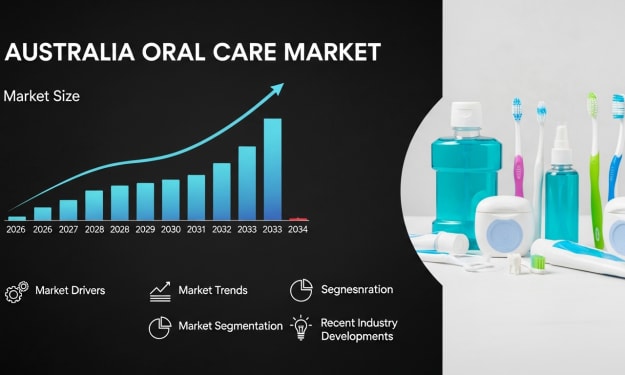
According to IMARC Group, the Australia oral care market reached USD 1.1 Billion in 2025 and is projected to grow to USD 2.3 Billion by 2034, exhibiting a compound annual growth rate (CAGR) of 7.74% during 2026–2034. The market’s rapid expansion reflects rising awareness of oral hygiene and its connection to overall wellness across Australia. Consumers are increasingly investing in preventive dental care, advanced hygiene tools, and cosmetic oral products. Technological innovations such as electric and smart toothbrushes, along with demand for natural and eco-friendly solutions, are reshaping product portfolios and strengthening Australia oral care market share.
By Kevin Cooper4 days ago in Futurism



Comments (4)
It's good but see My story 😉
Good 👍
I am never ceased to be amazed about how people view things by 2050. The automated drivers are better than we were when we were kids. Absolutely amazing. Well written, and I hope that it doesn't come true, I fear for my Grandchildren. Well Done.
Well written thank you for sharing it.