
"Unlocking the Power of AI (Artificial Intelligence): A Beginner's Guide
"Understanding the Basics of Artificial Intelligence"
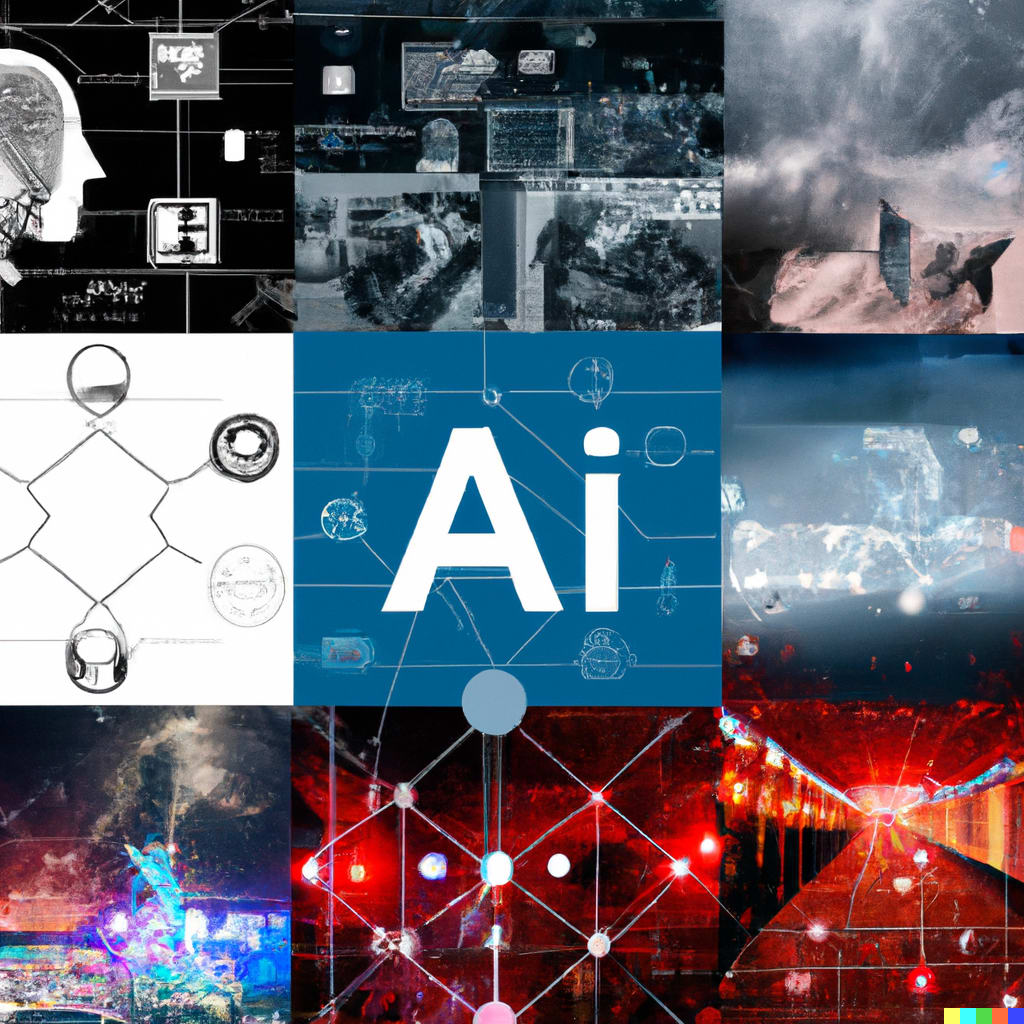
INTRO
Artificial Intelligence, or AI, is one of the most exciting and rapidly growing fields of technology today.
But what exactly is AI and how can it be used to improve our lives? Let's find out.
*AI is a branch of computer science that deals with creating machines that can perform tasks that would normally require human intelligence. From chatbots that can answer customer inquiries to self-driving cars, AI is already being used in a wide range of applications.
*Here are several types of AI, including rule-based AI, which follows a set of pre-programmed rules to perform tasks, machine learning, which learns from data, and deep learning, which is based on neural networks
1. Machine learning
Machine learning is a subfield of artificial intelligence that focuses on the development of algorithms and statistical models that enable computers to learn from data, without being explicitly programmed. It's a way to make a computer program or system to improve its performance with the experience it gains, without being explicitly programmed.
There are three main types of machine learning:
Supervised Learning: The computer is provided with a labeled dataset, which includes input-output pairs, and the goal is to learn a function that maps inputs to outputs. Common examples include image classification, speech recognition, and predicting numerical values.
Unsupervised Learning: The computer is provided with an unlabeled dataset and the goal is to discover patterns and structure in the data. Common examples include clustering, dimensionality reduction, and anomaly detection.
Reinforcement Learning: The computer interacts with an environment and learns by trial and error, receiving rewards or penalties for its actions. Common examples include game playing, robotics, and autonomous systems.
The most common and widely used algorithms in machine learning are:
Linear and Logistic Regression
Decision Trees
Random Forest
Gradient Boosting
Neural Networks
SVM (Support Vector Machines)
K-means Clustering
PCA (Principal Component Analysis)
K
2. Deep learning
Deep learning is a subfield of machine learning that is based on artificial neural networks, which are designed to simulate the way the human brain works. Deep learning algorithms use multiple layers of artificial neural networks to learn features and patterns in the data, allowing them to perform tasks such as image and speech recognition, natural language processing, and decision making.
Deep learning algorithms are particularly well-suited to large, complex datasets, and can be used for a wide range of applications, including image and speech recognition, natural language processing, and decision making.
There are several types of deep learning algorithms, including:
Convolutional Neural Networks (CNNs) - used for image and video analysis
Recurrent Neural Networks (RNNs) - used for sequence data such as speech and text
Generative Adversarial Networks (GANs) - used for generating new data
Autoencoders - used for dimensionality reduction and feature learning
Transformer models - used for natural language processing
Deep learning algorithms require a significant amount of data, computational power and resources to train, and it's important to have a good understanding of the underlying concepts and mathematical principles to effectively use them.
It's worth noting that deep learning is a rapidly evolving field, new architectures and techniques are being developed and improved all the time, and it's important to stay up to date with the latest developments.
*By using AI, companies can automate processes, increase efficiency, save costs and improve accuracy. But, AI is not only limited to big corporations, small businesses and individuals can also benefit from it.AI has the potential to revolutionize the way we live and work. This video will provide a beginner's guide to understanding AI, its applications, and its potential. So, stay tuned
About the Creator
Keep reading
More stories from Thimezh Arunprasath and writers in Futurism and other communities.
Fluid Loss Additives Market Outlook: Drilling Efficiency Enhancement and Oilfield Services Growth Opportunities
According to IMARC Group's latest research publication, The global fluid loss additives market size was valued at USD 318.42 Million in 2025. Looking forward, IMARC Group estimates the market to reach USD 409.06 Million by 2034, exhibiting a CAGR of 2.82% from 2026-2034.
By James Whitmana day ago in Futurism
Australia Textile & Apparel Market: Sustainable Fashion, E-commerce Growth & Fabric Innovation
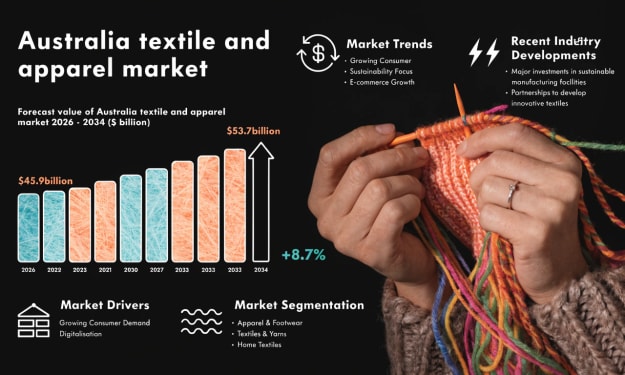
According to IMARC Group, the Australia textile and apparel market reached a value of USD 30.3 Billion in 2025 and is projected to reach USD 45.7 Billion by 2034, growing at a compound annual growth rate (CAGR) of 4.66% during 2026–2034. The market is evolving as consumer preferences increasingly favor sustainable fashion, innovative fabric technologies and digitally driven retail experiences. Rising disposable incomes and changing lifestyle trends are encouraging consumers to spend more on clothing, footwear and fashion accessories. At the same time, growing awareness about environmental sustainability is driving demand for eco-friendly textiles, recycled fabrics and ethically produced garments. The rapid expansion of e-commerce platforms and online fashion marketplaces is also transforming how consumers shop for apparel, enabling brands to reach wider audiences across Australia. As fashion companies adopt new production technologies and sustainable manufacturing practices, the textile and apparel sector is undergoing significant transformation.
By Kevin Cooperabout 6 hours ago in Futurism



Comments
There are no comments for this story
Be the first to respond and start the conversation.