
United States Dishwasher Market Size & Forecast 2025–2033
How Smart Kitchens, Energy Efficiency, and Changing Lifestyles Are Shaping the Future of Dishwashing in America

United States Dishwasher Market Overview
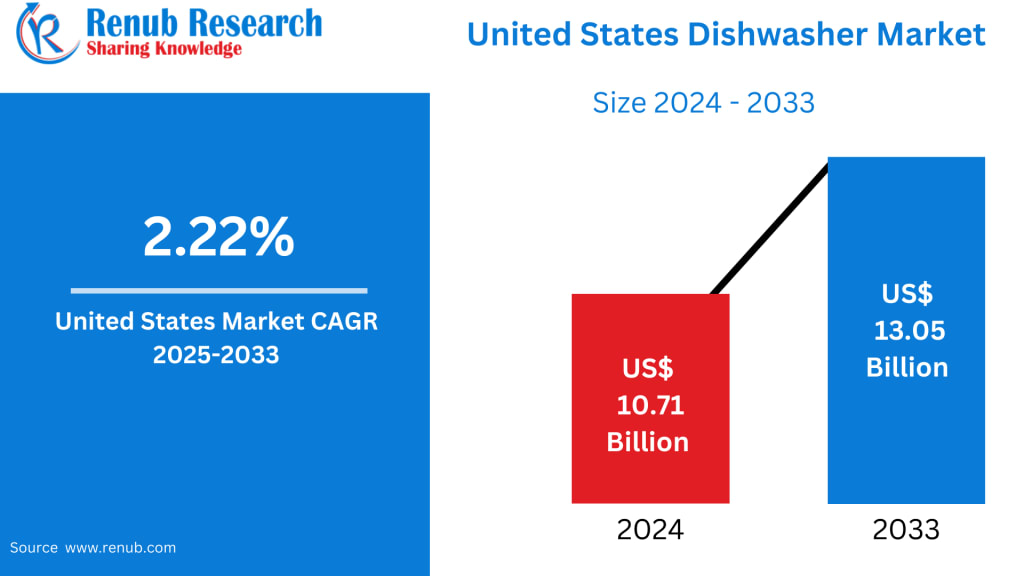
The United States Dishwasher Market is poised for steady expansion over the next decade, reflecting the country’s growing reliance on modern, time-saving home appliances. According to Renub Research, the U.S. dishwasher industry is expected to grow from US$ 10.71 billion in 2024 to US$ 13.05 billion by 2033, registering a Compound Annual Growth Rate (CAGR) of 2.22% from 2025 to 2033.
This growth is being fueled by evolving consumer lifestyles, increased awareness of water and energy efficiency, and the accelerating adoption of smart home technologies. Dishwashers, once viewed as luxury appliances, are increasingly becoming essential kitchen fixtures across both residential and commercial settings in the United States.
Understanding the Dishwasher Market in the United States
A dishwasher is an automated kitchen appliance designed to clean and sanitize dishes, cookware, and utensils using a combination of hot water, detergent, and mechanical action. In the United States, dishwashers have become a symbol of convenience, hygiene, and efficiency, particularly in households where time constraints and sustainability concerns influence purchasing decisions.
Modern dishwashers are engineered with advanced features such as multiple wash cycles, soil sensors, noise-reduction technology, and energy-efficient motors. These innovations allow consumers to customize cleaning based on load size and soil intensity while minimizing water and electricity consumption.
Compared to traditional handwashing, dishwashers use significantly less water and achieve higher sanitation levels by operating at temperatures that effectively eliminate bacteria. This dual benefit of hygiene and resource efficiency has strengthened their appeal among environmentally conscious American consumers.
Key Growth Drivers in the United States Dishwasher Market
Rising Demand for Convenience and Time-Saving Appliances
One of the most influential drivers of dishwasher adoption in the U.S. is the growing demand for convenience. Urbanization, dual-income households, and fast-paced lifestyles have significantly reduced the time available for manual household chores. Dishwashers offer a practical solution by automating one of the most time-consuming kitchen tasks.
Additionally, the integration of smart technology has enhanced the appeal of dishwashers among tech-savvy consumers. Features such as Wi-Fi connectivity, mobile app controls, voice assistant compatibility, and automated maintenance alerts align seamlessly with modern smart home ecosystems. As connected living becomes more mainstream, dishwasher adoption continues to rise across American households.
Increased Focus on Energy Efficiency and Sustainability
Environmental awareness and government regulations are playing a critical role in shaping the U.S. dishwasher market. Consumers are increasingly prioritizing appliances that conserve water and reduce energy consumption. ENERGY STAR-certified dishwashers have gained widespread acceptance due to their long-term cost savings and reduced environmental impact.
Manufacturers are investing heavily in innovations such as intelligent soil detection, optimized spray systems, and eco-friendly wash cycles. These technologies not only lower utility bills but also support national sustainability goals. Federal and state-level rebate programs further encourage consumers to replace older appliances with energy-efficient dishwasher models, accelerating market growth.
Expansion of the Housing and Home Renovation Sector
Growth in residential construction and home renovation activities across the United States has positively impacted dishwasher sales. Built-in dishwashers are increasingly being installed as standard fixtures in newly constructed homes, particularly in suburban and urban developments.
Post-pandemic lifestyle changes have also driven homeowners to invest more in kitchen upgrades. Renovation projects frequently include replacing outdated appliances with modern, smart-enabled dishwashers that enhance both functionality and aesthetics. As real estate development and home improvement spending remain strong, dishwasher demand is expected to maintain consistent momentum.
Challenges Limiting Market Growth
High Initial Costs and Maintenance Expenses
Despite their advantages, dishwashers still face adoption barriers due to relatively high upfront costs. Smart and energy-efficient models often carry premium price tags, making them less accessible to lower-income households. Installation expenses, repair costs, and replacement parts further contribute to ownership concerns.
While financing options and promotional discounts have eased affordability issues for some consumers, cost sensitivity remains a challenge, particularly in rural and price-conscious market segments. Manufacturers will need to balance innovation with affordability to expand their customer base further.
Limited Adoption in Small Apartments and Rental Properties
Space constraints in small apartments and older urban housing structures continue to restrict dishwasher penetration. Many rental units lack the plumbing infrastructure required for built-in dishwashers, discouraging both landlords and tenants from investing in installations.
Although portable and countertop dishwashers offer alternatives, awareness and availability remain limited. Installation complexity and space limitations continue to pose obstacles, especially in densely populated urban areas.
Market Segmentation Analysis
United States Built-in Dishwasher Market
Built-in dishwashers represent the largest and fastest-growing product segment in the U.S. market. These models are favored for their seamless integration into modern kitchen designs, quieter operation, and larger capacity. Increasing kitchen remodeling activities and new housing projects continue to drive demand.
Middle- and high-income households show strong preference for built-in dishwashers equipped with advanced features such as touch controls, smart connectivity, and energy-efficient cycles. As aesthetic appeal and performance remain key purchasing factors, built-in models are expected to dominate the market throughout the forecast period.
United States Residential Dishwasher Market
The residential segment remains the backbone of the U.S. dishwasher industry. Rising disposable incomes, increased home cooking, and growing awareness of hygiene have all contributed to higher household penetration.
While suburban homes primarily favor built-in units, urban consumers increasingly opt for compact or portable models. Manufacturers are introducing affordable, energy-efficient dishwashers to attract first-time buyers, reinforcing steady growth in residential demand.
United States Commercial Dishwasher Market
Commercial dishwashers are widely used in restaurants, hotels, hospitals, cafeterias, and institutional kitchens. These environments require high-capacity machines capable of rapid cleaning while meeting strict hygiene standards.
Labor shortages, operational efficiency requirements, and sustainability initiatives have strengthened demand for automated dishwashing solutions in the foodservice sector. As hospitality and foodservice industries continue to recover and expand, commercial dishwasher sales are expected to remain robust.
Distribution Channel Insights
Offline Dishwasher Market
Offline retail remains the dominant distribution channel for dishwashers in the United States. Physical stores allow consumers to inspect products, compare features, and access installation and after-sales services. Major retailers such as Home Depot, Lowe’s, and Best Buy play a crucial role in driving offline sales.
Bundled offers, financing options, and personalized consultations enhance consumer confidence, especially for high-value appliance purchases. Offline channels continue to perform strongly in suburban and rural regions.
Online Dishwasher Market
E-commerce is gaining traction, particularly among younger and urban consumers seeking convenience and competitive pricing. Online platforms offer a wide selection of models, detailed product information, and home delivery services. Although still secondary to offline sales, online channels are expected to grow steadily over the forecast period.
State-Level Market Insights
California Dishwasher Market
California stands out as one of the most influential state markets due to its large population, high environmental awareness, and strict energy regulations. Water conservation concerns have accelerated the adoption of energy-efficient dishwashers. Urban centers such as Los Angeles and San Francisco show strong demand for premium, smart-enabled models.
New York Dishwasher Market
New York’s dishwasher market reflects a mix of suburban adoption and urban space constraints. Built-in dishwashers dominate suburban areas, while compact and portable models are popular in New York City apartments. The state’s vibrant hospitality industry also supports strong commercial dishwasher demand.
New Jersey Dishwasher Market
New Jersey benefits from its suburban housing base and proximity to major metropolitan areas. Consumers show preference for mid-range and premium dishwashers, supported by relatively high disposable incomes. Both offline retail and e-commerce channels contribute to steady market growth.
Market Segmentation Summary
By Product:
Freestanding
Built-in
By Application:
Residential
Commercial
By Distribution Channel:
Offline
Online
By Key States:
California, Texas, New York, Florida, Illinois, Pennsylvania, Ohio, Georgia, New Jersey, Washington, North Carolina, Massachusetts, Virginia, Michigan, Maryland, Colorado, Tennessee, Indiana, Arizona, Minnesota, Wisconsin, Missouri, Connecticut, South Carolina, Oregon, Louisiana, Alabama, Kentucky, Rest of United States
Competitive Landscape and Key Players
The U.S. dishwasher market is moderately competitive, with global and regional manufacturers focusing on innovation, energy efficiency, and smart features. All companies have been evaluated across five viewpoints: Overview, Key Personnel, Recent Developments, SWOT Analysis, and Revenue Performance.
Key players operating in the United States dishwasher market include:
Electrolux AB
Panasonic
Whirlpool
Robert Bosch GmbH
Samsung
Siemens
LG Electronics
Haier
These companies continue to invest in product differentiation, sustainability, and digital innovation to strengthen their market positions.
Final Thoughts
The United States Dishwasher Market is entering a phase of steady, innovation-driven growth. While affordability and space constraints remain challenges, rising demand for convenience, energy efficiency, and smart home integration continues to reshape consumer preferences. Backed by favorable housing trends and sustainability initiatives, dishwashers are transitioning from optional appliances to essential kitchen solutions across American households and commercial spaces.
As manufacturers focus on balancing advanced features with cost-effective solutions, the market is well-positioned to achieve its projected US$ 13.05 billion valuation by 2033, reinforcing its importance within the broader U.S. home appliance industry.
About the Creator
Keep reading
More stories from Aaina Oberoi and writers in Futurism and other communities.
Wi-Fi Chipset Market Size and Forecast 2025–2033
Introduction: Wi-Fi Chipsets at the Heart of the Connected World Wireless connectivity has become as essential as electricity in the modern digital economy. From smartphones and laptops to smart homes, industrial automation, and connected vehicles, seamless internet access underpins everyday life. At the core of this connectivity ecosystem lies the Wi-Fi chipset—a fundamental semiconductor component that enables devices to communicate over wireless networks.
By Aaina Oberoi5 days ago in Futurism
About Binding Prometheus
I want to start actively advocating on behalf of my own work, and the most valuable part of my canon is, without a doubt, Binding Prometheus, the play I have been working on since 2019 and only finished in 2023 as part of my MA. The play itself is an amalgamation of a million different inspirations. On one end, it evokes the Ancient Greek myth-play, deriving its own title from the earliest extant work of Western drama we have, Aeschylus’s Prometheus Bound. On the other end, it borrows significantly from the sci-fi bulwarks from over the years, namely Mary Shelley’s Frankenstein and Karel Capek’s Rossum’s Universal Robots. The play could be an episode of Black Mirror, I fear. I don’t know. I’ve only ever seen one episode of Black Mirror.
By Steven Christopher McKnight11 days ago in Futurism
Japan Personal Computer Market Size & Forecast 2025–2033
Japan Personal Computer Market Overview Japan’s personal computer market is entering a renewed phase of expansion, supported by evolving work habits, digital education programs, and increasing demand for high-performance computing. According to Renub Research, the Japan Personal Computer Market is projected to grow from US$ 7.25 billion in 2024 to US$ 13.44 billion by 2033, registering a Compound Annual Growth Rate (CAGR) of 7.11% during 2025–2033.
By jaiklin Fanandish4 days ago in Futurism
FPS: The Last Flame Challenge Winners
Welcome to our first Winners Announcement of the year and to the final challenge in the Fall Poetry Series. The Last Flame invited writers to sit with endings, using fire as a central image to consider what remains when something burns out: ash, warmth, memory, silence, or the faint promise of what comes next. The strongest pieces treated endings as gradual rather than sudden, allowing them to flicker, dim, and linger.
By Vocal Curation Team4 days ago in Resources


Comments
There are no comments for this story
Be the first to respond and start the conversation.