
United States Cotton Market Size and Forecast 2025–2033
Steady Growth Supported by Exports, Sustainability, and Advanced Farming Technologies


United States Cotton Market Overview
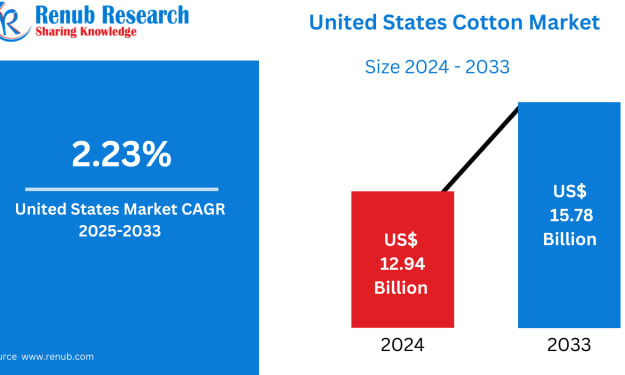
The United States Cotton Market continues to play a central role in the global agricultural and textile ecosystem. According to Renub Research, the market is expected to grow from US$ 12.94 billion in 2024 to US$ 15.78 billion by 2033, registering a Compound Annual Growth Rate (CAGR) of 2.23% between 2025 and 2033. This moderate but steady expansion reflects the market’s resilience amid climatic uncertainty, shifting global trade policies, and evolving consumer preferences.
Cotton remains one of the most valuable cash crops in the United States, supporting rural livelihoods, export earnings, and downstream textile industries. The country is consistently among the world’s top cotton exporters, supplying high-quality fiber to major textile manufacturing hubs across Asia and beyond. Texas leads national output, followed by Georgia, Mississippi, and Arkansas, while California specializes in premium extra-long staple cotton.
Market size and performance are shaped by multiple interlinked factors, including weather conditions, global cotton prices, export demand, government support programs, and technological innovation in farming practices. Despite challenges, the U.S. cotton sector continues to adapt, invest, and maintain competitiveness on the global stage.
United States Cotton Industry Outlook
Cotton production in the United States is dominated by upland cotton, which accounts for nearly all cultivated acreage. Extra-long staple (ELS) cotton, such as Pima cotton, represents a smaller but higher-value segment primarily grown in California and parts of Arizona. According to data from the U.S. Department of Agriculture, upland cotton represented nearly 99% of total planted cotton area in recent years.
In the 2023–2024 marketing year, the United States produced approximately 12.07 million bales of cotton, making it the fourth-largest producer globally. Roughly 40% of total U.S. cotton production originates from Texas, highlighting the state’s critical role in national supply.
The industry benefits from extensive mechanization, advanced seed genetics, and a well-developed logistics and grading system. Government programs such as crop insurance, disaster assistance, and income support schemes help farmers manage risks associated with volatile prices and unpredictable weather. At the same time, sustainability initiatives and traceability programs are reshaping how cotton is grown, marketed, and consumed.
Key Drivers of the United States Cotton Market
Strong Global Demand and Export Orientation
Exports are the backbone of the U.S. cotton market, with nearly 80% of total production shipped overseas. Major importing countries include China, Vietnam, Bangladesh, Pakistan, and Turkey. In 2023 alone, China, Pakistan, and Vietnam together accounted for over 50% of U.S. cotton export volumes.
U.S. cotton is favored internationally due to its consistent quality, reliable supply chains, and transparent fiber classification systems. Trade agreements and long-standing commercial relationships further strengthen export competitiveness. As emerging economies expand textile manufacturing capacity to meet global apparel demand, U.S. cotton continues to benefit from sustained international interest.
Technological Advancements in Cotton Farming
Innovation remains a critical growth enabler for the U.S. cotton industry. Farmers increasingly rely on precision agriculture tools, including GPS-guided planting, satellite imagery, soil sensors, and data-driven irrigation systems. These technologies help optimize yields, reduce input costs, and improve environmental outcomes.
Biotechnology has also played a transformative role. Genetically modified cotton varieties resistant to pests and tolerant to drought conditions reduce dependency on chemical pesticides and enhance crop resilience. Mechanized harvesting equipment minimizes labor dependency and accelerates harvesting timelines, improving overall farm efficiency and profitability.
Rising Preference for Natural and Sustainable Fibers
Consumer awareness regarding sustainability, biodegradability, and microplastic pollution has driven renewed interest in natural fibers like cotton. Global apparel brands are increasingly committing to responsible sourcing and transparent supply chains.
Programs such as the U.S. Cotton Trust Protocol promote sustainable farming practices, reduced water usage, lower greenhouse gas emissions, and traceability from farm to finished product. As sustainability becomes a key purchasing criterion for global brands, certified U.S. cotton gains a competitive advantage in premium and mass-market segments alike.
Challenges Facing the United States Cotton Market
Climate Variability and Extreme Weather Risks
Climate change poses one of the most significant threats to cotton production, particularly in key growing regions such as Texas and the Southeast. Prolonged droughts, heatwaves, storms, and irregular rainfall patterns can severely impact yields and fiber quality.
Recent drought events in Texas have resulted in large-scale crop abandonment, highlighting the vulnerability of cotton to water scarcity. While crop insurance provides partial relief, long-term sustainability will depend on investments in drought-resistant seed varieties, efficient irrigation technologies, and adaptive farming practices.
Trade Policy Uncertainty and Global Competition
The U.S. cotton industry faces intense competition from low-cost producers such as India, Brazil, and Uzbekistan. These countries benefit from lower labor costs and, in some cases, substantial government support, enabling them to price cotton more competitively in global markets.
Additionally, geopolitical tensions and trade policy shifts—particularly involving major buyers like China—can disrupt export flows. Tariffs, import restrictions, or diplomatic disputes introduce uncertainty, making export-dependent producers vulnerable to sudden demand fluctuations. Diversifying export destinations and strengthening trade partnerships remain essential strategies for long-term stability.
United States Cotton Market by State
Texas Cotton Market
Texas is the undisputed leader in U.S. cotton production, contributing more than 40% of national output. The state’s vast acreage, established infrastructure, and favorable growing regions—especially the High Plains—support large-scale upland cotton cultivation. Despite recurring drought challenges, advancements in irrigation technology, federal crop insurance, and strong export demand continue to sustain Texas’s dominance.
California Cotton Market
California plays a specialized role, focusing primarily on high-quality extra-long staple cotton such as Pima. Grown mainly in the San Joaquin Valley, California cotton is valued for its superior fiber length, softness, and strength, making it suitable for luxury textiles and premium apparel. However, water scarcity, environmental regulations, and competition from higher-value crops have reduced acreage over time.
Georgia, Mississippi, and Arkansas
These Southeastern states form the backbone of the U.S. cotton belt after Texas. Favorable climate conditions, fertile soil, and proximity to ports enhance their production and export capabilities. These states primarily grow upland cotton and contribute significantly to domestic supply and international shipments.
Florida Cotton Market
Florida’s cotton production is limited and concentrated mainly in the Panhandle region. While not a major producer, cotton remains important for crop diversification among local farmers. Weather-related risks such as hurricanes and land competition constrain growth, though improved seed technology has helped stabilize yields.
New York Cotton Market
New York does not produce cotton due to unsuitable climatic conditions. However, the state holds strategic importance through its influence on fashion, textile design, commodity trading, and financial services. Apparel brands, importers, and trading firms based in New York help shape demand trends and pricing dynamics across the cotton value chain.
Recent Developments in the U.S. Cotton Market
In June 2024, representatives from the U.S. and Indian textile industries emphasized strengthening trade relationships during a Cotton Council International meeting in New Delhi. Indian spinners highlighted increasing preference for U.S. cotton due to its quality and consistency, reinforcing export growth opportunities and deepening bilateral cooperation.
Market Segmentation Overview
The United States Cotton Market Report (2025–2033) covers all states across four analytical dimensions:
Production
Consumption
Imports
Exports
State Coverage Includes
California, Texas, New York, Florida, Georgia, Mississippi, Arkansas, North Carolina, South Carolina, Alabama, Louisiana, Arizona, Tennessee, and the Rest of the United States.
Company Analysis Includes
Aarti International Limited,
Coats Group plc,
Damodar Group,
Fortex,
Huafang Group,
KPR Mill Limited,
Maharaja Shree Umaid Mills Limited,
Nahar Spinning of Companies,
Nitin Spinners Ltd.,
Weiqiao Textile Company Limited
Each company profile includes business overview, key personnel, recent developments, SWOT analysis, and revenue insights.
Final Thoughts
The United States cotton market is entering a period of measured yet resilient growth, supported by strong export demand, technological innovation, and rising preference for sustainable natural fibers. While challenges related to climate change, trade uncertainty, and global competition persist, ongoing investments in efficiency, sustainability, and market diversification are helping the industry adapt.
With a forecasted market value of US$ 15.78 billion by 2033, U.S. cotton remains a cornerstone of the nation’s agricultural economy and a vital contributor to global textile supply chains. As sustainability and traceability gain prominence worldwide, U.S. cotton is well-positioned to maintain its relevance and competitiveness in the decade ahead.
About the Creator
Janine Root
Janine Root is a skilled content writer with a passion for creating engaging, informative, and SEO-optimized content. She excels in crafting compelling narratives that resonate with audiences and drive results.
Keep reading
More stories from Janine Root and writers in Futurism and other communities.
United States Cotton Market Size and Forecast 2025–2033
United States Cotton Market Overview The United States Cotton Market continues to play a central role in the global agricultural and textile ecosystem. According to Renub Research, the market is expected to grow from US$ 12.94 billion in 2024 to US$ 15.78 billion by 2033, registering a Compound Annual Growth Rate (CAGR) of 2.23% between 2025 and 2033. This moderate but steady expansion reflects the market’s resilience amid climatic uncertainty, shifting global trade policies, and evolving consumer preferences.
By Janine Root 10 days ago in Futurism
About Binding Prometheus
I want to start actively advocating on behalf of my own work, and the most valuable part of my canon is, without a doubt, Binding Prometheus, the play I have been working on since 2019 and only finished in 2023 as part of my MA. The play itself is an amalgamation of a million different inspirations. On one end, it evokes the Ancient Greek myth-play, deriving its own title from the earliest extant work of Western drama we have, Aeschylus’s Prometheus Bound. On the other end, it borrows significantly from the sci-fi bulwarks from over the years, namely Mary Shelley’s Frankenstein and Karel Capek’s Rossum’s Universal Robots. The play could be an episode of Black Mirror, I fear. I don’t know. I’ve only ever seen one episode of Black Mirror.
By Steven Christopher McKnight11 days ago in Futurism



Comments
There are no comments for this story
Be the first to respond and start the conversation.