
United States Communication Equipment Market Size & Forecast 2025
The Backbone of America’s Connected Future—Powered by 5G, Cloud, IoT & Next-Gen Networks


From video calls to national defense networks, the United States communication equipment industry is the invisible infrastructure keeping the country connected, productive, and secure. Valued at US$ 123.11 billion in 2024, the market is on a steady growth trajectory and is projected to reach US$ 168.09 billion by 2033, expanding at a CAGR of 3.42% from 2025 to 2033, according to Renub Research.
The market’s upward momentum is powered by the nationwide 5G rollout, rising IoT adoption, expanding cloud communication, and increasing demand for real-time data access across industries. The technology ecosystem is undergoing a seismic shift as America embraces faster networks, smarter devices, and more resilient digital infrastructure.
Communication Equipment: The Invisible Engine of Modern Life
Communication equipment refers to hardware and systems that enable the transmission of voice, video, and data across wired and wireless networks. The category spans mobile devices, routers, broadcast systems, fiber optics, switches, satellites, digital networking tools, radios, and more.
In the United States, these technologies play a mission-critical role in:
Telecommunications: 5G rollout, broadband expansion, Internet connectivity
Healthcare: Telemedicine, emergency response networks
Defense & Security: Secure military and government communication
Business & Enterprise: Cloud-enabled communication, VoIP, hybrid workforce collaboration
Transportation: GPS-based networks, smart logistics, connected vehicles
Consumer Tech: Smartphones, wearables, smart homes, and personal networking
Driven by government policies, private sector investments, and public demand for seamless connectivity, communication equipment is now the nerve system of America’s digital and economic transformation.
What’s Powering Market Growth? Key Trends & Drivers
1. 5G Infrastructure Deployment – The Biggest Growth Catalyst
The U.S. is aggressively scaling 5G infrastructure through telecom giants like AT&T, Verizon, and T-Mobile. The rollout demands heavy deployment of:
Small cells
Fiber-optics
Base stations
Advanced spectrum technologies
The benefit? Ultra-low latency communication that supports:
Autonomous driving
IoT in smart cities
AI-enabled cloud communication
Industrial automation
In February 2025, Aduna partnered with AT&T, T-Mobile, Verizon, and Ericsson to launch carrier-grade SIM Swap and Number Verification APIs, strengthening security and supporting innovation in enterprise mobile solutions.
2. Cloud Communication & Collaboration Revolution
The workplace is rapidly shifting from office spaces to hybrid and remote environments. This shift is forcing enterprises to migrate from traditional PBX and desk phones to:
VoIP solutions
Cloud PBX
Unified communication platforms
Software-Defined Networking (SDN)
Cloud communication enables scalability, cost optimization, and flexibility, making it indispensable for modern enterprises.
In January 2025, Granicus unveiled upgraded cloud communication services to help governments modernize public communication systems—signaling growing public sector adoption.
3. IoT Explosion & Smart Device Ecosystem
The Internet of Things has turned everyday products into connected communication endpoints. From smart thermostats and security cameras to industrial sensors, reliable network connectivity has become non-negotiable.
According to Oberlo:
69.91 million U.S. smart homes in 2024
77.05 million in 2025
93.59 million projected by 2027
This surge fuels demand for routers, communication modules, gateways, and low-latency network hardware.
Market Challenges: The Roadblocks in America’s Connectivity Race
1. Sky-High Infrastructure Costs
Building communication infrastructure is capital-intensive. The rollout of:
Fiber-optic networks
Data centers
5G towers
Satellite communication equipment
…requires billions in investment. Licensing fees for spectrum usage and regulatory approvals further raise the barriers to entry, making it difficult for smaller companies to compete.
2. Cybersecurity & Data Privacy Risks
As communication networks go digital, they also become vulnerable. Threats include:
Hacking and identity theft
Ransomware attacks
Network vulnerability exploitation
IoT device breaches
To combat these concerns, companies now spend heavily on:
AI-driven network security
Advanced encryption
Multi-factor authentication (MFA)
Regulatory compliance (GDPR, CCPA, etc.)
Market Breakdown By Key Segments
1. Mobile Communication Equipment Market
Driven by the rapid adoption of 5G smartphones, mobile routers, and wearables, this segment is expanding quickly. Enterprises and consumers rely on mobile networks for business communication, streaming, e-commerce, gaming, digital payments, learning, and beyond.
Innovations transforming this space include:
Foldable and AI-powered smartphones
Smart earbuds, fitness wearables
Rugged enterprise communication devices
In March 2025, Telness Tech launched its MVNO service using T-Mobile’s 5G network, offering U.S. telecom operators greater scalability and customization.
2. Fixed-Line Communication Equipment Market
Despite the wireless boom, fixed-line systems remain essential in:
Healthcare
Government communication
Banking & financial institutions
Defense systems
Fiber-to-the-Home (FTTH) and VoIP upgrades are empowering the resurgence of secure, high-capacity wired communication.
3. Network Communication Equipment Market
This includes routers, Wi-Fi infrastructure, modems, switches, and optical networking equipment. Demand is rising due to:
Cloud adoption and data center expansion
Remote collaboration tools
5G backhaul infrastructure
AI-driven network performance management
Software-defined networking (SDN) and cybersecurity-integrated network tools are gaining momentum.
Regional Market Insights
West U.S. – Innovation & Tech Powerhouse
Home to Silicon Valley, the West leads in:
Data center infrastructure
AI communication tools
Cloud computing systems
5G penetration
Defense and aerospace networking
However, rural connectivity remains a challenge.
East U.S. – Finance, Government & Telecom Hub
The East leads in:
Enterprise communication equipment
Government-grade encrypted communication
Cloud networking solutions for finance firms
R&D in telecom innovations
Cities like New York, Boston, and Washington D.C. push demand for secure real-time communication ecosystems.
North U.S. – Industrial IoT and Broadband Growth
Manufacturing automation, connected automotive ecosystems, school connectivity initiatives, and rural broadband funding programs are shaping breakthroughs in network deployment.
South U.S. – 5G Rollout & Emerging Smart City Projects
The South is witnessing rapid infrastructure development including smart city pilots, suburban broadband expansion, and IoT-based agricultural communication networks.
Market Segmentation Snapshot
By Product
Mobile
Fixed-Line
By Type
Mobile Communication Devices
Optical Communication Equipment
Network Communication Equipment
By Region
East
West
North
South
Leading Market Players
The competitive landscape consists of global and U.S.-centric tech giants focused on innovation, 5G hardware, consumer electronics, and enterprise networking solutions:
Apple Inc.
AT&T
LG Electronics
Lenovo
Sony Corporation
Panasonic
Xiaomi
OnePlus
These players are investing heavily in cloud networking, edge computing, AI-powered communication tools, and next-gen digital ecosystems.
Final Thoughts: Charting the Future of U.S. Connectivity
The U.S. communication equipment sector stands at the intersection of innovation and necessity. Over the next decade, the industry will be shaped by:
✔ Hyper-fast 5G networks
✔ Smart city communication layers
✔ Cloud-first business operations
✔ AI-managed communication infrastructure
✔ IoT expansion across homes, vehicles, and industries
With strategic investments, public-private partnerships, and a tech-hungry consumer base, America’s communication landscape is set for unprecedented evolution.
About the Creator
Sushant. Renub Research
I’m Sushanta Halder, Digital Marketing Manager at Renub Research with 15+ years in SEO, content, PPC & lead generation. Passionate about data-driven growth strategies.
Keep reading
More stories from Sushant. Renub Research and writers in Futurism and other communities.
Saudi Arabia Poultry Meat Market: Growth, Self-Sufficiency & New Consumer Trends Shaping 2033
Saudi Arabia is carving a firm position for itself as the beating heart of the GCC’s poultry industry. From being a heavy importer to rapidly shifting toward self-reliant production, the Kingdom has turned poultry into not just a dietary staple, but a strategic economic asset. According to Renub Research, the Saudi Arabia Poultry Meat Market is expected to reach US$ 5.62 billion by 2033, up from US$ 4.75 billion in 2024, expanding at a CAGR of 1.90% from 2025 to 2033.
By Sushant. Renub Research2 months ago in Futurism
About Binding Prometheus
I want to start actively advocating on behalf of my own work, and the most valuable part of my canon is, without a doubt, Binding Prometheus, the play I have been working on since 2019 and only finished in 2023 as part of my MA. The play itself is an amalgamation of a million different inspirations. On one end, it evokes the Ancient Greek myth-play, deriving its own title from the earliest extant work of Western drama we have, Aeschylus’s Prometheus Bound. On the other end, it borrows significantly from the sci-fi bulwarks from over the years, namely Mary Shelley’s Frankenstein and Karel Capek’s Rossum’s Universal Robots. The play could be an episode of Black Mirror, I fear. I don’t know. I’ve only ever seen one episode of Black Mirror.
By Steven Christopher McKnight11 days ago in Futurism
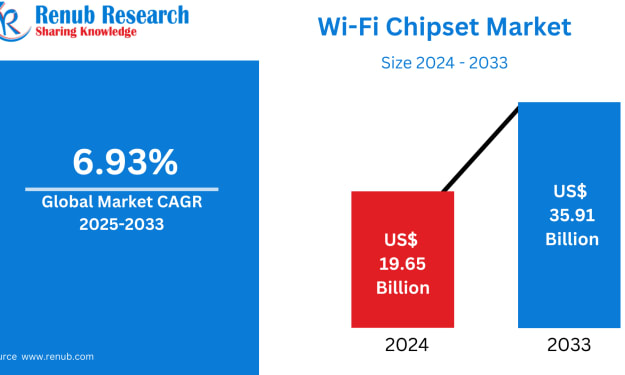
Wi-Fi Chipset Market Size and Forecast 2025–2033
Introduction: Wi-Fi Chipsets at the Heart of the Connected World Wireless connectivity has become as essential as electricity in the modern digital economy. From smartphones and laptops to smart homes, industrial automation, and connected vehicles, seamless internet access underpins everyday life. At the core of this connectivity ecosystem lies the Wi-Fi chipset—a fundamental semiconductor component that enables devices to communicate over wireless networks.
By Aaina Oberoi5 days ago in Futurism



Comments
There are no comments for this story
Be the first to respond and start the conversation.