
United States Automotive Service Market Size and Forecast 2025–2033
Tech-Driven Maintenance Boom Fuels a $308.75 Billion Industry by 2033


The Backbone of U.S. Mobility Is Entering a Golden Service Era
America runs on wheels. But today, it doesn’t just run—it requires precision tuning, advanced diagnostics, and smart maintenance powered by technology. According to Renub Research, the United States Automotive Service Market is forecast to climb from US$ 182.44 billion in 2024 to US$ 308.75 billion by 2033, registering a CAGR of 6.02% from 2025 to 2033. The growth story isn’t driven by new car sales alone but by an aging vehicle fleet, a tech-heavy automotive ecosystem, and an emerging generation of electrified and autonomous vehicles demanding smarter service capabilities.
What Exactly Is Automotive Service Today?
Automotive service in 2025 is no longer only about oil changes and brake pads. It now spans:
Mechanical overhauls (engine, transmission, exhaust systems)
Predictive diagnostics using software and AI-led systems
Battery health checks and EV powertrain service
Structural and exterior repair
Fluid, tire, and component replacement
Telematics-enabled maintenance tracking
As vehicles get smarter, repair shops and service centers evolve into high-tech hubs of diagnostics, calibration, and software maintenance—rather than just hardware repair.
Market Drivers Powering the U.S. Auto Service Boom
1. A Geriatric Car Fleet in Its Prime for Service
The average car on U.S. roads is now close to 13 years old—the oldest in the nation’s history. Older vehicles mean:
Higher breakdown probability
Frequent repair intervals
More demand for part replacements
Increased dependency on service providers
Instead of upgrading to new cars, many consumers are choosing to maintain existing ones longer, especially amid inflation and rising car ownership costs.
2. Vehicles Are Now Rolling Computers
Modern cars are packed with neural networks, sensors, cameras, radar, lidar, and embedded AI. That means:
Every service begins with a diagnostic scan
Repairs involve software and firmware updates
Mechanics now need coding skills as much as wrench skills
Calibration services for ADAS (Advanced Driver Assistance Systems) have become mainstream
This leap in automotive intelligence has turned vehicle servicing into a high-skill digital operation—raising service costs and fueling market expansion.
3. Electrification Is Unlocking a New Service Category
Unlike ICE vehicles, EVs require:
Battery diagnostics and servicing
Thermal management system maintenance
Power electronics checks
Charging system calibration
Specialized safety handling
Although EVs have fewer mechanical parts, they demand highly trained technicians, specialized equipment, and certified service environments—creating a premium revenue stream for the service sector.
4. Aftermarket Parts Economy Is Exploding
With Right to Repair legislation gaining traction, consumers and independent mechanics now enjoy greater access to:
Diagnostic data
OEM components
Repair manuals
Aftermarket alternatives
This has accelerated demand for low-cost, customizable, and widely available aftermarket parts, making service more affordable and fueling competitive growth across independent repair shops.
5. Rise of Eco-Conscious Service Behavior
Car owners today actively seek:
✅ Environmentally safe repair practices
✅ Recycled and refurbished components
✅ Carbon-efficient servicing
✅ Longer vehicle lifespans instead of replacement
Sustainability is no longer a trend—it is shaping the future of automotive service decision-making.
Major Challenges Reshaping the Landscape
1. Fierce Market Competition
The U.S. auto service market is fragmented and fiercely competitive with players including:
Independent garages
Quick-service chains
Dealership service departments
Mobile repair startups
Online service booking platforms
Price wars and service speed competition have squeezed margins, forcing businesses to improve efficiency, tech adoption, and customer experience.
2. Supply Chain Instability
Parts shortages, import delays, geopolitical tensions, and logistics bottlenecks have led to:
Longer customer wait times
Higher parts procurement costs
Complex inventory management
Increased service backlogs
Quick part availability has now become a competitive advantage in the service sector.
3. Technician Skill Gap
Modern vehicle systems require expertise in:
Software diagnostics
Battery systems
Automotive cybersecurity
AI-driven sensor calibration
High-voltage safety
Yet, trained automotive technicians remain in short supply—driving up labor costs and slowing service scalability.
Market Segmentation Snapshot
By Vehicle Type
Passenger Cars (largest share due to volume)
Light Commercial Vehicles
Heavy Commercial Vehicles
Electric Vehicles (fastest growth category)
By Service Type
Mechanical Services
Maintenance Services
Exterior & Structural Services
By Propulsion Type
Internal Combustion Engine (ICE)
Electric (rapid adoption and premium service opportunity)
By States (Leading Markets)
California, Texas, New York, Florida, Illinois, Pennsylvania, Ohio, Georgia, Washington, New Jersey, Rest of U.S.
Strategic Industry Moves & M&A Heatmap
Year Development
Dec 2022 AutoNation acquired mobile service giant RepairSmith to strengthen on-site servicing.
May 2022 Monro Inc. & ATD signed an agreement to transfer wholesale tire assets under Tires Now.
Mar 2022 Monro Inc. acquired Mountain View Tire & Service, adding 116 stores and ~$45M annual revenue.
These moves indicate a strong trend toward service consolidation, mobile repair expansion, and multi-channel servicing models.
Key Industry Players
Company
Firestone Complete Auto Care
Jiffy Lube International, Inc.
Meineke Car Care Centers, LLC
Midas International, LLC
Monro Inc.
Safelite Group
Walmart Inc.
Pep Boys
Each brand competes across 5 strategic pillars:
Company Overview
Key Leadership
Recent Developments
SWOT Analysis
Sales Insights
Market Outlook: What’s Next?
By 2033, the U.S. automotive service ecosystem will be defined by:
🚗 Connected vehicle maintenance using telematics
🔋 EV battery service as a mainstream revenue stream
🤖 AI diagnostics replacing manual troubleshooting
🧰 Mobile and on-demand repair expansion
📱 App-based service booking and predictive maintenance alerts
👨🔧 Tech-trained technician demand surpassing classical mechanics
Why This Market Matters More Than Ever
As consumers drive less toward buying new vehicles and more toward maintaining existing ones, automotive service has shifted from being an auxiliary industry to a core pillar of U.S. mobility infrastructure.
It serves:
Daily commuters
Logistics and freight fleets
Gig economy drivers
EV owners
Corporate and commercial operators
Every mile driven today is tomorrow’s service request.
Final Thoughts
The United States Automotive Service Market is not just growing—it is transforming. The fusion of technology, electrification, sustainability, and aftermarket freedom has reshaped service centers into futuristic mobility clinics driven by software, data, and skilled technicians.
With a market value projected to touch US$ 308.75 billion by 2033, the question is no longer whether the industry will grow—but how fast service providers can innovate to keep up.
From calibrated sensors to calibrated profit strategies, one thing is clear: America’s auto service story has only just begun.
About the Creator
Sushant. Renub Research
I’m Sushanta Halder, Digital Marketing Manager at Renub Research with 15+ years in SEO, content, PPC & lead generation. Passionate about data-driven growth strategies.
Keep reading
More stories from Sushant. Renub Research and writers in Futurism and other communities.
Asia Pacific LIDAR Market Set to Skyrocket to USD 4.8 Billion by 2033, Reinventing Mobility and Digital Mapping
From autonomous roadways to 3D city modeling, LIDAR (Light Detection and Ranging) has quietly become the digital nervous system of modern mobility, infrastructure, and environmental intelligence. Once considered an elite sensing technology reserved for aerospace and defense, LIDAR has now expanded into automotive, robotics, agriculture, logistics, forestry, mining, disaster planning, smart cities, and even climate risk modeling.
By Sushant. Renub Research2 months ago in Futurism
About Binding Prometheus
I want to start actively advocating on behalf of my own work, and the most valuable part of my canon is, without a doubt, Binding Prometheus, the play I have been working on since 2019 and only finished in 2023 as part of my MA. The play itself is an amalgamation of a million different inspirations. On one end, it evokes the Ancient Greek myth-play, deriving its own title from the earliest extant work of Western drama we have, Aeschylus’s Prometheus Bound. On the other end, it borrows significantly from the sci-fi bulwarks from over the years, namely Mary Shelley’s Frankenstein and Karel Capek’s Rossum’s Universal Robots. The play could be an episode of Black Mirror, I fear. I don’t know. I’ve only ever seen one episode of Black Mirror.
By Steven Christopher McKnight18 days ago in Futurism
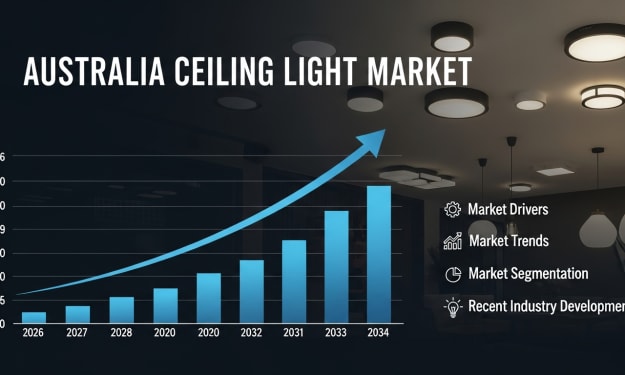
Australia Ceiling Light Market: Smart Illumination, Energy Efficiency & Future-Ready Living
In 2025, Australia ceiling light market was valued at USD 994.81 Million. Looking ahead, the market is projected to reach USD 1,461.66 Million by 2034, growing at a compound annual growth rate (CAGR) of 4.37% during 2026–2034.
By Kevin Cooper6 days ago in Futurism



Comments
There are no comments for this story
Be the first to respond and start the conversation.