
Trump's Controversial Push to Mine the Ocean Floor: A Resource War to Challenge China’s 80% Control
Breaking China’s Resource Stranglehold: Trump’s Bold Move to Mine the Ocean Floor

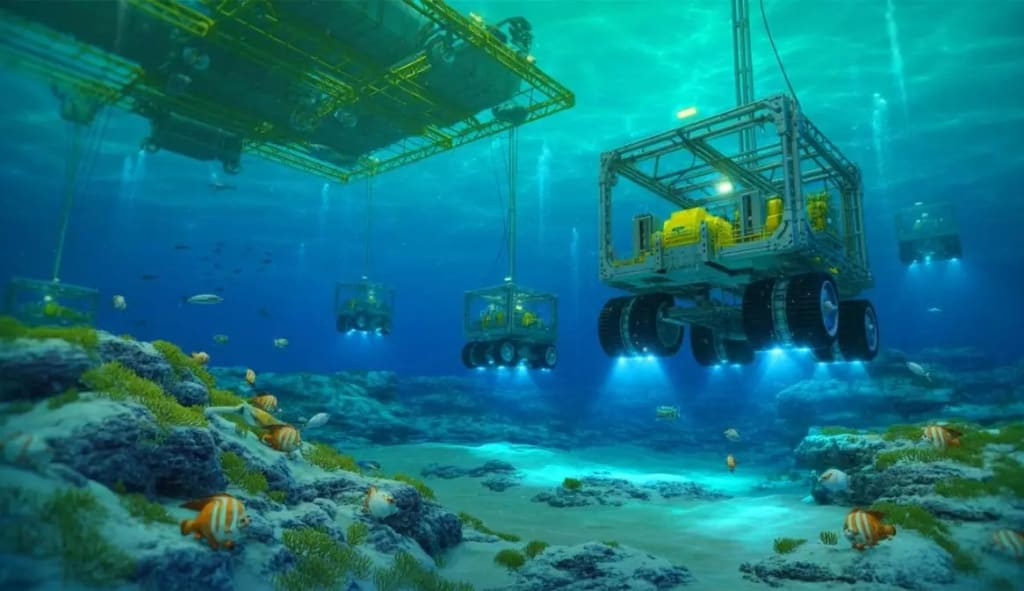
In a bold and contentious move, former U.S. President Donald Trump has declared a “resource war” aimed at tapping into the vast and largely unexploited resources of the ocean floor. The controversial move, outlined in an executive order, is set to expedite the process of deep-sea mining within U.S. and international waters. The primary goal behind this initiative is to break China’s stranglehold on the global supply chains of critical minerals, which are vital for numerous industries, including electronics, defense, and renewable energy technologies.
This article delves deep into the implications of this move, exploring the rationale behind Trump's decision, the potential risks involved, the ongoing debates around it, and the broader geopolitical and environmental ramifications.
The Geopolitical Landscape and the Resource War
For years, China has held a dominant position in global supply chains for essential minerals, commanding control over nearly 80% of the global supply of critical materials such as lithium, cobalt, and rare earth elements. These minerals are integral to the production of technologies ranging from smartphones to electric vehicles (EVs) and renewable energy solutions like wind turbines and solar panels. However, this overwhelming control has raised concerns, especially in Western nations, where dependency on China for such critical resources is seen as a strategic vulnerability.
The Trump administration’s push to exploit ocean floor mining is fundamentally aimed at reducing the United States' reliance on Chinese resources. By tapping into deep-sea mineral deposits, particularly those found in international waters, Trump aims to build a more self-sufficient supply chain for the U.S. and reduce China's grip on the market. The United States, along with its allies, has been increasingly concerned about the security risks posed by this dependency. As global tensions rise, especially concerning trade and technology, Trump’s executive order seeks to safeguard the U.S. economy and national security by diversifying its resource base.
The shift toward ocean floor mining also serves as a response to the geopolitical competition between the U.S. and China, particularly in the field of renewable energy and technology. While China has been making significant strides in advancing green technology, the U.S. is striving to catch up, and having access to rare minerals is essential for the nation's growth in these industries.
What is Deep-Sea Mining?
Deep-sea mining refers to the process of extracting valuable minerals from the ocean floor, particularly from polymetallic nodules that lie on the seabed. These nodules contain a mix of metals such as nickel, cobalt, copper, and manganese, all of which are crucial for manufacturing batteries, electronics, and other high-tech products. As global demand for electric vehicles, renewable energy infrastructure, and electronic devices continues to rise, the need for these minerals has skyrocketed.
Polymetallic nodules, one of the primary targets for deep-sea mining, are seen as a potentially rich source of these crucial metals. They are found in the Clarion-Clipperton Zone (CCZ), a vast area of the Pacific Ocean that stretches between Hawaii and Mexico. The metals found in these nodules are critical to the production of lithium-ion batteries, which power everything from cell phones to electric cars, as well as renewable energy systems.
However, while the economic benefits of deep-sea mining are clear, the process is fraught with risks and uncertainties. These include the potential for severe environmental damage, the disruption of fragile marine ecosystems, and the legal complexities surrounding the exploration of international waters.
Environmental Concerns: A Risk to Marine Ecosystems?
One of the biggest points of contention surrounding Trump’s initiative to mine the ocean floor is the environmental risk it poses to marine ecosystems. The deep ocean is a largely unexplored frontier, teeming with unique species and delicate ecosystems that have evolved over millions of years. The extraction of polymetallic nodules and other resources from the ocean floor could have significant long-term impacts on these ecosystems, leading to the destruction of biodiversity and the disruption of critical oceanic processes.
Environmental groups have strongly opposed the idea of deep-sea mining, warning that it could cause irreversible damage to marine life. For example, the process of mining the ocean floor involves the use of heavy machinery that may churn up sediment, which can suffocate marine organisms and introduce harmful substances into the water. Additionally, deep-sea mining operations could potentially release toxic chemicals into the ocean, further compromising the health of marine ecosystems.
Scientists and environmental advocates argue that the long-term effects of deep-sea mining are still largely unknown. While some argue that the ocean’s depth and distance from human settlements provide a buffer against immediate damage, others emphasize that the scale of disruption caused by large-scale mining operations could be catastrophic.
Legal and International Implications: The Bypass of the International Seabed Authority
Another significant issue raised by critics of Trump’s ocean floor mining initiative is the potential violation of international law. The United States has not ratified the 1982 United Nations Convention on the Law of the Sea (UNCLOS), an international treaty that governs the use of the world’s oceans and their resources. This treaty established the International Seabed Authority (ISA), which regulates mining in international waters to ensure that it is carried out responsibly and with consideration for the global commons.
By bypassing the ISA, Trump’s executive order could be seen as a unilateral move that undermines international agreements. This has raised concerns among legal experts and international governments who argue that such actions could destabilize ocean governance and set a dangerous precedent for other countries to pursue similar resource extraction efforts without regard for established international norms.
The U.S. government’s decision to push forward with deep-sea mining without ratifying UNCLOS further complicates the legal landscape. Critics contend that this could lead to disputes over resource ownership, environmental protection, and the potential for conflict over the regulation of mining activities in international waters.
The Role of Mining Companies: The Metals Company and Impossible Metals
Several companies are already seeking permits to mine polymetallic nodules in the Clarion-Clipperton Zone. Among the most notable are The Metals Company and Impossible Metals, which are working to obtain licenses to begin deep-sea mining operations. These companies argue that mining the ocean floor is essential to meeting the growing demand for critical minerals, particularly as the world shifts toward electric vehicles and renewable energy technologies.
The Metals Company, for example, has focused on developing sustainable methods of mining that minimize environmental impacts. However, even these companies’ claims are met with skepticism, as critics argue that the ecological risks of deep-sea mining are simply too high to ignore. The companies maintain that their operations will be monitored and regulated to ensure minimal environmental disruption, but many environmentalists remain unconvinced by these assurances.
Impossible Metals, another player in the deep-sea mining industry, has also received attention for its efforts to develop mining technologies that aim to reduce environmental harm. The company claims to be focused on innovative approaches that will make the extraction of ocean resources more sustainable. However, the deep-sea mining industry as a whole continues to face significant scrutiny due to the unpredictable nature of its environmental consequences.
The Economic Promise: A Path to Self-Sufficiency?
Despite the many concerns surrounding deep-sea mining, there are undeniable economic incentives for the United States to explore ocean floor resources. Access to critical minerals could provide a significant boost to the U.S. economy, particularly as industries like electric vehicle manufacturing, renewable energy, and defense continue to grow. The U.S. government is increasingly focusing on securing a stable and independent supply of these materials, reducing reliance on foreign sources, particularly China.
The development of a domestic deep-sea mining industry could also create jobs and stimulate economic growth, particularly in regions where such operations would take place. Proponents of the initiative argue that by tapping into the resources of the ocean floor, the U.S. can gain a competitive edge in the global market, particularly in industries that are poised to become increasingly important in the coming decades.
However, the economic benefits must be weighed against the potential long-term environmental and legal costs. It is essential for policymakers to balance the need for resource independence with the preservation of marine ecosystems and international cooperation.
Conclusion: A Controversial Path Forward
Trump’s decision to accelerate deep-sea mining is a bold and controversial one that raises numerous questions about the balance between economic growth, environmental sustainability, and international cooperation. While the move may help reduce the U.S.’s dependence on China for critical minerals, it also risks causing significant environmental harm and potentially violating international law.
As the world moves towards a more sustainable future, it is essential that policymakers and companies involved in deep-sea mining proceed with caution, ensuring that they do so in a way that respects both the environment and international agreements. The debate surrounding this issue is far from over, and it remains to be seen whether the benefits of deep-sea mining will outweigh the risks in the long term.
About the Creator
Tech Horizons
Exploring the future of technology, AI, gadgets, and innovations shaping tomorrow. Stay updated with Tech Horizons!
Keep reading
More stories from Tech Horizons and writers in Futurism and other communities.
How Memories Are Formed: New Harvard Discovery Reveals Synaptic Secrets Behind Learning
Memory is one of the most fascinating and essential functions of the human brain. It's how we store our experiences, learn new skills, and navigate daily life. But while scientists have long understood that memories are linked to changes in the brain's neural connections, the exact mechanics of how those changes occur has remained elusive—until now.
By Tech Horizons8 months ago in Futurism
About Binding Prometheus
I want to start actively advocating on behalf of my own work, and the most valuable part of my canon is, without a doubt, Binding Prometheus, the play I have been working on since 2019 and only finished in 2023 as part of my MA. The play itself is an amalgamation of a million different inspirations. On one end, it evokes the Ancient Greek myth-play, deriving its own title from the earliest extant work of Western drama we have, Aeschylus’s Prometheus Bound. On the other end, it borrows significantly from the sci-fi bulwarks from over the years, namely Mary Shelley’s Frankenstein and Karel Capek’s Rossum’s Universal Robots. The play could be an episode of Black Mirror, I fear. I don’t know. I’ve only ever seen one episode of Black Mirror.
By Steven Christopher McKnight18 days ago in Futurism
Food Service Equipment Market: Smart Kitchens, Operational Efficiency & Industry Trends
According to IMARC Group's latest research publication, global food service equipment market size reached USD 40.1 Billion in 2024. Looking forward, IMARC Group expects the market to reach USD 59.6 Billion by 2033, exhibiting a growth rate (CAGR) of 4.5% during 2025-2033.
By Andrew Sullivan4 days ago in Futurism
A Dart at Dusk
Seconds ago, the sullen sun set on the two of us… my exuberant furry companion and me. A fresh breeze embraces us, delivering welcome relief from the day’s oppressive heat. His typical stumbling and staggering along — apace with a sloth — has turned into trip-trapping, high-stepping, almost skipping along.
By Angie the Archivist 📚🪶5 days ago in Petlife




Comments
There are no comments for this story
Be the first to respond and start the conversation.