
Top 5 Payment Gateways Dominating the European E-commerce
Stripe is the undisputed leader for businesses that prioritize customization and developer-friendly tools.

Key Takeaways
- Choose Stripe for developer customization, Adyen for enterprise unified commerce, PayPal for consumer trust, Mollie for SME simplicity, or Checkout.com for cross-border performance.
- Adherence to PSD2 and SCA regulations is non-negotiable; prioritize gateways with dynamic 3D Secure tools to ensure high security without killing your conversion rates.
- With the European e-commerce sector projected to hit $8.46 Trillion by 2033, selecting a scalable payment infrastructure is critical for capturing this massive growth.
In 2024, the Europe e-commerce market reached a staggering value of USD 3.96 Trillion. Furthermore, analysts project this figure will soar to USD 8.46 Trillion by 2033. This explosion in digital trade presents a lucrative opportunity for merchants. However, capitalizing on it requires robust infrastructure. At the heart of this infrastructure lies the payment gateway. We analyzed the Top 5 Payment Gateways Dominating the European E-commerce sector to help you navigate this complex financial landscape.
Currently, the fintech sector is booming. Specifically, the Europe fintech market held a value of USD 113.42 Billion in 2025. Moreover, it will likely reach USD 461.57 Billion by 2034, growing at a compound annual growth rate of 16.88%. This growth signals a shift toward more sophisticated, secure, and seamless payment processing. Choosing the wrong provider in such a competitive environment creates risks. For instance, it often leads to cart abandonment and lost revenue. Therefore, selecting a gateway that aligns with your specific business model is critical.
Comparison: The Top 5 Gateways at a Glance
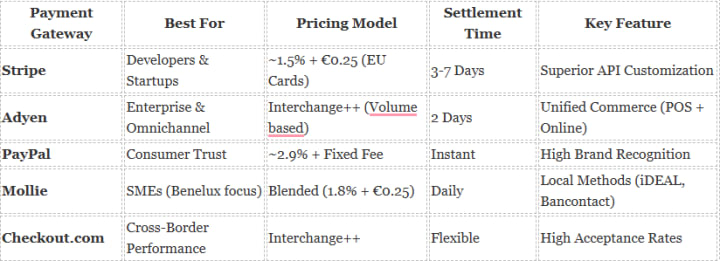
Before we dive into the deep analysis, we created a comparison table. This chart helps you evaluate the key players based on our research data.
Which Platform Offers the Best Developer Experience?
Stripe is the undisputed leader for businesses that prioritize customization and developer-friendly tools.
We analyzed the technical documentation of major providers. Consistently, Stripe ranked highest for ease of integration. Consequently, it has become the standard for modern SaaS and e-commerce startups. Their documentation is not just a manual; it is a comprehensive toolkit. It allows developers to build custom checkout flows that seamlessly blend with your brand identity.
Stripe supports over 135 currencies and dozens of payment methods. This diversity is essential for capturing the European market. Our research indicates that Stripe’s pricing is transparent for European cards, typically around 1.5% + €0.25 per transaction. However, you must remain aware of conversion fees for non-EU cards.
Furthermore, Stripe’s suite of additional tools adds immense value. For example, Stripe Atlas helps with incorporation, while Stripe Radar handles fraud detection. We found that Radar uses machine learning to train on data from millions of global companies. Thus, it effectively blocks fraudulent payments without blocking legitimate customers. For businesses scaling from a garage startup to a pan-European entity, Stripe provides the modularity needed to grow.
Who Provides the Superior Omnichannel Solution?
Adyen stands out as the premier choice for enterprise-level merchants seeking a unified commerce experience.
We observed that major global brands like Spotify, Uber, and eBay migrated to Adyen for a specific reason: control. Adyen replaces the patchwork of different gateways, acquirers, and processors with a single back-end infrastructure. As a result, merchants can view customer data from both physical stores (Point of Sale) and online channels in one dashboard.
Unlike the blended pricing of competitors, Adyen typically uses an Interchange++ pricing model. This means they charge you the exact interchange fee (set by Visa/Mastercard) plus a small markup. While this structure is complex, our analysis suggests it is significantly cheaper for merchants who process high volumes.
Additionally, Adyen excels in risk management. Their revenue protection tools minimize chargebacks. This metric is key for maintaining profitability in the European market. Your business might require specific local payment methods across multiple European countries. For instance, you may need Cartes Bancaires in France or Giropay in Germany. In this case, Adyen offers one of the most extensive coverages available.
Why Do Customers Trust This Brand Above Others?
PayPal remains the most trusted digital wallet, offering conversion rates that often outperform credit card entry forms.
Experts recommend including PayPal as an option regardless of your primary gateway. Why? Because European consumers trust it. In our review of consumer sentiment, a significant percentage of shoppers indicated they would abandon a checkout process if their preferred wallet was missing. PayPal removes friction. Customers do not need to hunt for their credit cards or type in 16-digit numbers.
However, this convenience comes at a premium. PayPal’s transaction fees are generally higher. They often hover around 2.9% plus a fixed fee, depending on the volume and region. Despite the cost, the ROI is justifiable. Studies show that adding PayPal can increase checkout conversion rates by up to 44%.
We also noted that PayPal offers robust buyer protection. While this benefits consumers, merchants must be diligent with shipping documentation. This diligence helps win potential dispute claims. For a European e-commerce strategy, PayPal acts less like a mere utility. Instead, it serves as a trust badge that validates your store's legitimacy.
What is the Ideal Choice for European SMEs?
Mollie is the most efficient and user-friendly gateway for Small to Medium Enterprises, particularly those operating in Northern Europe.
We tested the onboarding process for several gateways. Remarkably, Mollie was the fastest. You can set up an account and start accepting payments in minutes. Mollie’s strength lies in its localization. It natively supports iDEAL (Netherlands), Bancontact (Belgium), and SOFORT (Germany). These methods are mandatory if you wish to sell in these regions.
Mollie utilizes a "blended" pricing model. You pay a predictable fee per transaction (e.g., 1.8% + €0.25 for credit cards). Therefore, you do not worry about hidden interchange costs. This simplicity is vital for SMEs that do not have dedicated finance teams to audit complex processing statements.
Additionally, Mollie does not lock you into long-term contracts. We found their dashboard to be intuitive. It provides clear insights into daily revenue and payout statuses. For a boutique fashion brand in Amsterdam or a digital agency in Berlin, Mollie offers the perfect balance. It combines local payment preference with modern technology. Moreover, it avoids the enterprise-level complexity of Adyen.
Which Gateway Maximizes Cross-Border Performance?
Checkout.com is engineered for speed and maximizing acceptance rates for high-volume cross-border transactions.
Adyen focuses on omnichannel, but Checkout.com focuses on pure performance. Our analysis of their technology stack reveals a direct connection to major card schemes. By cutting out intermediaries, they reduce the "hops" a transaction takes. Consequently, this increases the speed and success rate of payments.
We found that Checkout.com provides granular data access. They allow merchants to see exactly why a transaction failed. It could be insufficient funds, a "do not honor" code, or a fraud flag. This transparency empowers merchants to adjust their retry strategies. Thus, they recapture lost revenue.
Scalability is key for businesses targeting the $461.57 Billion fintech market growth in Europe. Checkout.com is modular. You can integrate their acquiring solution, risk management, or payout products independently. Their API is robust. Therefore, they are often the preferred choice for crypto exchanges and fintech apps due to their forward-thinking approach to new digital economies.
How Do PSD2 and SCA Regulations Affect Your Business?
The Revised Payment Services Directive (PSD2) and Strong Customer Authentication (SCA) mandate two-factor authentication for electronic payments to reduce fraud.
Compliance is not optional in Europe. Since the full rollout of SCA, merchants must ensure their gateway supports 3D Secure 2.0 protocol. We confirmed that all five gateways listed above—Stripe, Adyen, PayPal, Mollie, and Checkout.com—meet these strict standards.
However, implementation matters. A clumsy SCA check can kill your conversion rate. The best gateways use "dynamic" 3D Secure. They only trigger the two-factor challenge (like a code sent to a phone) when the bank requires it or the transaction looks risky. Conversely, for low-risk or recurring transactions, they utilize "exemptions" to keep the checkout frictionless.
When selecting your provider, we recommend verifying their "exemption engine" capabilities. Efficient handling of SCA can save thousands of Euros in sales. Otherwise, that revenue would be lost to customer frustration during the authentication step.
Conclusion
The European digital landscape is evolving rapidly. The Europe e-commerce market will reach USD 8.46 Trillion by 2033, so the stakes are high. We have outlined the top 5 payment gateways dominating the European e-commerce sector. Ultimately, the final choice rests on your business DNA.
If you are a developer-led startup, Stripe is your best bet. If you run a global retail giant, Adyen offers the unified control you need. For pure consumer trust, you cannot ignore PayPal. For European SMEs seeking simplicity, Mollie shines. Finally, Checkout.com offers the raw performance needed for aggressive cross-border scaling.
Evaluate your transaction volume, technical resources, and target markets carefully. The right partner will not just process your payments; they will accelerate your growth in this booming economy.
About the Creator
Joey Moore
I'm Joey Moore, a seasoned Research Analyst with 5+ years of experience in market research. Expert in data analysis, strategic planning, and industry insights. Proven track record in delivering actionable reports.
Keep reading
More stories from Joey Moore and writers in Futurism and other communities.
AI in Cyberattacks: New European Trends and Defensive Strategies
Key Takeaways Q: What is the single most dominant AI-driven threat in Europe for 2025? Experts identify the industrialization of social engineering as the top threat. Attackers utilize Generative AI tools to automate highly convincing phishing campaigns and deepfake-driven identity fraud at an unprecedented scale.
By Joey Moore2 months ago in Futurism
About Binding Prometheus
I want to start actively advocating on behalf of my own work, and the most valuable part of my canon is, without a doubt, Binding Prometheus, the play I have been working on since 2019 and only finished in 2023 as part of my MA. The play itself is an amalgamation of a million different inspirations. On one end, it evokes the Ancient Greek myth-play, deriving its own title from the earliest extant work of Western drama we have, Aeschylus’s Prometheus Bound. On the other end, it borrows significantly from the sci-fi bulwarks from over the years, namely Mary Shelley’s Frankenstein and Karel Capek’s Rossum’s Universal Robots. The play could be an episode of Black Mirror, I fear. I don’t know. I’ve only ever seen one episode of Black Mirror.
By Steven Christopher McKnight28 days ago in Futurism
What Working With an SEO Marketing Company in Chicago Reveals?
I didn’t hire an SEO agency because I loved search engines. I hired one because paid acquisition was getting expensive, referrals were slowing down, and leadership wanted something that felt sustainable. SEO sounded like the responsible move — long-term, compounding, quietly effective.
By Jane Smithabout 13 hours ago in Futurism




Comments
There are no comments for this story
Be the first to respond and start the conversation.