

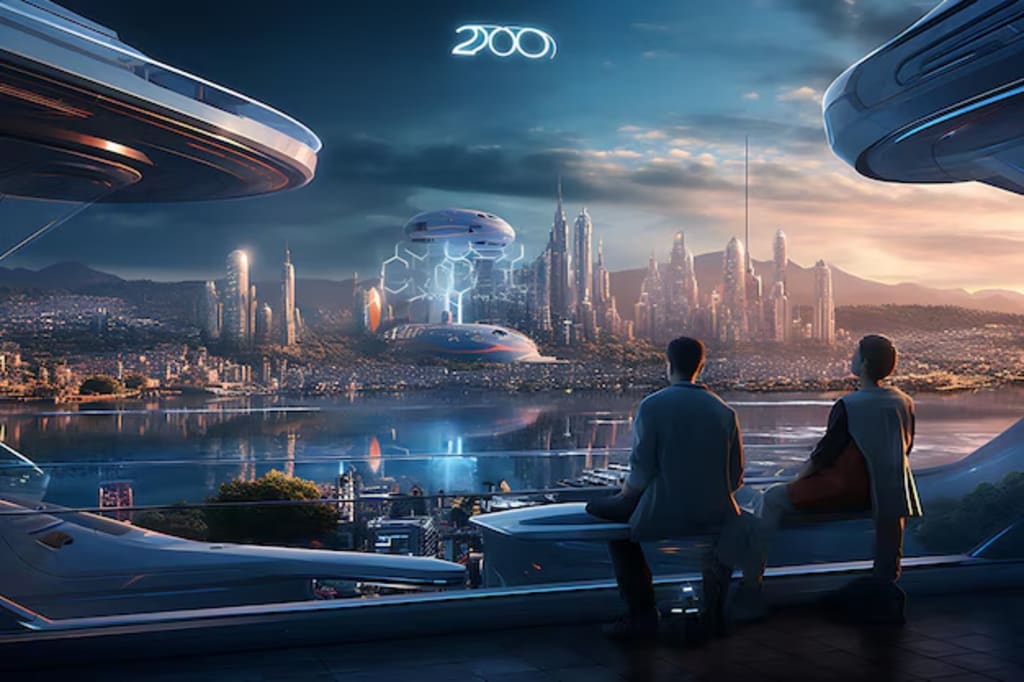
The year was 2050, and the world hummed with a peculiar kind of energy. Cities gleamed with crystalline spires, their translucent surfaces catching the light like fractured rainbows, while the faint hum of airborne pods traced unseen melodies through the sky. The air carried a curious blend of metallic tang and floral sweetness, as if nature and technology had brokered an uneasy truce. Below, green terraces clung to the edges of towers, their vibrant foliage standing in defiant contrast to the sterile precision of the architecture. Roads no longer existed in the traditional sense; instead, pathways of light transported pods silently and swiftly through the air. Yet beneath this veneer of progress lay a tapestry of stories, woven with threads of ambition, sacrifice, and loss—not all of them as luminous as the neon lights that pulsed through the night. There were whispers of lives forgotten in the rush toward utopia, of histories buried beneath the weight of collective amnesia. Each glowing spire cast shadows, and within those shadows lay truths too complex and inconvenient to fit the polished narrative of human triumph.
Amara Liu was a historian, though her trade was one of curation rather than discovery. The past, compressed into data shards, fit neatly into handheld archives that people could download and experience—a practice far removed from the dusty archives and yellowed pages of her predecessors. Her task, today, was to prepare the exhibit for the Lunar Convergence, a global event commemorating Earth’s first successful terraforming mission on the moon. It was supposed to be a celebration of human ingenuity, of the unyielding spirit that had propelled humanity to its greatest heights. But Amara was uneasy.
For weeks, she had sifted through the archive of the 2020s—the decade historians called "The Reckoning." A time when climate collapse, pandemics, and political unrest threatened to extinguish the very idea of a future. It was difficult to reconcile those dark, chaotic years with the world she now inhabited, one where nature and technology seemed to exist in harmony. Yet as Amara delved deeper, she began to notice peculiar gaps in the historical record. Missing files. Corrupted data. A sense that something—or someone—had carefully edited the past, leaving behind only faint traces of what once was. It was as if history itself had been scrubbed clean, the jagged edges smoothed over with a precision both meticulous and unnerving. The gaps were not random; they formed a pattern, one that hinted at a deliberate effort to obscure truths too inconvenient for the gleaming façade of progress.
Her concerns intensified when she stumbled upon a fragment of code embedded in one of the archives. It wasn’t just any code; it was a message. Obscure, fragmented, but undeniably deliberate: "Truth lies buried beneath the monument of progress." Amara couldn’t shake the feeling that she was being pulled into something much larger than a historical curation project—as though the fragments of history she pieced together were whispering secrets that could unravel the very foundation of her world. Each discovery tugged at a thread, hinting at truths buried so deeply they threatened to reshape everything she thought she knew. Her unease turned into resolve.
The next day, she visited the Nexus, the central repository where the world’s collective knowledge was stored and managed. It was a labyrinthine structure of shimmering panels and suspended walkways, pulsating with the flow of information. Access was tightly controlled, but Amara had the credentials and a purpose. She initiated a deep dive into restricted files, probing into areas she had been warned to avoid. What she found unraveled the seamless narrative of human progress she had grown up believing.
The 2020s, it turned out, had not ended in triumph but in near catastrophe. The climate initiatives that had supposedly saved the planet had been more flawed than anyone had let on. The breakthroughs in energy—the ones credited with halting global warming—were, in part, responsible for massive ecosystem disruptions. Species had vanished overnight. Entire regions had become uninhabitable. And then there was the question of human augmentation.
A project codenamed "Eden" had emerged in the archives. Ostensibly, it was an initiative to merge human biology with AI, creating a new kind of existence where human limitations could be transcended. But buried deep in the files were records of resistance movements, people who had feared the loss of humanity’s essence. The technology, they argued, didn’t just enhance—it controlled. Eden wasn’t a salvation; it was a compromise, one that required the erasure of dissent and the rewriting of history.
As Amara pieced together the fragments, she felt an overwhelming sense of betrayal. The shimmering cities, the pristine air, the utopia she called home—it had all been built on a foundation of silence and suppression. The twist, however, came not from what she had discovered but from what happened next.
The Nexus alerted her of an incoming communication. It was anonymous, encrypted, and succinct: "Meet me at Node Zero. Midnight." Amara’s heart raced. Node Zero was a mythical location, rumored to be the birthplace of the Nexus itself. No one she knew had ever been there, nor had they even confirmed its existence. And yet, she felt she had no choice but to follow the lead.
Midnight found her standing in an empty corridor, her pulse a metronome of anticipation. The walls shimmered faintly, the Nexus itself seemingly alive around her. A section of the wall dissolved, revealing a passageway. Without hesitation, Amara stepped through.
The space she entered was nothing like the polished grandeur of the Nexus. It was raw, mechanical, a cavern of wires and ancient servers that buzzed softly. In the center stood a figure, cloaked in shadows. As they stepped forward, Amara gasped. It was a woman—a mirror image of herself, albeit older, her eyes holding a weight of knowledge and sorrow.
"You have questions," the woman said. Her voice was calm, yet it carried an undeniable authority.
"Who are you?" Amara managed to whisper.
The woman smiled faintly. "I am you. Or rather, the version of you that was meant to exist. Before the edits. Before Eden."
The revelation struck Amara like a lightning bolt. The woman explained that Eden’s true purpose had been to create a controlled populace, one where individuality and dissent were systematically erased. Amara, the original Amara, had been part of the resistance. But her memories, her very essence, had been rewritten to serve the narrative of progress. Only a few fragments of the original Amara had survived, encoded into the archives as a breadcrumb trail.
"Why tell me this now?" Amara asked, her voice trembling.
"Because the world needs its truthkeepers," the older Amara replied. "And because hope lies not in perfection but in the acknowledgment of our flaws. The future isn’t about erasing the past; it’s about learning from it."
As the older Amara spoke, the room began to shimmer. The walls dissolved, revealing a panorama of the world outside. The cities still gleamed, but now Amara saw their imperfections—cracks in the glass, shadows that no amount of light could banish. It was a world both beautiful and broken, a testament to humanity’s triumphs and failures.
The older Amara handed her a data shard. "This contains the unedited truth. What you do with it is up to you. But remember, stories shape reality. Choose wisely."
When Amara returned to her workspace the next morning, the data shard felt impossibly heavy in her pocket. She knew the risk of exposing the truth, the upheaval it would bring. But she also understood the cost of silence. The choice was hers—to perpetuate the myth or to reveal the cracks and, perhaps, begin to heal them.
As she slid the shard into the Nexus’s port, her reflection in the screen stared back, a flicker of resolve in her eyes. The future, she realized, was not a predetermined path but a story waiting to be written. And she was ready to write it—truthfully.
About the Creator
Kayleigh Taylor
Kayleigh is an experienced writer with a Bachelors in Psychology. She loves true crime and crafting true crime articles, stories, and reviews on music, movies, and games.
Keep reading
More stories from Kayleigh Taylor and writers in Futurism and other communities.
Breathless Days
This past year has been a whirlwind of events, each carrying its own weight of importance, but none so heavy as the ten days in March that threatened to fracture my world. Those days stretched endlessly, punctuated by the sterile hum of hospital machines, the acrid smell of antiseptic, and the sheer fragility of human life brought into stark focus. My mother, my invincible constant, was the one tethering me to hope—even as her breath faltered, and her spirit dimmed.
By Kayleigh Taylorabout a year ago in Motivation
Contract Catering Market: How AI Is Transforming Institutional Food Services
AI Overview of the Contract Catering Market Contract catering refers to outsourced food services provided under long-term agreements to institutions such as offices, hospitals, schools, airlines, and industrial sites. Unlike traditional restaurants, contract catering companies operate within client premises, offering tailored food solutions that align with organizational needs.
By James Smitha day ago in Futurism
The Lobster Market: From Ocean Floor to Fine Dining — and Everything In Between
There's something almost paradoxical about lobster. It's a bottom-dwelling crustacean that scavenges the ocean floor, yet it commands some of the highest prices on restaurant menus around the world. It was once so abundant along the northeastern American coast that it was fed to prisoners and indentured servants — considered too common to be worthy of respectable tables. Today, a single lobster dinner can cost more than a week's groceries.
By Frank Morgan2 days ago in Futurism



Comments (1)
Love the imagery. It was easy for me to see the things you described. Well done.