
This planet is more suitable for human future immigrants to live in
The rapid development of science and technology has made human civilization develop by leaps and bounds, and it has also intensified the rapid consumption of the earth's resources. We all know that the earth's resources are formed over hundreds of millions of years and billions of years, and they are all non-renewable resources, so use a little less. With the rapid development of human science and technology, we will inevitably face the depletion of the earth's resources in the future.

Once the resources are exhausted, human science and technology will come to a halt and human civilization will face extinction. It is important to know that the survival of any life is inseparable from resources. Every existence of human beings needs the support of resources every day. Without resources, human beings cannot survive.
Scientists searching for human future immigration alien planet, in addition to the problem because the earth's resources dried up, and one reason is that with the rapid development of human science and technology, the earth's ecological environment has been deteriorating, slowly will not be suitable for human survival, to the continuation of civilization, will also have to leave the earth, immigration to other planet.
Of course, the universe is vast, with hundreds of billions of stars in a single galaxy, and the number of Earth-like planets in the Milky Way is incalculable. Therefore, there is no shortage of naturally habitable planets in the Milky Way for humans to live on, and there may be planets with exactly the same ecological environment as Earth. But these habitable Earth-like planets are outside our solar system, at least a few light years away, sometimes hundreds of light years away.
With the development rate of human science and technology, we will not be able to explore out of the solar system for a long time in the future, so the search for new planets suitable for human life can only be found in the solar system. The most popular among scientists is naturally Mars. Mars has been in the sights of scientists for a long time, and many probes have been launched to explore the Martian environment.
After decades of exploring and studying Mars, scientists now know a lot about the planet. Although Mars is similar to Earth, it has only a thin atmosphere and a very bad environment. It will be very difficult for humans to immigrate to Mars in the future. It depends on whether it can be modified successfully. In addition to Mars, scientists are also actively exploring other possible habitable planets in the solar system.
Scientists have explored seven other planets in the solar system and found that they are not suitable for human life, but Titan, a moon of Saturn, has attracted scientists' interest as a better environment for future human migration than Mars. Why?
Titan is a satellite orbiting Saturn, is the second largest satellite in the solar system, he has a very domineering name, called Titan, it is the only has a thick atmosphere of the satellite in the solar system, and the atmospheric pressure is 1.5 times of the earth, gravity, and the moon is quite a variety of conditions, according to the satellite in life are likely to exist.
Scientists observing Titan have also found that it is still in a pristine state, much like primitive Earth. It is rich in organic compounds and elements like nitrogen, an environment very similar to that of the early Earth. And scientists have discovered that Titan's thick ice sheet may harbor a vast subglacial ocean.
It has a thick atmosphere and underground liquid water, two conditions that are very important for the birth of life, but also for the survival of human beings. For Earth life and human beings, if a planet does not have a thick atmosphere, it will not be able to block all kinds of strong radiation in the universe, and human beings can not survive on the surface of the planet.
So the first thing scientists need to find a habitable planet is a thick atmosphere. Mars has an atmosphere, but it's very thin. Titan, on the other hand, has a very thick atmosphere. As a result, scientists believe Titan is better suited to future human migration needs than Mars. Of course, since Titan is not in the habitable zone, its surface temperature is too cold for liquid water to exist.
What scientists have observed on Titan's surface is an ice sheet, with the possibility of a liquid ocean beneath it. So Titan wouldn't be able to be inhabited directly by humans, and it would require a series of modifications in the future.
The main reason scientists think Titan is a better place for future human settlers is that it's built with a very good ecology, a thick atmosphere, a lot of ice sheet, and where the ice sheet may have a liquid ocean. There is nothing wrong with it except the low temperature, which is the easiest thing to solve in the future.
While it's not technologically possible to warm up an icy planet, it won't be that difficult in the future. One way to do this would be to put giant solar panels in orbit that would reflect the sun's energy onto Titan's surface. That would warm it up, melting the ice caps, creating a liquid ocean on the surface, and slowly warming the planet back up to the point where we could live.
Another option would be to create an artificial sun that could be placed in orbit around Titan after we succeed in using controlled nuclear fusion. Once Titan gets the right temperature, its surface ice sheet melts slowly, and it has a thick atmosphere, it could be another Earth. In the same way, it's not that hard to engineer Mars and warm it up, but it's not that easy to thicken its atmosphere.
However, Titan also has a disadvantage is that it does not have a magnetic field, without the magnetic field can not effectively protect against the solar wind invasion, although the thick atmosphere of the second layer of protection, but the radiation is larger than the Earth, will cause some trouble for human survival. Of course, all is not perfect, especially since humans are shrinking in the solar system, and finding a natural new Earth is unlikely.
In the future, when human technology is more powerful and we have the ability to explore the outer solar system, we will be able to go out of the solar system and explore the new Earth in the nearby galaxy, without limiting the solar system to Janemon, Mars and so on.
About the Creator
Keep reading
More stories from writers in Futurism and other communities.
About Binding Prometheus
I want to start actively advocating on behalf of my own work, and the most valuable part of my canon is, without a doubt, Binding Prometheus, the play I have been working on since 2019 and only finished in 2023 as part of my MA. The play itself is an amalgamation of a million different inspirations. On one end, it evokes the Ancient Greek myth-play, deriving its own title from the earliest extant work of Western drama we have, Aeschylus’s Prometheus Bound. On the other end, it borrows significantly from the sci-fi bulwarks from over the years, namely Mary Shelley’s Frankenstein and Karel Capek’s Rossum’s Universal Robots. The play could be an episode of Black Mirror, I fear. I don’t know. I’ve only ever seen one episode of Black Mirror.
By Steven Christopher McKnight17 days ago in Futurism
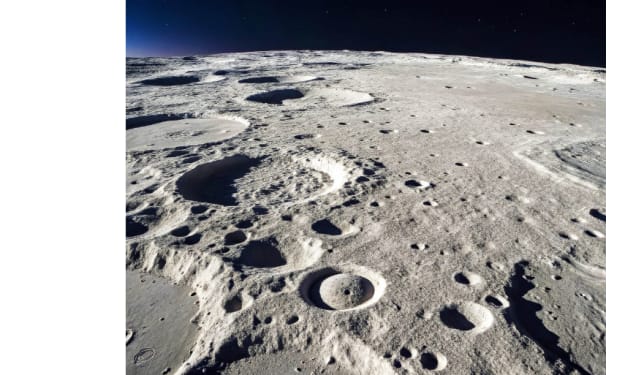
Contrary to popular perception, far-side observations show that Earth's moon is not "dead."
For a long time, the moon appeared to be a world that had completed its major transformations before becoming silent. Although there are still scars on its surface from heavy impacts and past lava floods, many experts have viewed such features as remnants of a far older era.
By Francis Dami5 days ago in Futurism



Comments
There are no comments for this story
Be the first to respond and start the conversation.