
This Isn’t the Cloud’s Story Anymore
How Local AI Is Quietly Taking Over
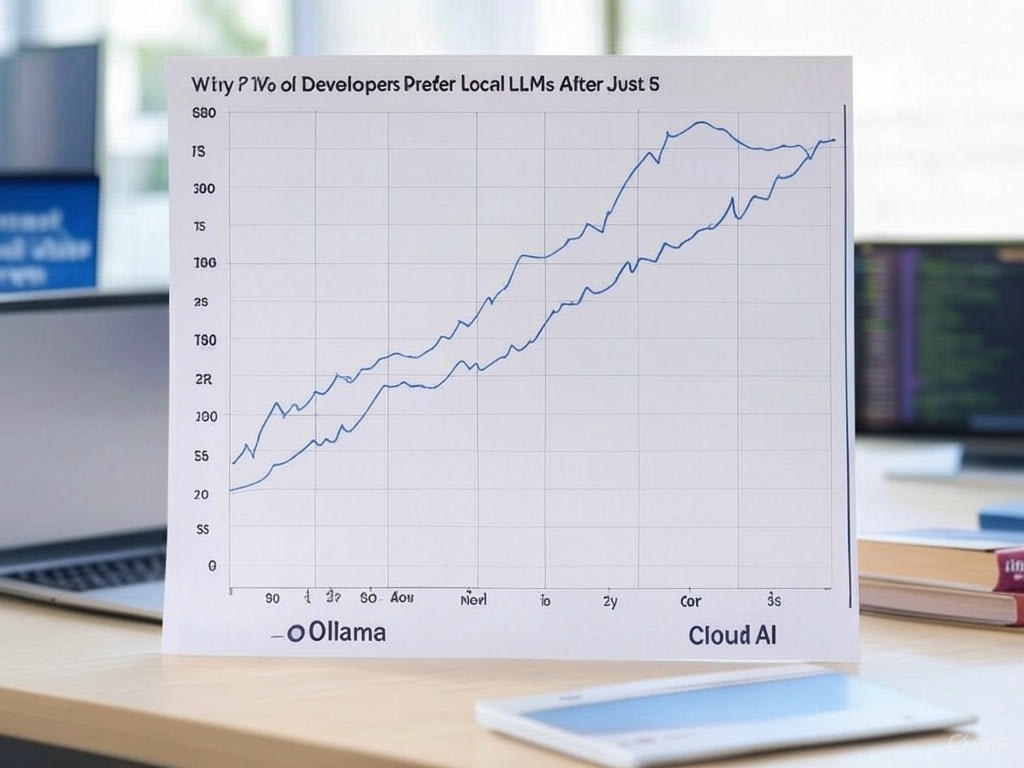
Something surprising is happening in the world of AI, and it’s not where you think. While headlines continue to talk about billion-dollar model training runs in massive data centers, a quiet, local revolution is underway. Professionals, educators, developers, and researchers are discovering that the most meaningful AI experiences can happen without cloud access. The tool making this possible is Ollama.
Ollama doesn’t need an API key. It doesn’t require a connection to OpenAI, Google, or Anthropic. Instead, it runs models like LLaMA 2, Mistral, and Phi-2 directly on your laptop or desktop machine. The result? AI that responds in milliseconds, respects your data boundaries, and doesn’t charge you per word.
It’s a radical shift. And it’s spreading.
The key is ownership. With most cloud-based AI tools, you’re renting a slice of intelligence through a third-party gateway. Every interaction is logged, monetized, and piped through infrastructure you don’t control. That’s fine for casual usage. But when the data you work with is sensitive—like patient records, legal documents, or unpublished research—relying on cloud services starts to feel risky. That’s why developers and decision-makers are reconsidering their relationship with GenAI. They’re realizing that a model isn’t just a product—it can be a resource they run, manage, and refine. Ollama makes that idea actionable.
Instead of sending your prompt to a server and waiting for a response, Ollama runs the entire inference cycle locally. Once the model is downloaded, everything happens on your device. It’s like moving from streaming music online to owning a library of songs. You lose a bit of convenience, but you gain speed, freedom, and control.
One real-world example stands out. A law firm in Delhi built a private AI assistant to help parse and analyze case law using a local model. They trained it on Indian legal texts, connected it to a local vector database, and wrapped the interface using simple open-source tools. The results? No latency, no billing, and no data risk. It performed faster than GPT APIs and remained fully compliant with regional data laws.
This is what local AI unlocks: on-demand intelligence that is adaptable, inspectable, and completely self-contained. Whether you’re in rural India or a government agency in Europe, the value of keeping your data on-site cannot be overstated.
The economic story is just as compelling. Cloud API costs are notoriously unpredictable. Depending on the model, a single user session could rack up dollars in inference fees. Multiply that by thousands of users, and the economics become prohibitive. Local models have a flat cost: hardware and electricity. That’s it. Once installed, they scale horizontally across devices without scaling cost. What’s more, the performance gap is shrinking. Local inference engines, supported by advances in model quantization and chip acceleration, can now serve responses in under 500 milliseconds. That’s fast enough for real-time interfaces and faster than many cloud-based deployments facing network lag.
In this ecosystem, Ollama is playing a crucial role. It packages complexity into simplicity. Developers don’t have to worry about CUDA versions, dependency hell, or GPU configurations. They install it, pick a model, and start working. This accessibility lowers the barrier to AI experimentation, especially in regions or sectors without access to expensive cloud infrastructure.
To visualize it, imagine a laptop with arrows connecting a local model to a document database and a user query interface—all within one machine. No cloud icons. No outbound traffic. Just clean, fast, local inference. This isn’t a return to the past. It’s a correction. A rebalancing of AI away from centralized control and toward personal agency. Ollama is helping to shift the default from hosted to owned, from rented to resident.
As the adoption of local AI grows, so does its influence. More professionals are choosing to build models they can trust, on devices they control, for use cases that demand reliability. It’s not flashy. But it’s working.
And it just might reshape how we think about AI forever.
About the Creator
Keep reading
More stories from Roger Thompson and writers in Futurism and other communities.
The Search Engine That Thinks
"Information is not knowledge unless it's understood and understanding needs a thinking assistant." Introduction Imagine asking a question online and getting not just an answer, but a well-researched, cited response written in clear language. Now imagine following up with a related question and receiving even deeper insights, all without switching tabs or scrolling through ad-ridden web pages. Welcome to the world of Perplexity AI, a conversational search engine that's transforming how we access knowledge. At the intersection of search, artificial intelligence, and user experience, Perplexity AI merges the best of large language models (LLMs) like GPT-4 with real-time web retrieval. It's not just another chatbot or another search bar—it's a cognitive companion for creators, learners, and professionals.
By Roger Thompson9 months ago in Futurism
About Binding Prometheus
I want to start actively advocating on behalf of my own work, and the most valuable part of my canon is, without a doubt, Binding Prometheus, the play I have been working on since 2019 and only finished in 2023 as part of my MA. The play itself is an amalgamation of a million different inspirations. On one end, it evokes the Ancient Greek myth-play, deriving its own title from the earliest extant work of Western drama we have, Aeschylus’s Prometheus Bound. On the other end, it borrows significantly from the sci-fi bulwarks from over the years, namely Mary Shelley’s Frankenstein and Karel Capek’s Rossum’s Universal Robots. The play could be an episode of Black Mirror, I fear. I don’t know. I’ve only ever seen one episode of Black Mirror.
By Steven Christopher McKnight22 days ago in Futurism
Saudi Arabia Dried Fruits and Nuts Market Analysis: Key Players and Market Forecast
According to IMARC Group's latest research publication, the Saudi Arabia dried fruits and nuts market size reached USD 590.61 Million in 2024. The market is projected to reach USD 1,059.61 Million by 2033, exhibiting a growth rate of 6.71% during 2025-2033.
By Abhay Rajput2 days ago in Futurism



Comments
There are no comments for this story
Be the first to respond and start the conversation.