
The Trust Imperative: AI Ethics, Governance, and the Road to Responsible Innovation
Navigating the Ethical Maze: Principles, Policies, and the Human-Centric Approach to AI

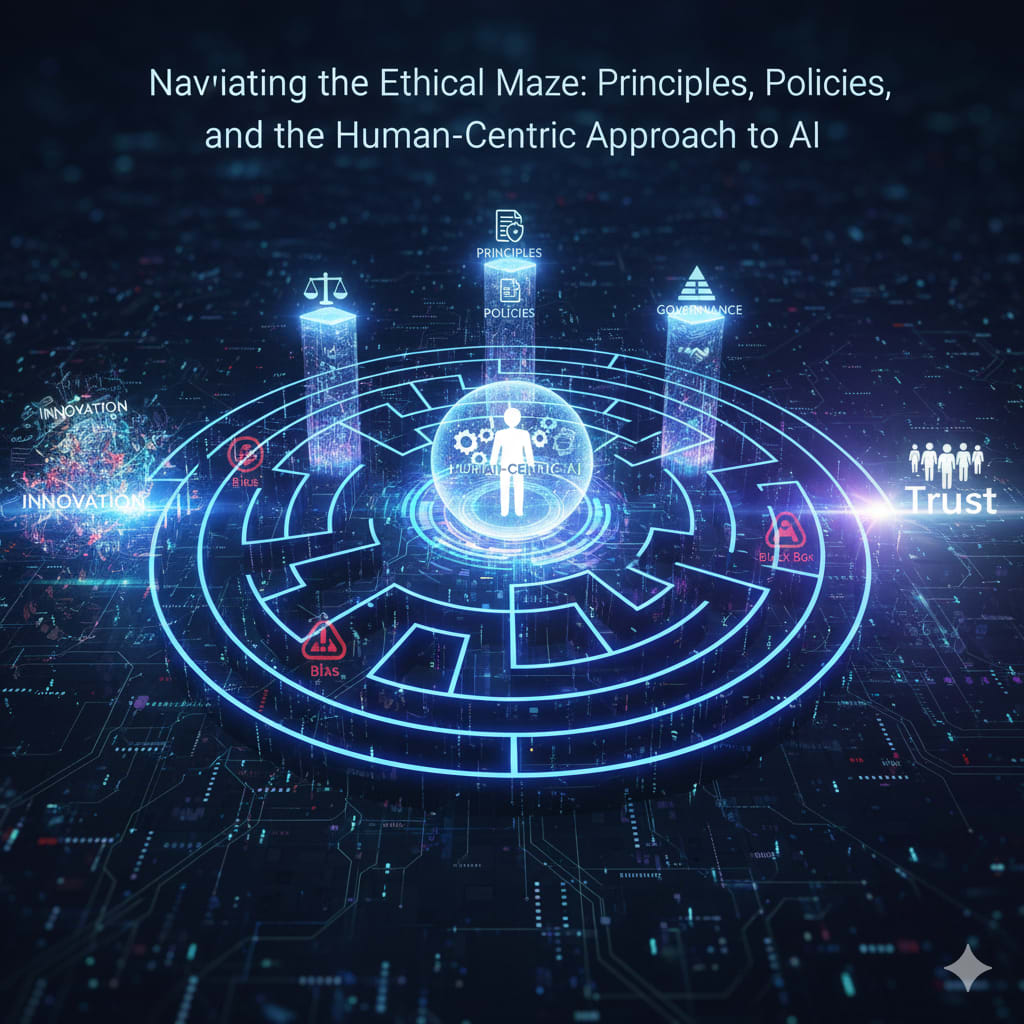
⚖️ Introduction: When Innovation Meets Responsibility
The rapid deployment of Generative AI and autonomous systems has brought immense technological leaps. However, this progress is shadowed by complex ethical, legal, and societal challenges. As AI moves from a predictive tool to a decision-maker in fields like recruitment, lending, and law enforcement, the question shifts from "Can we build it?" to "Should we build it, and how do we control it responsibly?"
AI Ethics and Governance have emerged as the paramount concern for businesses and governments alike. It is the framework that ensures AI systems are fair, transparent, accountable, and aligned with human values and fundamental rights. Without robust governance, public trust erodes, and the transformative potential of AI is curtailed by fear and regulation.
🚫 The Core Challenges: Understanding AI Risk
The push for responsible AI stems from several critical, well-documented failure points where AI can cause real-world harm:
1. Algorithmic Bias and Fairness
AI systems are only as unbiased as the data they are trained on. If a model is trained primarily on data reflecting historical inequalities (e.g., predominantly male applicants for a technical role), the resulting AI will perpetuate and amplify that bias, leading to discriminatory outcomes in hiring, credit scoring, and criminal justice.
2. The Black Box Problem (Lack of Explainability)
Many sophisticated AI models, especially Deep Learning networks, operate as "black boxes." It is often impossible for a human to trace the exact steps or logic that led to a critical decision (e.g., why a patient was denied a specific treatment).
- The Ethical Demand: For high-stakes decisions, regulatory bodies require Explainable AI (XAI) to ensure transparency and allow for human oversight and appeal.
3. Autonomy and Accountability
With the rise of Agentic AI, systems make independent, multi-step decisions. If an autonomous agent causes financial loss or legal harm, determining who is legally responsible—the developer, the deployer, or the system itself—becomes a complex legal and ethical challenge.
🏛️ The Governance Response: Building a Regulatory Shield
Governments and industry leaders are now racing to establish governance frameworks to mitigate these risks. These frameworks transform abstract ethical principles into concrete, enforceable policies.
1. Global Regulations (The EU AI Act and Beyond)
Legislation like the EU AI Act sets a precedent for global AI governance by classifying AI systems based on their risk level:
- Unacceptable Risk: Banning systems that pose a clear threat to fundamental rights (e.g., social scoring).
- High Risk: Subjecting systems used in critical sectors (healthcare, finance) to strict requirements for data quality, transparency, and human oversight.
- Minimal Risk: Allowing free use with light transparency requirements.
2. Corporate Governance and Internal Audits
Leading companies are establishing dedicated structures to ensure compliance and ethical alignment:
- AI Ethics Committees: Diverse, cross-functional teams tasked with reviewing high-risk AI projects before deployment.
- Continuous Monitoring (Auditing): Implementing technical tools to constantly monitor AI system performance, check for bias drift over time, and log every decision for legal auditability.
- Data Lineage Tracking: Ensuring that all data used for training is sourced ethically and complies with privacy laws (e.g., GDPR).
🌐 The Future: Responsible AI as a Competitive Advantage
In the next decade, responsible AI will shift from being a regulatory burden to a strategic competitive advantage. Consumers and business partners will prioritize dealing with organizations whose AI systems are certified as fair and transparent.
- Trust Equals Adoption: Systems perceived as trustworthy will be adopted faster and integrated deeper into critical business processes.
- Innovation in Safety: The demand for ethical tools is creating a new market for AI Governance Technology (AIGC), which offers solutions for bias testing, explainability, and compliance automation.
- The Skills Shift: Companies are increasingly seeking professionals in the field of Responsible AI Engineering, bridging the gap between data science and ethical policy.
✅ Conclusion: Choosing the Path of Trust
The pursuit of powerful AI cannot be separated from the pursuit of responsible AI. The challenge lies in fostering innovation while safeguarding societal values. By embedding ethics, transparency, and accountability into the very design of AI systems (Ethics-by-Design), organizations can not only comply with new laws but also build the enduring public trust necessary لـ to secure AI's truly beneficial future.
About the Creator
AI Lens
Exploring AI’s evolving universe—from tool reviews and comparisons to text-to-image, text-to-video, and the latest breakthroughs. Curated insights to keep you ahead in the age of artificial intelligence.
About Binding Prometheus
I want to start actively advocating on behalf of my own work, and the most valuable part of my canon is, without a doubt, Binding Prometheus, the play I have been working on since 2019 and only finished in 2023 as part of my MA. The play itself is an amalgamation of a million different inspirations. On one end, it evokes the Ancient Greek myth-play, deriving its own title from the earliest extant work of Western drama we have, Aeschylus’s Prometheus Bound. On the other end, it borrows significantly from the sci-fi bulwarks from over the years, namely Mary Shelley’s Frankenstein and Karel Capek’s Rossum’s Universal Robots. The play could be an episode of Black Mirror, I fear. I don’t know. I’ve only ever seen one episode of Black Mirror.
By Steven Christopher McKnight18 days ago in Futurism
High Energy Lasers Market: Solid-State Innovations, Laser Weapon Advancements & Global Security Demand
The global high energy lasers market is evolving rapidly, driven by the convergence of advanced defense needs and high-precision industrial manufacturing. As nations prioritize non-kinetic defense solutions and industries seek efficient material processing, high energy laser (HEL) systems are becoming central to technological modernization strategies.
By sujeet. imarcgroup6 days ago in Futurism




Comments
There are no comments for this story
Be the first to respond and start the conversation.