
The Thorny Rose of House Drăculeşti
A short story inspired by historical events

The Vassal
The sultan’s turban, an imposing confection of white silk, emeralds, and ostrich feathers, swayed slowly as Fatih was nodding, deep in thought. Radu waited, his eyes fixed on the gems arranged in elaborate patterns, for he could not bear the basilisk stare of his overlord. But the sultan was in no hurry to pronounce his decision.
Radu’s future depended on the will of Mehmed Fatih. His domain, Wallachia, was a province of the Ottomans, a subjugated, tribute-paying paşalık of the great Empire. Radu did not mind that. He believed The Sublime Porte was a great civilizing power that brought peace and prosperity to its territories, considering his brother Vlad’s struggle for independence a foolish quest.
Yet it was Vlad who now held the throne. It was Vlad who gained the love of the Wallachian people despite his severe justice. It was said that one could leave a purse of gold at a crossroads and find it intact three days later. Such was the fear that The Impaler put in the thieves and bandits of the land.
‘Go and kill your brother,’ finally said the sultan. ‘I will give you ten thousand Janissary and five thousand Sipahi.’
‘It should be enough, Hünkarım*,’ replied Radu. ‘Thank you.’
The sultan smiled, dismissing him. Radu knelt and kissed the hem of Fatih’s cloth-of-gold kaftan, wishing it were easy to kill Vlad. Even with the hordes of Janissary and Sipahi that would follow him home.
---
*My lord sovereign.
The Warlord
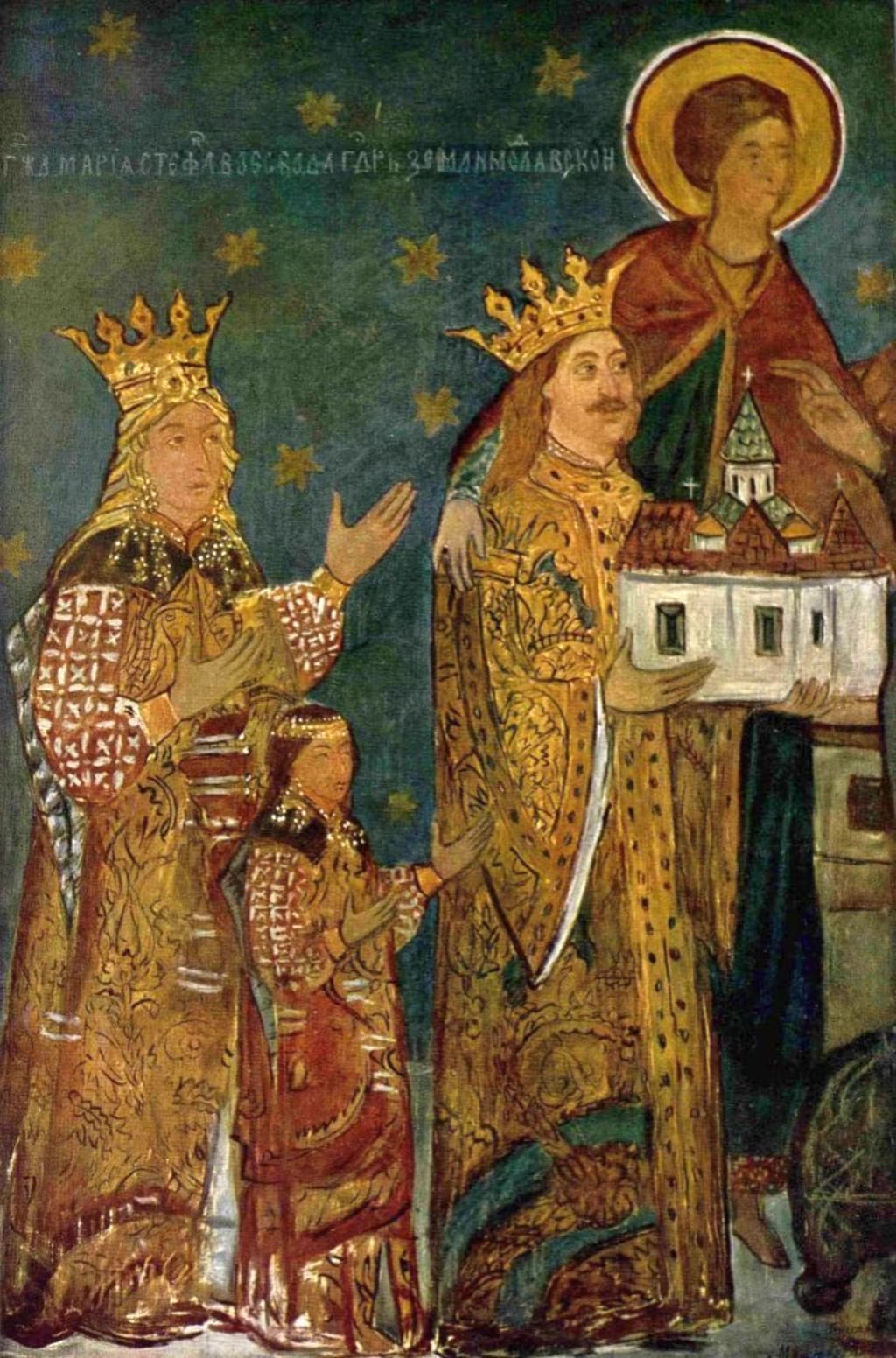
Stephen III Muşatin’s crown, a heavy wreath of gold and rubies, was making his neck and shoulders ache. But the Voivode* of Moldavia knew it was the Lord’s way to tell him he bore the cross of his entire land on his shoulders. Now, the Lord saw fit to add responsibility for Wallachia to his weary load.
He looked through the stained glass at the courtyard of the magnificent architectural ensemble that served as seat to the princes of Wallachia. He let his boys, as he called his soldiers, loot Târgovişte after his victorious march, but Curtea Domneasca and all its residents were to be left intact. Then he shifted his gaze to the fair-hared, handsome man kneeling in front of him.
Cerbul, his faithful bodyguard, was forcing the man to stay down, but Stephen signaled to let him get up. He did not know what to do. Execution or exile? From one hand, House Draculeşti and House Muşatin were related. From the other hand, Vlad once helped Stephen dethrone Peter Aaron the Usurper, the killer of his father. Would he do Vlad a service by sparing his brother who tried to commit fratricide and treason with the Turks’ help?
‘Prince Radu, you stand accused of conspiring with the enemy against your brother Vlad, the rightful ruler of Wallachia, of bringing enemy hordes to sovereign Romanian territories, and of the deaths of Romanians, Wallachians and Moldavians alike, who sacrificed their lives to defend these Christian lands from invaders. How do you plead?”
“Guilty, cousin,” said the man heavily. “My fate is in your hands, but I have only one request before you voice your decision.”
“Speak,” said Stephen, his voice wary.
“Have mercy on my lady wife Maria Despina and my daughter Maria Voichița. They are innocent!”
“Their fate is decided. They will be executed with you. Cerbul, bring them in, please.”
The women have barely entered the hall, when Radu’s daughter wiggled from Cerbul’s grasp and threw herself at Stephen’s feet. He did not hear her words as she pleaded for him to spare her parents. He was unable to think, speak or stop staring, for he beheld the most arresting face, high of cheekbone and pointed of chin, skin like white rose petals, dark silky eyebrows arching like the sickle moon. Her eyes, swimming in tears, met his gaze with supplication and submission, but he also read signs of intelligence and wit in their blue depths. His heart contracted with the strangest mix of pain and delight. She will be mine, and I will be hers, he thought.
---
*Warlord Prince.
The Palaiologina
Under the black veil and sapphire-studded coronet, Maria’s skin looked yellowish and unhealthy. Even her beautiful dark Byzantine eyes, liquid and expressive, could not compensate for the thin mouth and the sallow cheeks. She and her lord husband Stephen were of the same age, and now, at forty-two, she could only hope to give him a son.
If only he would come to their marital bed as eagerly as before! When Maria of Mangup was a young noble flower of Houses Palaiologos, Asen, Gavras, and Komnenos, Stephen seemed to be infatuated with her. He seemed content, if not happy, when she gave him daughters. He seemed sad when they died, one by one, except her beloved Ana. And presently, he seemed to feel nothing but cold respect for her.
She knew why her dreams of new motherhood were not destined to come true. The Wallachian slattern had stolen his heart, had driven his body to sin and his soul to perdition. To add insult to injury, Stephen decreed that Maria Despina and Voichița were not humble exiles, but honored guests at his court, and therefore the Princess-consort had to take them in as her ladies-in-waiting.
Every time Maria looked at her rival’s face, fresh and lovely, a little smile always playing on the full pink lips, envy and hatred gnawed at her heart. Why did Voichița have to be both beautiful and highborn? Her mother was of the albanese Komneni, her father - a grandson of Mircea the Old himself. So, Maria had to call her “cousin” and be polite to her, when all she really wanted was to rip out that abundant, lustrous dark-brown hair. Yet she restrained herself. After all, Christ ordained us to love our enemies.
One wintry day in the year of the Lord 1475, after the divine service in the church of the Suceava palace, Maria and her ladies were sitting in the morning room. The Princess-consort was embroidering her own shroud. Stephen thought it a grotesque idea, but Maria found a strange kind of solace in the needlework.
As she was threading her needle, Stephen entered the hall and approached them with urgency. Maria was alarmed. He never came to her morning room, he never burst in unannounced, and she had never seen him so worried.
‘Bad news, my lady’, said Stephen. ‘The Ottomans are marching on Moldavia. A host of 120,000, led by Süleyman-paşa. They are now crossing the Danube on ice.’
‘The Turks are coming, the Turks are coming!’ The women were whispering anxiously, one of them fainted, and only Voichița was calm, eyes downcast. Yet Maria had noticed those blue eyes flashing before Voichița lowered her eyelids modestly.
‘When are you leaving, Măria Ta*?’ asked Maria, trying to sound calm and collected.
‘On the morrow, my lady. We are gathering our forces at Vaslui.’
She saw him exchange glances with Voichița, and pain pierced her already distressed heart. “I will come to your bedchamber tonight,” said his eyes. “I will be waiting,” the trembling of her eyelashes replied. Well, this wouldn’t last for long. Maria made up her mind. When Stephen returns, he won’t find you here, whore, she thought, returning to her embroidery.
---
*Your Majesty.
The Priest
Theoctist’s mitre, an abundance of pearls and enamel, was sitting crookedly on his balding head. He was listening to the princess, taking in her slight frame as she paced the room and explained her plan.
Theoctist knew it already, and he wholeheartedly agreed with it, except for the murder of Maria of Mangup. But then, he thought, Voichița is the granddaughter of Vlad the Dragon and the niece of Vlad the Impaler. That family produced nothing but bloodthirsty monsters.
It was hard to believe Voichița was one, for such beautiful vessel could only hold a beautiful heart. Yet Theoctist had enough experience with the vagaries of the high and the mighty to understand that Maria Voichița of House Drăculeşti was as ruthless and determined as her famous relatives. The role of a simple mistress could never satisfy her. She wanted the throne.
The bishop of Moldavia knew she had beguiled, threatened, and cajoled more than half of the courtiers into taking her side. As Stephen was preparing for war in the field, he had no idea that a war of intrigue and conspiracy was already unfolding at his court. Theoctist also knew that she would give the Prince strong sons, which was the main reason he was helping her. Moldavia needed heirs, not the weak girls Maria was producing.
‘My lady, I beg of you, do not take mortal sin upon your soul,’ said the bishop pacifyingly as Voichița paused, flushed and out of breath with arguing for Maria’s death. ‘It is much easier to get rid of her if we convince her that her daughter is in danger. Ana is a simpleton, it will not be hard for us to abduct her. Also, I will arrange for Maria’s veiling at Putna, and we will set up an empty crypt. We will tell Stephen she died of a sudden illness.’
Voichița nodded. When she spoke, her voice was just as lovely as her person, silken, melodic, and seductive. Yet the words she uttered made the bishop’s few remaining hairs stand on end.
‘It has to be done as soon as possible. I heard Stephen triumphed at Vaslui and is coming home. She embroidered her own shroud, the fool! Let her now look at it when she lights candles and sweeps floors at Putna! Were it my will, she would lie under it!’ Her laughter was like the tinkling of silver bells.
‘It will happen on the morrow, my lady.’
‘Do me a favor, Theoctist,’ added Voichița after a pause. ‘Have her tongue ripped out.’
‘But…’
‘We cannot risk her telling the story, even though no one will believe her.’
‘My lady…’
‘Do as I command!’
Theoctist said a prayer for forgiveness in his mind, as he bade his new Doamna* good night.
---
*Lady, also, title and form of address for the Princess-consort in the Medieval Romanian principalities.
The Centurion
Cerbul scratched his head under his cuşma, the pointy sheepskin cap the Romanian commonfolk wore all year round, and spurred his horse. As a bodyguard, he was part of Stephen and Voichița’s great alai* heading to the Monastery of Putna, where the Prince and his Wallachian bride were to be wedded. The centurion was not impressed by his new mistress. Aye, her beauty was legendary, but he heard unsavory rumours about her. Despicable things. He didn't condemn her, but didn't worship her either.
He rode at the side of his master, unwillingly eavesdropping on his conversation with the Bishop of Moldavia. Maria of Mangup was dead, and Theoctist was just telling Stephen details of how he himself performed the last rites for her. Cerbul thought it was a wrong step for his master to marry his lover so soon, when his lady wife’s body didn’t cool in the grave yet. But it was not his business to judge his lord and commander.
Maria’s tombstone was covered by an embroidered shroud. As the centurion was admiring it, keeping an eye on Stephen who was standing further away with the bishop, a nun approached him. She was all in black, her eyes enormous and liquid, full of grief. She started pointing at him, then at Stephen, then at herself, and Cerbul realized she was mute.
‘What do you want?’ he whispered. She pointed at Stephen insistently, then at herself again. More wild gesticulation followed, and Cerbul felt a stab of annoyance.
‘I don’t understand you! What do you want?’
She ran away. Cerbul noticed her again on the church doorstep, when the wedding ceremony was underway, but could not possibly leave his post at the Prince’s side. She was showing him something that looked like a square of paper with letters on it. But he turned away and soon forgot about her completely. He did not know how to read anyway.
---
*Procession.
About the Creator
Anastasia Stratu
I was born. I live. I will be gone someday.
That's the biography of anyone, but oh, how many wondrous happenings and adventures hide in the subtext of these humble lines!
I hope my potential readers will find my tales captivating. Thank you.
Keep reading
More stories from Anastasia Stratu and writers in Futurism and other communities.
About Binding Prometheus
I want to start actively advocating on behalf of my own work, and the most valuable part of my canon is, without a doubt, Binding Prometheus, the play I have been working on since 2019 and only finished in 2023 as part of my MA. The play itself is an amalgamation of a million different inspirations. On one end, it evokes the Ancient Greek myth-play, deriving its own title from the earliest extant work of Western drama we have, Aeschylus’s Prometheus Bound. On the other end, it borrows significantly from the sci-fi bulwarks from over the years, namely Mary Shelley’s Frankenstein and Karel Capek’s Rossum’s Universal Robots. The play could be an episode of Black Mirror, I fear. I don’t know. I’ve only ever seen one episode of Black Mirror.
By Steven Christopher McKnight18 days ago in Futurism
Egypt Kitchen Appliances Market: Retail Expansion, Smart Features & Market Dynamics
According to IMARC Group's latest research publication, Egypt kitchen appliances market size reached USD 728.88 Million in 2024. The market is projected to reach USD 1,202.05 Million by 2033, exhibiting a growth rate of 5.13% during 2025-2033.
By Abhay Rajput6 days ago in Futurism
Ludacris and Nelly draw backlash over bookings at MAGA-coded music festival
Ludacris and Nelly headlining a mostly right-wing event is good for them. It’s also great for the genre of hip hop. The two rap veterans have showcased their talents on other stages. Why can’t they perform for mostly MAGA folks and grab that bag?
By Skyler Saunders4 days ago in Beat



Comments
There are no comments for this story
Be the first to respond and start the conversation.