
Nobody but Phil Watterson felt so angry to see his bank account increase by $20,000. Two weeks ago, to battle a crisis of getting old, Phil’s father went skydiving. He landed gracefully and his testimony was the experience was exhilarating. Three days later, he died by tripping in the shower. It didn’t matter to the insurance agent that his death was unrelated to skydiving. All he saw was that a retired client went skydiving three days before his death, and that was enough excuse to cut his life insurance down from $200 trillion to a mere $20,000.
His father’s death was worth $20,000.
The year is 2221. Skydiving in the Venusian gas clouds in “the twilight zone,” the boundary between night and day in Venus’s 244-earth-day hours where the temperature was not hazardous, is one of the wonders pioneered in Phil’s time. Staying within the twilight zone was simple—just follow the migrating Venusian beasts! But do not unequip the hazmat apparatus and expect to imitate the beasts' biochemical processes. The revolutionary shifts of this era would be unthinkable 200 years prior, but some old trends die hard, and people who only think about money perpetuated the same problems. The decreasing value of currency has inflated to the point that $20,000 is worth about $200 in the year 2021.
194 and single, Phil was part of the “immortal” generation; most human diseases and aging was cured by jellyfish DNA, and many from his generation didn’t have kids. It was an amusing irony to his father that people Phil’s age shamed each other with accusations of lost virginity, but that was the values of their generation; people who remained virgins commanded high respect, because with the socioeconomic climate on Earth, having children was impractical.
Phil Watterson always wanted to go to Proxima Centauri. It was a new frontier to the unknown and the thought of spending the rest of his life—however long that will be—in the solar system triggered pangs in his heart. He always yearned for something more. To be an explorer. Noticeable “Evolution” was happening to generations of Lunars and Martians that are adapted to their environment. Unlike those who stayed on Earth, the pilgrims to the moon and Mars had rapid and excessive birth and death rates. Those that survived on the moon are now thin and spindly things that thrive in low gravity. Martians have gone underground and became stocky, furry white gnomish anthropic beings with poor eyesight.
Phil was $100 trillion too short for a relativistic implant needed for that trip to happen, and despite his indefinite time, he didn’t have forever. Earth’s governments were imposing a draft to ship people to other worlds to control the population, and as one of the old guys over age 150, he was selected. This time around people could choose Mars or Proxima Centauri. Venus and Jupiter’s moons still had things to be ironed out before big colonies could start coming in. The Proxima Centauri trip was prestigious and the ship designed to go there was state-of-the-art. The light-speed message from Proxima Centauri confirmed — as of 16 years ago when the message was sent — that they had built structures and the place was ready for more people, among details of what the planet was like.
Phil imagined himself adjusting to the alien environment of Proxima Centauri, and having children there where it was not taboo. It was mankind’s first Super-Earth: a rocky world 1.08 times Earth’s radius and 1.27 times Earth’s mass that orbits its star for a year equivalent to 11 Earth days, though it feels shorter there because the rate of time is slow in relation to its high mass and velocity. He thought of ochre and deep chartreuse landscapes under a teal-azure sky, wearing red-dwarf shades to protect his eyes from the star that would be closer to the planet than the sun is to Earth. His spectrum of colors would augmented with new pentachromatic eyeballs with shortened rods for the narrow visible frequencies. Gravity 25% stronger than Earth’s would make for strong legs that marathon runners lust for.
The trip, in Earth time, would take a little over 30 years, but because of relativity and the implants required to survive it, it would be a few minutes to the people on board. Someday full light speed will be feasible, but for now half the speed of light isn’t bad for a human. It’s faster than any speed a cheetah or king fisher ever managed.
If his father didn’t go skydiving and insurers weren’t greedy pigs in penguin-suits, he wouldn’t be condemned to an underground life at Mars now. In a universe of wonder, fantastic technological advancements, and experiences yet to unfold of innumerable, cosmological, and metaphysical portents, all Phil could think about in that moment was money. Worthless pieces of currency with abstract value attached to it. He’d adopted the money-centric mindset of his father’s insurance agent.
*
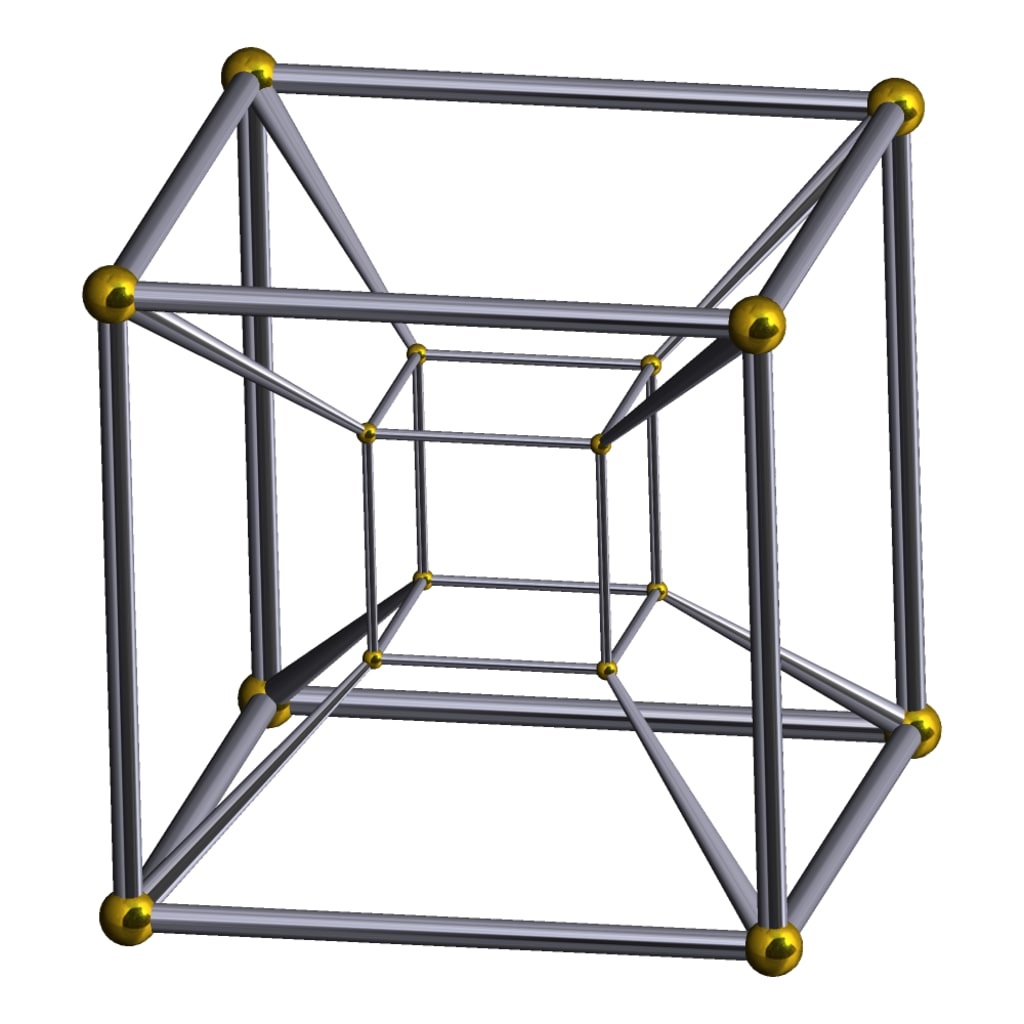
The year is 2257. Phil is an archaeologist and uncovered something of unfathomable meaning to the history of the universe and humanity’s place in it. It was a little black brick he found underground on Mars. This thing was obviously not natural, and it was there long before anybody from Earth got to Mars’s surface, let alone so far into its depths. The most curious and groundbreaking thing about it, he found, was that when he pulled a slab at its side, the little black thing contorted in an incomprehensible way. It was a kind of rotation that people have seen before, but not in real space before their eyes. It was a kind of spin only seen in computer simulations of a tesseract; a four dimensional “hypercube” with a w-axis.
It was proof of a fourth dimension beyond human perception. And what he found on the other “sides” from the w-plane looked like it opened up to a large volume of tattered material with strange markings. Although “volume” refers to three-dimensional measurement, it is the best word that can be used as his vision can only perceive three dimensions at a time. After some examination, he came to a hypothesis that the markings were writing. It was a book. A four-dimensional, little black book that closes by turning it to its side where it appears to be an ingot.
The solar system should have received a message of the arrival of the new Proxima Centaurians by now, but there was silence. Enough time had passed to know that something went wrong, and it was impossible to know what.
The book was impossible to read, but by examining its form, Martian science had developed new, four-dimensional physics. With these new advancements, a “telescope” was built that could see into the vicinity of Proxima Centauri and “cheat” by using four dimensional refraction.
This revealed metal fragments orbiting around Proxima-Centauri b. It was the remains of the ship as it crashed into a bewilderingly dense-yet-transparent electronic field at the brim of Proxima Centauri-b’s atmosphere. Spectrographs revealed that Proxima Centauri b has no carbon or oxygen. The first humans that were there somehow vanished by the time the new colony arrived, and the electron field of death was new. Astrophysicists’ commenced research of this phenomenon and prepared tests for future trips outside the solar system to observe and gather data for theories on the Proxima Centauri b anomaly.
Phil thought about how he spent too many of his days thinking about wasted time or having more money. His father’s risky behavior before his untimely death turned out to save his life by not granting him $200 trillion. His life’s work passionately excavating Martian geography turned out to be much more fulfilling than he expected, and someday, he would get another chance to realize his dream to visit Proxima Centauri and beyond. From then on he didn’t get caught up in the trap of the unquenching pursuit of money, and didn’t forget the things that gave true meaning to his life. But sometimes a $200 trillion prize contest to the most comprehensive research paper on the little black tesseract was a good motivator to his creativity and work ethic.
About the Creator
Keep reading
More stories from Bill Waterman and writers in Futurism and other communities.
About Binding Prometheus
I want to start actively advocating on behalf of my own work, and the most valuable part of my canon is, without a doubt, Binding Prometheus, the play I have been working on since 2019 and only finished in 2023 as part of my MA. The play itself is an amalgamation of a million different inspirations. On one end, it evokes the Ancient Greek myth-play, deriving its own title from the earliest extant work of Western drama we have, Aeschylus’s Prometheus Bound. On the other end, it borrows significantly from the sci-fi bulwarks from over the years, namely Mary Shelley’s Frankenstein and Karel Capek’s Rossum’s Universal Robots. The play could be an episode of Black Mirror, I fear. I don’t know. I’ve only ever seen one episode of Black Mirror.
By Steven Christopher McKnight24 days ago in Futurism
Laptop Market Size and Forecast 2025–2033: Global Industry Outlook, Growth Drivers, and Future Trends
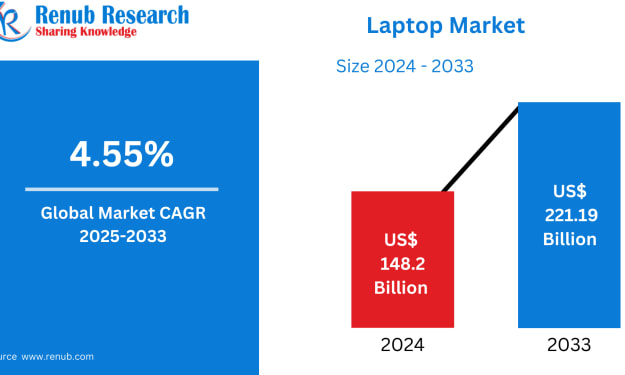
Global Laptop Market Outlook 2025–2033 The Global Laptop Market is entering a new phase of sustained growth, driven by evolving work cultures, rapid digital transformation, and rising demand for portable computing solutions. According to Renub Research, the global laptop market was valued at US$ 148.2 billion in 2024 and is expected to reach US$ 221.19 billion by 2033, growing at a CAGR of 4.55% from 2025 to 2033.
By Aaina Oberoi2 days ago in Futurism



Comments
There are no comments for this story
Be the first to respond and start the conversation.