
The Surprisingly Creative Ways People Are Using AI in 2026
Artificial intelligence is no longer just generating text. In Minnesota, it now manages crops, hearing aids, and hospital beds.


If you walked into a boardroom in Minneapolis or a farm co-op in Rochester back in 2023, the conversation about Artificial Intelligence was mostly speculative. It was the era of the "magic trick"—generating a poem, a logo, or a funny email.
Fast forward to 2026, and the novelty has worn off. In its place, something far more substantial has taken root. The "shiny object" syndrome is dead, replaced by a pragmatic, uniquely Minnesotan approach to technology: Does it work, and does it help us get the job done before the snow flies?
In the Twin Cities and across Greater Minnesota, the creative application of AI is no longer about generating content; it is about "Agentic AI"—systems that don't just talk, but act. From reducing physician burnout at the Mayo Clinic to micro-managing nitrogen levels in cornfields, 2026 has become the year AI became invisible, essential, and surprisingly creative.
The Shift: From "Generative" to "Agentic"
To understand how people are using AI differently in 2026, you have to look at the fundamental shift in the technology itself.
Throughout 2024 and 2025, the industry moved away from Large Language Models (LLMs) that simply predict the next word, toward "Agentic AI." As discussed extensively at the Minneapolis Technology Summit in July 2025, the focus is now on orchestration.
An "AI Agent" in 2026 doesn't just write a plan for logistics; it logs into the ERP system, checks the inventory, routes the driver, and sends the invoice. This shift has allowed Minnesota businesses—historically rich in healthcare, agriculture, and logistics—to deploy AI in ways that feel less like sci-fi and more like a highly competent, sleepless employee.
Use Case 1: The "Un-Bureaucrating" of Healthcare
Perhaps the most creative use of AI in 2026 isn't a new surgical robot, but a cure for administrative fatigue.
By 2025, the Mayo Clinic had fully operationalized its "ambient intelligence" strategy. For years, the biggest complaint among physicians was the "pajama time"—hours spent late at night entering data into Electronic Health Records (EHRs).
In 2026, this dynamic has flipped. Doctors in Rochester now enter patient rooms with "ambient listening" AI running securely in the background. The system doesn't just transcribe; it structures the conversation into clinical notes, orders the relevant labs based on the context of the dialogue, and tees up the billing codes for review.
Dr. Clark Otley, Chief Medical Officer of the Mayo Clinic Platform, framed this philosophy perfectly during the platform's expansion:
"Technology should enhance medical practice, not complicate it... we are bringing the human aspect back into digital medicine, with one clear goal: to improve the patient experience and health outcomes." (Source: ICT&health, late 2025)
The creativity here lies in the restraint. They didn't use AI to replace the doctor; they used AI to remove the computer screen that stood between the doctor and the patient.
Use Case 2: Precision Agriculture and "Green Finance"
Drive south of the metro area, and you will see another massive shift. In 2026, farming has become a data science profession.
At the 2025 MN Conference on Precision Agriculture, hosted by the University of Minnesota, the buzz wasn't just about self-driving tractors—it was about predictive soil arbitrage.
Farmers are now using localized AI models that combine satellite imagery, drone data (from companies like the platinum sponsor Maverick), and historical yield data to manage fields down to the square inch. But the creative twist in 2026 is financial.
Farmers are using this verified, AI-processed data to unlock "Green Finance" and carbon credits. By proving via immutable data trails that they used specific precision nitrogen management techniques to reduce runoff, they can access better loan rates and sell carbon offsets. The AI isn't just growing corn; it's auditing the environmental impact in real-time to generate a secondary revenue stream.
Use Case 3: The Smartest Buildings in Bloomington
Minnesota winters are unforgiving, and heating commercial real estate is one of the largest line items for any local business.
75F, a Bloomington-based company that has been watching the "Climatetech" space explode since their Series B raise in early 2025, represents the new standard for 2026. Their AI doesn't just set a thermostat. It utilizes "predictive thermal modeling."
The system looks at the weather forecast, the angle of the sun, and the real-time occupancy of a meeting room to adjust the HVAC before the room gets cold (or hot). It’s a creative application because it anticipates human comfort needs before the humans even realize they are uncomfortable.
Similarly, Starkey, based in Eden Prairie, transformed the hearing aid market with their Omega AI launch in late 2025. In 2026, a hearing aid is no longer just for hearing; it’s a fall-detection device, a language translator, and a cognitive health tracker, all processed on the edge (on the device itself), not in the cloud.
The Blueprint: How to Implement "Agentic AI" in 2026
For business owners reading this who aren't running a hospital or a 2,000-acre farm, how do you replicate this success? The "throw everything at ChatGPT" phase is over.
Here is the 2026 Vertical Integration Framework for adopting these creative strategies:
Phase 1: The "Drudgery Audit"
Don't ask "What can AI do?" Ask "What do my people hate doing?"
- Identify repetitive workflows: Data entry, scheduling, inventory matching.
- Look for high-error tasks: Anything involving manual transfer of data between two legacy systems.
Phase 2: The "Wrapper" Strategy
Most businesses in 2026 aren't building their own models; they are building "wrappers" or specialized interfaces that connect powerful AI agents to their specific data.
- This often requires custom software development. You need a way for your field teams or remote workers to interact with the AI without needing a degree in prompt engineering.
- Whether you are building a proprietary tool for your sales team or integrating a customer-facing portal, partnering with experts in mobile app development in Minnesota is often the bridge between raw AI potential and a usable interface that actually fits your workflow.
Phase 3: The "Human-in-the-Loop" Validation
As "Agentic AI" takes actions (sending emails, booking trucks), you must establish a review protocol.
- The 90/10 Rule: Let AI handle 90% of the draft/prep work.
- The Golden Minute: A human spends one minute reviewing the output before it goes live. This ensures the "Minnesota Nice" tone remains authentic and prevents costly hallucinations.
Future Outlook: The "Invisible" Era
As we move deeper into 2026, the most successful AI implementations are the ones you don't see.
- It’s the traffic light in St. Paul that stays green a little longer because it "sees" a bus approaching.
- It’s the supply chain software at a Duluth port that reroutes a shipment automatically because it predicted a weather delay three days out.
- It’s the app on your phone that proactively suggests a maintenance check for your furnace because it analyzed the vibration patterns.
The creativity of 2026 isn't about generating wild, sci-fi images. It is about the creativity of efficiency. It is about solving the boring, expensive, complex problems that have plagued industries for decades.
Key Takeaways
- Agentic Over Generative: In 2026, value comes from AI that does things (executes tasks), not just AI that says things.
- Local Context Matters: The best implementations are specific to the environment—like 75F’s HVAC optimization for Northern climates or UMN’s precision ag for Midwest soil types.
- Health as a Service: From Mayo’s ambient listening to Starkey’s wellness-tracking hearing aids, AI is merging with health hardware to reduce friction and improve care.
- Data is Currency: In agriculture and logistics, AI-verified data is now a financial asset (carbon credits, insurance rates).
- Integration is Key: The magic happens in the "last mile" of software—the custom mobile apps and dashboards that let humans control these powerful agents easily.
About the Creator
Keep reading
More stories from Devin Rosario and writers in Futurism and other communities.
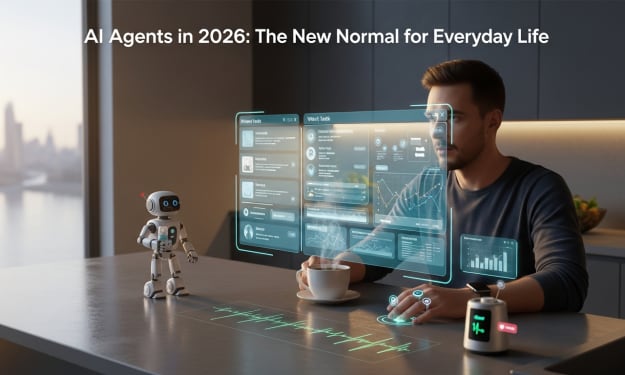
AI Agents in 2026: The New Normal for Everyday Life
Crossing the Agentic Threshold The AI discussion dominated 2024 and 2025. This focus centered on Large Language Models, or LLMs. Chatbots excel at summarizing and generating drafts. They are powerful but remain reactive tools. You asked them a question; they gave an answer.
By Devin Rosario29 days ago in Futurism
About Binding Prometheus
I want to start actively advocating on behalf of my own work, and the most valuable part of my canon is, without a doubt, Binding Prometheus, the play I have been working on since 2019 and only finished in 2023 as part of my MA. The play itself is an amalgamation of a million different inspirations. On one end, it evokes the Ancient Greek myth-play, deriving its own title from the earliest extant work of Western drama we have, Aeschylus’s Prometheus Bound. On the other end, it borrows significantly from the sci-fi bulwarks from over the years, namely Mary Shelley’s Frankenstein and Karel Capek’s Rossum’s Universal Robots. The play could be an episode of Black Mirror, I fear. I don’t know. I’ve only ever seen one episode of Black Mirror.
By Steven Christopher McKnight12 days ago in Futurism
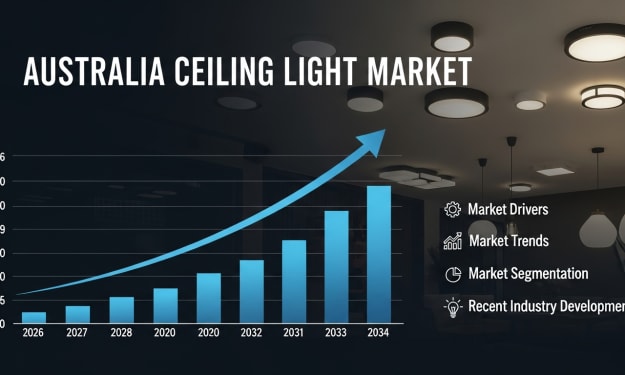
Australia Ceiling Light Market: Smart Illumination, Energy Efficiency & Future-Ready Living
In 2025, Australia ceiling light market was valued at USD 994.81 Million. Looking ahead, the market is projected to reach USD 1,461.66 Million by 2034, growing at a compound annual growth rate (CAGR) of 4.37% during 2026–2034.
By Kevin Cooperabout 11 hours ago in Futurism


Comments
There are no comments for this story
Be the first to respond and start the conversation.