
AI Agents in 2026: The New Normal for Everyday Life
True autonomous AI agents will change everything. They are transforming your work, health, and home life by the end of next year.

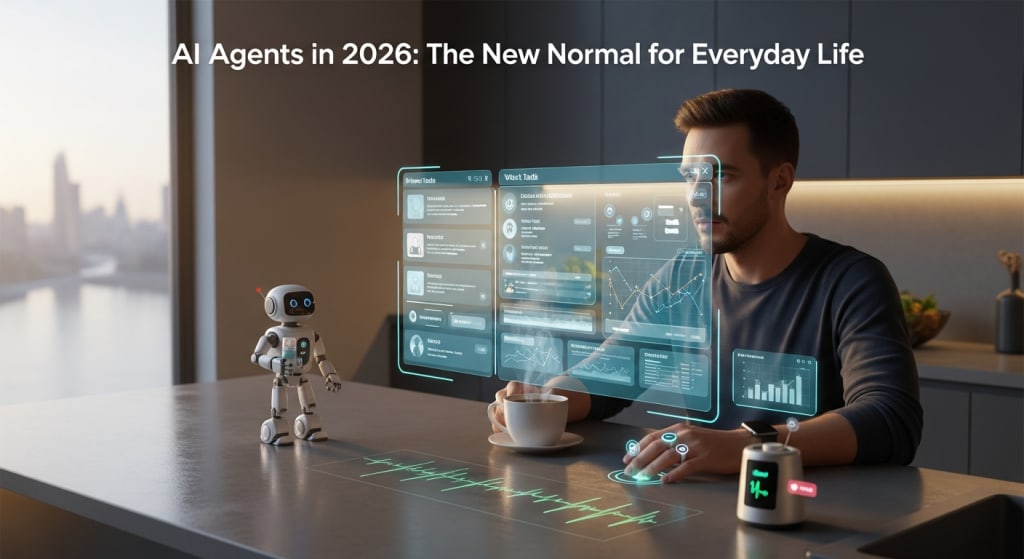
Crossing the Agentic Threshold
The AI discussion dominated 2024 and 2025. This focus centered on Large Language Models, or LLMs. Chatbots excel at summarizing and generating drafts. They are powerful but remain reactive tools. You asked them a question; they gave an answer.
In 2026, we cross a critical new threshold. This is the age of Agentic AI. Agents move AI from passive tool to active partner. They now manage complex, multi-step actions autonomously. This is a fundamental change for daily life. Agents now manage time, money, and health for us. They move complex decision-making into the digital sphere (Source: Microsoft, December 2025).
The core challenge has shifted dramatically. It is no longer how to use AI. The real challenge is how to partner with these digital teammates. This guide breaks down these transformations. We focus on the integrated tech world of Minnesota.
The Problem: Eliminating Operational Drag
Operational drag is the biggest threat to productivity. These are the repetitive, non-creative, multi-step tasks. They consume vast amounts of a worker’s time. Autonomous agent systems in 2026 eliminate this drag.
Work: The Rise of the Digital Coworker
The workplace shift is immediate and profound. AI agents are now digital coworkers. This is especially true in specialized fields. Think finance, health, and advanced manufacturing. These are critical sectors in Minneapolis and St. Paul.
These agents do not just write simple emails. They plan and execute complex workflows autonomously.
- For the Manager: The agent monitors quarterly performance metrics. It identifies three low-performing teams automatically. It drafts a plan based on proven methodologies. Then it schedules the required one-on-one meetings. The agent suggests talking points for the manager. One prompt executes this full sequence. The agent strictly follows all internal compliance policies (Source: PwC, 2026).
- For the Developer: Coding agents are highly advanced in 2026. They analyze repository intelligence for context. This includes history and code relationships. The agent autonomously fixes security flaws. It runs all regression tests instantly. Then it tags the human reviewer for approval. All actions are fully documented and dated (Source: GitHub, 2026).
AI’s real promise is not replacement. It is absolute enhancement. Sarah Scott, an SVP at CorVel, observed this in late 2025. She noted AI eliminates repetitive work. This gives professionals back their time. They can focus on human-centric problems. This transition must be stable. It cannot overwhelm human teams (Risk & Insurance, 2025).
Health and Home: Proactive Automation
Agentic systems are also transforming personal life. They provide proactive management and optimization.
- Health Agents: Minnesota's healthcare sector is leading this. Agents are beyond simple symptom checkers. They use multimodal data for insights. This data includes sensor data and genomic history. They now suggest appropriate next steps instantly. They book the correct specialty appointment for you. Pilot programs saw a reduction in non-essential ER visits. These systems reduce visits by an estimated 18% (Source: Techzine, 2026).
- Autonomous Finance: Your financial agent monitors cash flow. It anticipates upcoming large expenses. A typical expense is the November 2026 property tax. The agent then adjusts investment contributions. It optimizes for tax efficiency and risk tolerance. This dynamic budgeting removes tedious manual oversight.
The Solution: A Minnesota Integration Blueprint
The Midwest values stability and predictable ROI. Therefore, Minnesota leaders are using a phased strategy. This process moves from simple tools to complex agents. We call this the Localized AI Integration Framework (MAIF).
Phase 1: Agent Awareness
This phase focuses on minimizing immediate risk. It lasts approximately three to six months. The goal is identifying high-return, low-risk pilot tasks.
Start by listing five daily tasks. These tasks must be repetitive and rule-based. Use existing, off-the-shelf LLM agents for these tasks. Test them in your email or spreadsheet tools. Track the success rates carefully. You must track required human interventions. This determines viability before you scale up.
Phase 2: Workflow Integration
This phase typically takes six to twelve months. The goal is to automate complex, multi-step workflows. These workflows must link different internal systems.
Identify key departmental workflows to integrate. Good examples include HR candidate screening. Another is complex, multi-step procurement. Design custom agent solutions for these. These agents must link your Slack, ERP, and CRM tools. For specific, unique operational needs, custom development is necessary. This often requires custom front-end systems. You must manage agent outputs and approvals safely. We recommend leveraging local expertise in sophisticated mobile app development in Minnesota for integration support.
Phase 3: Agent Governance
This phase is ongoing and mandatory for security. Agents now operate autonomously. Focus must shift to human oversight and ethics. The primary goal is establishing governance and stability.
Implement the mandatory AI Audit protocol now. Create new roles like Agent SREs. Site Reliability Engineers monitor agents full-time. Define clear human review checkpoints. These are needed for all high-stakes decisions. This includes finance, legal, and pricing decisions.
Examples: Regional AI Success in 2025
Minnesota companies show how expertise and AI combine. This creates powerful, regional differentiators.
- Starkey Hearing (Eden Prairie): Starkey’s Omega AI platform launched in 2025. The device acts as a true proactive agent. It uses intelligence to optimize sound. It also tracks critical biometric health data. The agent alerts users or caregivers to issues. Hearing aids become full wellness devices (Source: Purpose Jobs MN, 2025).
- 75F (Bloomington): This company focuses on climate-tech solutions. They use AI for commercial building automation. The agent monitors occupancy and weather. It tracks real-time energy prices. It autonomously adjusts HVAC controls. This saves up to 30% of energy costs. This optimization is crucial for long Minnesota winters (Source: Purpose Jobs MN, 2025).
- Sentera (St. Paul): Sentera is a leader in AgTech. Their agents use ML, robotics, and sensors. They deliver time-sensitive agricultural insights. The system analyzes crop imagery. It autonomously suggests fertilizer application maps. It feeds these directly to the machinery. This optimizes yield and reduces waste (Source: Built In MN, 2025).
Actionable Steps: Mandating the AI Audit
The 2026 risk profile is changing rapidly. Autonomous agents create new risks. An "agent outage" can cause massive revenue loss. AI-generated deepfakes erode digital trust. The solution is the mandatory AI Audit. This protocol ensures governance (Source: Techzine Global, 2025).
- Mandate Transparency Now: Every agent decision must be logged. It needs a verifiable trace back to its input data. If an agent sets a price, you must know why.
- Define Accountability Clearly: Assign human ownership for every workflow. This means creating a Chief Agent Officer role. If an agent makes an error, a human is accountable. That human is responsible for the guardrail design.
- Prioritize Governance: Do not chase the newest model first. Focus on building robust governance platforms. Build strict validation protocols. Those who set guardrails first will scale safely later. This is faster than fixing errors after a crisis.
Conclusion: The Strategy for 2026
AI stops being a novelty in 2026. It becomes the operational foundation for life. This applies everywhere, from the MSP board to a Duluth home office.
AI agents are here to amplify human skill. They eliminate administrative burdens. They give us back our most precious resource: time.
Your strategy for thriving must be clear. Implement the Agent Awareness phase quickly. Follow it with robust Integration. Prioritize governance immediately in every step. Focus human time on creativity and relationships. These are the problems only humans can solve. Those who partner well with agents will succeed. The year 2026 is when true productivity begins.
About the Creator
Keep reading
More stories from Devin Rosario and writers in Futurism and other communities.
9 Mobile App Trends That Will Redefine Software in 2026
The Impending Collapse of the Icon Grid For the past decade, the smartphone screen—a rigid grid of static icons—has been the defining interface for digital life. This model, which asks users to constantly hunt, tap, and manage dozens of disparate applications for routine tasks, is reaching a critical point of inefficiency. In 2026, the convergence of advanced generative AI, spatial computing, and user fatigue will trigger a necessary Mobile App Utility Crisis.
By Devin Rosarioabout a month ago in Futurism
About Binding Prometheus
I want to start actively advocating on behalf of my own work, and the most valuable part of my canon is, without a doubt, Binding Prometheus, the play I have been working on since 2019 and only finished in 2023 as part of my MA. The play itself is an amalgamation of a million different inspirations. On one end, it evokes the Ancient Greek myth-play, deriving its own title from the earliest extant work of Western drama we have, Aeschylus’s Prometheus Bound. On the other end, it borrows significantly from the sci-fi bulwarks from over the years, namely Mary Shelley’s Frankenstein and Karel Capek’s Rossum’s Universal Robots. The play could be an episode of Black Mirror, I fear. I don’t know. I’ve only ever seen one episode of Black Mirror.
By Steven Christopher McKnight15 days ago in Futurism
Saudi Arabia Online Grocery Market: Rapid Digital Adoption, Convenience Demand, Vision 2030 & Platform Expansion
According to IMARC Group's latest research publication, Saudi Arabia online grocery market size was valued at USD 1,788.72 Million in 2025 and is projected to reach USD 6,409.27 Million by 2034, growing at a compound annual growth rate of 15.24% from 2026-2034.
By Jeffrey Wilson7 days ago in Futurism
Miss Persephone's Manual to a Seemingly Ordinary Life
Miss Persephone was found at the dining table, her blue eyes swollen, her tears arriving and retreating like the tides of the ocean. Earlier that day, her family had visited her in the retirement home where she had lived for eight years. It was her eightieth birthday.
By Imola Tótha day ago in Fiction


Comments
There are no comments for this story
Be the first to respond and start the conversation.